Summery: OEM vs ODM Manufacturing in Japan
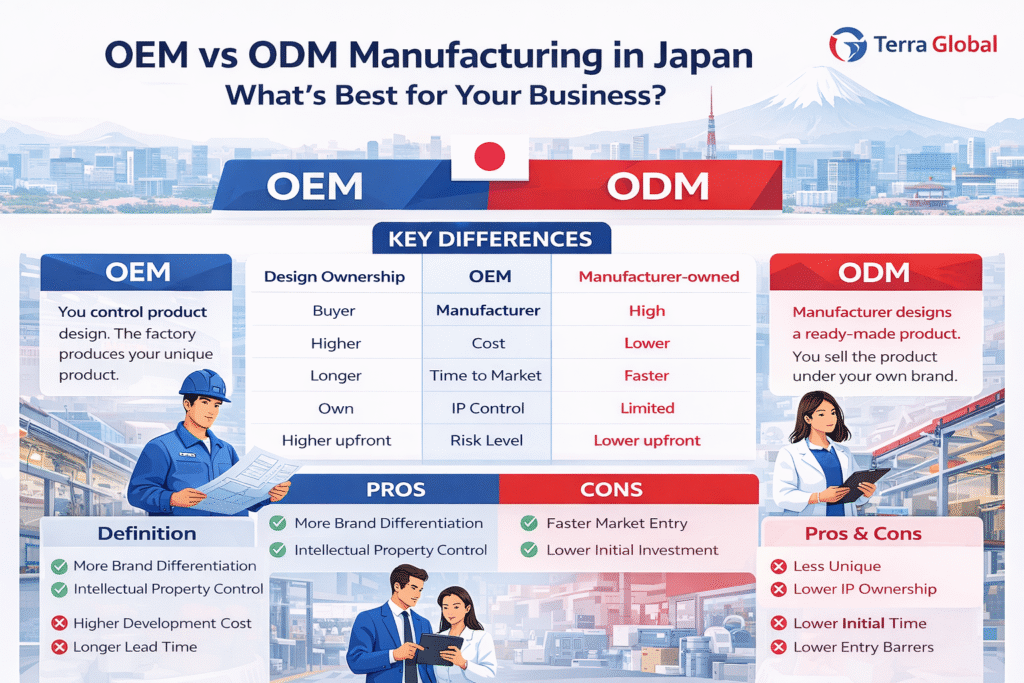
- OEM manufacturing in Japan means you control product design while a factory produces it.
- ODM manufacturing in Japan means the manufacturer designs and produces the product for you.
- OEM offers more control and brand differentiation.
- ODM offers faster speed-to-market and lower development cost.
- The best choice depends on your budget, customization needs, and long-term strategy.
What is the difference between OEM and ODM manufacturing in Japan?
OEM manufacturing in Japan means you provide the product design and the factory manufactures it to your specifications. ODM manufacturing means the Japanese supplier designs and produces a ready-made product that you brand and sell. OEM offers more customization, while ODM is faster and cost-efficient.
Why Is Choosing Between OEM and ODM So Important for Importers?
If you’re sourcing from Japan, this decision directly impacts your:
- Product uniqueness
- Cost structure
- Time to market
- Intellectual property control
- Long-term scalability
Many global B2B buyers entering Japan’s high-quality manufacturing ecosystem struggle with this exact question.
Japan is globally recognized for precision engineering, strict quality control, and innovation-driven production. But selecting the wrong model can delay launches or increase risk.
So the real question isn’t just OEM vs ODM. Which model aligns with your business growth strategy?
What Is OEM Manufacturing in Japan?
OEM manufacturing in Japan refers to producing products based on your custom design and technical specifications.
OEM (Original Equipment Manufacturer) manufacturing means you own the product concept, design, and branding, while the Japanese factory produces it under contract. In short, you control the blueprint.
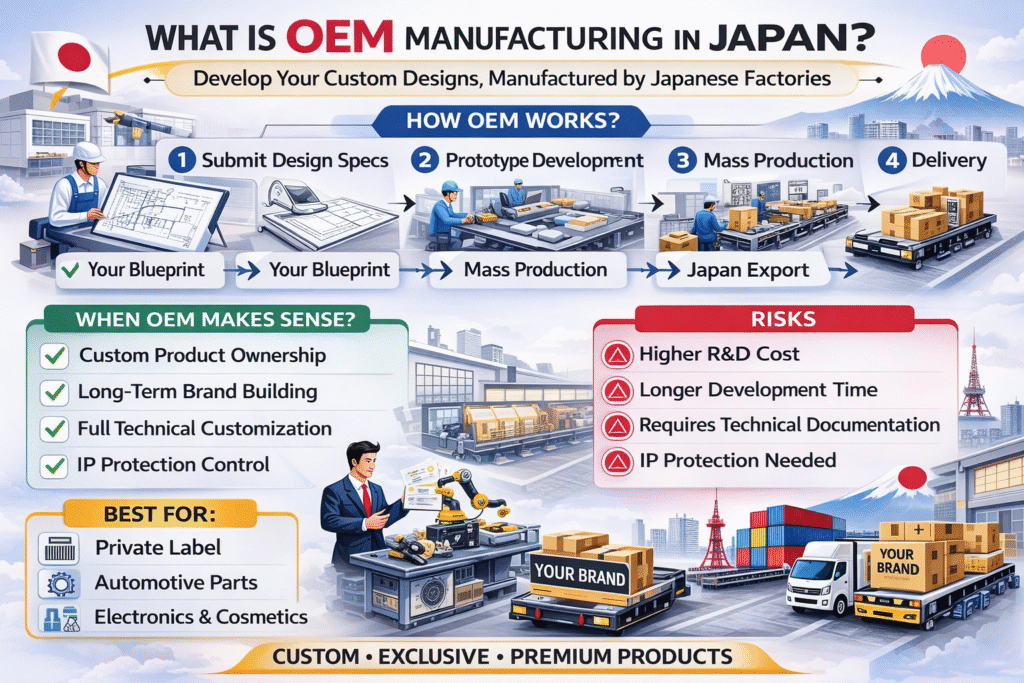
How OEM Works in Japan?
- You submit product design, drawings, or formula
- Factory reviews feasibility
- Prototype development
- Mass production under strict Japanese quality standards
- Product shipped under your brand
When OEM Makes Sense?
- You want full product differentiation
- You own intellectual property
- You are building a long-term private label brand
- You need technical customization
Japanese OEM partners are especially strong in:
- Automotive components
- Electronics
- Cosmetics formulation
- Industrial equipment
- High-precision tools
Advantages of OEM in Japan
- Higher product uniqueness
- Better brand positioning
- Strong quality control reputation
- Competitive edge in premium markets
Risks of OEM
- Higher R&D cost
- Longer development time
- Requires technical documentation
- IP protection management
OEM gives you maximum control and brand authority, but requires more investment and planning. If you want exclusivity, OEM is often the better long-term strategy.
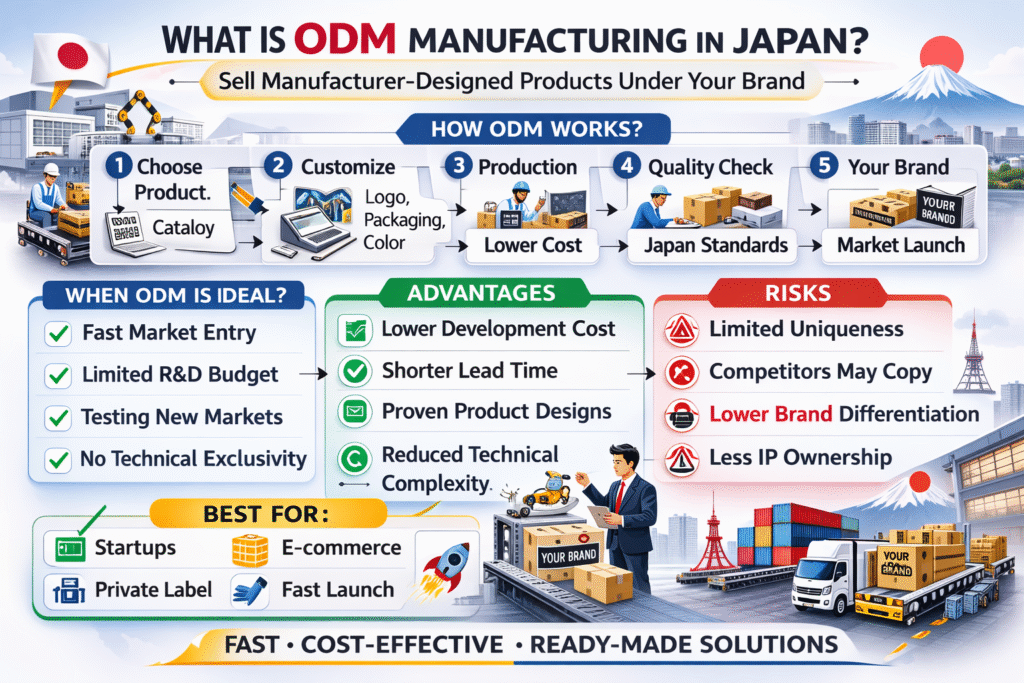
What Is ODM Manufacturing in Japan?
ODM manufacturing in Japan allows you to sell manufacturer-designed products under your own brand.
ODM (Original Design Manufacturer) refers to a Japanese supplier that designs and develops a product which you rebrand and distribute. In simple terms, the factory already has the product ready.
How ODM Works?
- You choose from existing product catalog
- Minor customization (logo, packaging, color)
- Lower tooling cost
- Faster production timeline
- Market launch under your label
When ODM Is Ideal?
- You want fast market entry
- You have limited R&D budget
- You’re testing new markets
- You don’t need technical exclusivity
Advantages of ODM in Japan
- Lower development cost
- Shorter lead time
- Proven product designs
- Reduced technical complexity
Risks of ODM
- Limited uniqueness
- Competitors may sell similar product
- Lower brand differentiation
- Less IP ownership
ODM is faster and budget-friendly, making it ideal for new or scaling businesses. However, customization and exclusivity are limited.
OEM vs ODM in Japan Differences Comparison
| Feature | OEM Manufacturing | ODM Manufacturing |
| Product Design | Buyer-owned | Manufacturer-owned |
| Customization Level | High | Low to Medium |
| Development Cost | Higher | Lower |
| Time to Market | Longer | Faster |
| IP Ownership | Buyer | Manufacturer |
| Brand Differentiation | Strong | Moderate |
| Risk Level | Higher upfront | Lower upfront |
How Do OEM and ODM Manufacturing Costs Compare in Japan?
OEM costs more upfront due to R&D and tooling, while ODM has lower startup costs but smaller long-term differentiation.
When sourcing from Japan, cost evaluation goes beyond factory price. It includes:
- Product development
- Tooling & molds
- Certification & compliance
- Minimum Order Quantity (MOQ)
- Quality inspection
- Logistics & export handling
OEM Cost Breakdown in Japan
OEM manufacturing usually includes:
- Custom tooling cost
- Prototype development
- Engineering adjustments
- Compliance testing
- Higher MOQ
Japanese factories maintain strict quality standards, which increases reliability but also development cost. However, OEM often leads to higher margin potential because the product is unique.
ODM Cost Breakdown in Japan
ODM typically involves:
- Ready-made tooling
- Lower development cost
- Reduced design fees
- Faster approval process
- Lower initial capital requirement
But because similar products may exist in the market, pricing competition can affect margins.
OEM = Higher investment, higher potential margin.
ODM = Lower investment, faster returns but competitive pricing pressure.
So the bottom line is: OEM is a long-term brand play. ODM is a strategic speed move.
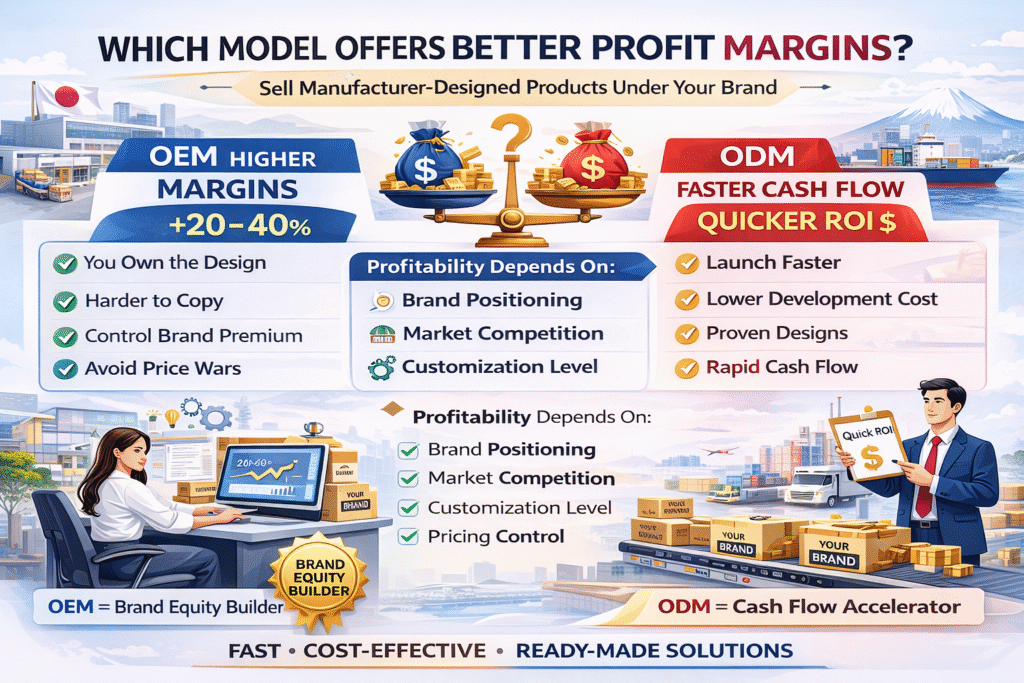
Which Model Offers Better Profit Margins?
OEM usually provides higher margins due to exclusivity, while ODM offers lower margins but faster cash flow. Profitability depends on:
- Brand positioning
- Market competition
- Customization level
- Pricing control
Why OEM Can Generate Higher Margins?
With OEM:
- You own the design
- Competitors cannot replicate easily
- You control brand premium
- You avoid price wars
In industries like electronics accessories or cosmetic private labels, OEM-built brands often command 20–40% higher pricing.
Why ODM Still Works for Many Businesses?
ODM is attractive for:
- New importers
- Retail testing
- E-commerce sellers
- Seasonal products
Because development time is shorter, cash flow begins faster.
OEM = Brand equity builder.
ODM = Cash flow accelerator.
Choosing depends on whether your priority is speed or strategic positioning.
What About Intellectual Property (IP) Protection in Japan?
OEM offers stronger IP ownership control, while ODM limits ownership since the manufacturer owns core design rights.
Japan has strong intellectual property protection laws, which is a major advantage compared to many sourcing countries. However, ownership structure differs by model.
OEM IP Structure
- You own design rights
- Patent registration possible
- Trademark under your brand
- Greater protection against copying
ODM IP Structure
- Manufacturer owns original design
- You license branding rights
- Limited patent control
- Possible resale to other buyers
If your product includes technical innovation, OEM is safer from an IP perspective. OEM protects innovation. ODM protects speed. If long-term intellectual asset value matters, OEM is usually the smarter move.
How Do Lead Times Differ Between OEM and ODM?
OEM takes longer due to development stages, while ODM enables faster launch using existing product designs.
OEM Timeline in Japan
- Design validation
- Prototype testing
- Quality approval
- Tooling adjustments
- Final production
Average timeline: 3–6 months (sometimes longer for technical products).
ODM Timeline in Japan
- Catalog selection
- Branding adjustment
- Production
- Export
Average timeline: 1–3 months. ODM is ideal if you need quick market entry. OEM is better if you’re building something defensible and premium.
Which Model Do Global B2B Buyers Prefer in Japan?
Established brands prefer OEM for control and differentiation, while startups and trading companies often choose ODM for speed and cost efficiency. Based on sourcing trends:
- Private label brands → OEM
- Amazon / e-commerce sellers → ODM
- Industrial importers → OEM
- Seasonal retailers → ODM
Japanese suppliers are flexible but expect professional documentation, especially for OEM projects. That’s where structured sourcing support becomes critical.
How Do You Decide Between OEM and ODM for Your Business?
Choose OEM if you want differentiation and IP ownership; choose ODM if you prioritize speed, lower risk, and faster market testing. Making the right choice requires evaluating three core pillars:
- Capital availability
- Brand vision
- Risk tolerance
Step-by-Step Decision Framework (How-To Structured)
Step 1: Define Your Market Position
Are you building a premium long-term brand or testing demand?
- Premium brand strategy → OEM
- Fast retail test → ODM
Step 2: Evaluate Budget & Cash Flow
- Limited capital → ODM
- Strong capital reserve → OEM
Step 3: Assess Technical Complexity
- Custom engineering needed → OEM
- Standard consumer product → ODM
Step 4: Consider Long-Term Exit Strategy
If you plan to scale or sell your company, OEM adds higher valuation due to intellectual property ownership.
OEM builds long-term asset value. ODM builds quick revenue traction. In short, your strategy determines your manufacturing model, not just price.
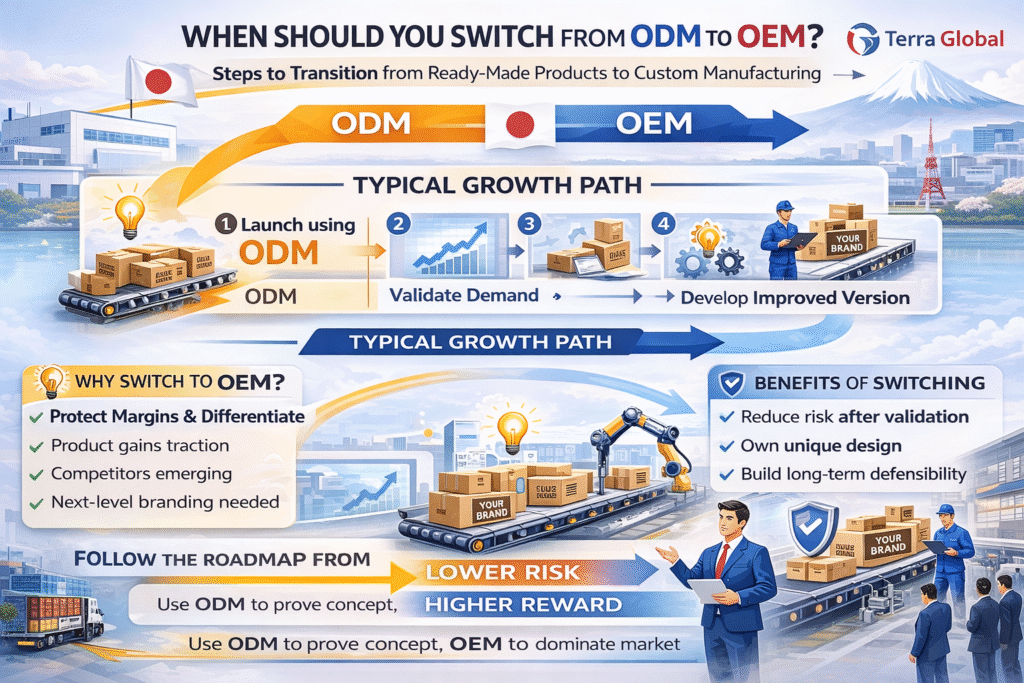
When Should You Switch from ODM to OEM?
Switch to OEM when your product gains market traction and you need differentiation to protect margins. Many businesses start with ODM and later transition to OEM.
Typical Growth Path
- Launch using ODM
- Validate demand
- Collect customer feedback
- Develop improved version
- Shift to OEM production
This reduces initial risk while building toward long-term defensibility. Japanese manufacturers often support this phased model if properly negotiated. ODM is often a stepping stone. OEM becomes the competitive shield.
Real-World Sourcing Scenario
Let’s consider a consumer electronics importer:
- Phase 1: Launch ODM Bluetooth accessory under private label
- Phase 2: Identify design weaknesses
- Phase 3: Develop improved battery & casing via OEM
- Phase 4: Patent new feature
Result: Higher margin, stronger brand perception, less competition. This hybrid approach balances risk and growth.
Final Recommendation, Which Is Best for You?
If your goal is:
- Short-term revenue → ODM
- Brand authority & exclusivity → OEM
- Long-term international expansion → OEM
- Testing new product category → ODM
So the bottom line is, OEM is a strategic investment. ODM is a tactical move. The best manufacturing model in Japan depends on your growth stage.
Conclusion
Choosing between OEM and ODM manufacturing in Japan is not about which is universally better. It’s about your financial structure, your brand ambition, your risk appetite, and your long-term expansion plan.
OEM creates proprietary advantage and long-term brand equity. ODM creates speed, flexibility, and lower entry barriers.Many successful global importers use both strategically at different growth stages.
Frequently Asked Questions
1. Is OEM manufacturing more expensive than ODM in Japan?
Yes. OEM involves custom design, tooling, and development costs, making it more expensive upfront compared to ODM.
2. Is ODM manufacturing safer for beginners?
Generally, yes. ODM reduces technical and financial risk because the product design is already tested and developed.
3. Can I protect my product idea in Japan?
Yes. Japan has strong intellectual property laws. OEM manufacturing allows better IP protection through patents and trademarks.
4. Do Japanese manufacturers accept small MOQ orders?
It depends on the factory. ODM usually offers lower MOQ compared to OEM, which often requires larger production runs.
5. Should I choose OEM or ODM for private labels in Japan?
If you want strong brand differentiation, OEM is better. If you want faster entry and lower investment, ODM is more practical.
Explore our Japanese wholesale product categories. Contact our team for structured OEM project support.