

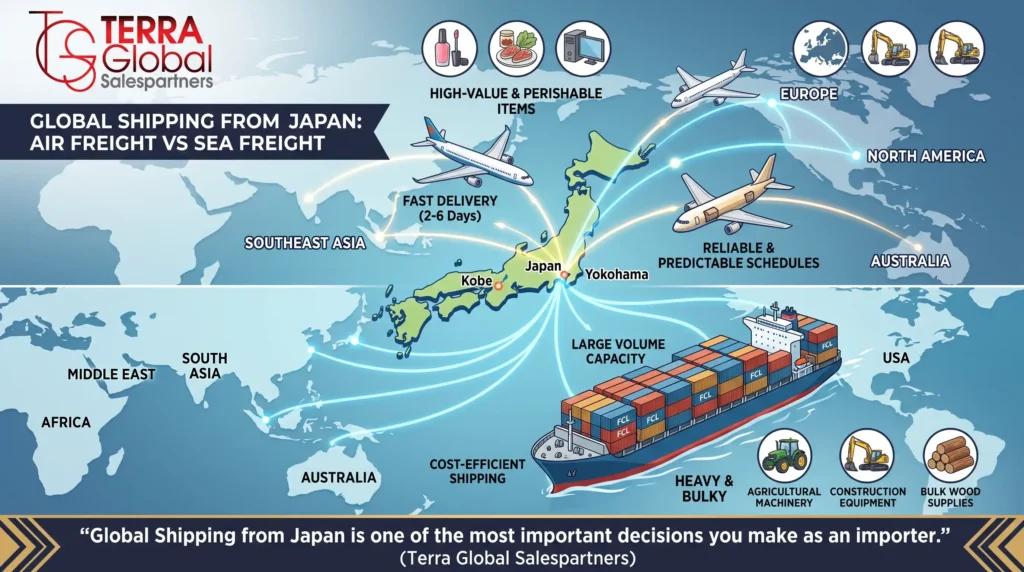
Global Shipping from Japan is one of the most important decisions you make as an importer. Get it right and your costs drop, your timelines stay on track, and your customers stay happy. Get it wrong and you pay for delays, damaged goods, and frustrated buyers.
At Terra Global Salespartners, we guide importers, wholesalers, and B2B buyers through every step of Global Shipping from Japan. We know the freight landscape, the port rules, the airline cargo schedules, and the customs requirements. We use that knowledge to help you choose the perfect shipping method for your specific cargo every single time.
This guide covers air freight and sea freight in full detail. You will find cost breakdowns, transit time comparisons, product-by-product shipping advice, and real statistics. Read this once and you will ship smarter from Japan forever.
Why Global Shipping from Japan Demands the Right Strategy?
Global Shipping from Japan is not a one-size-fits-all process. Japan exports everything from premium spreadable cheese to heavy excavators. Each product type has a different weight, shelf life, value, and customs requirement. The shipping method you choose must match all of those factors.
Japan is one of Asia’s top export nations. Its logistics infrastructure is world-class. But without local expertise and strong supplier relationships, importers often choose the wrong freight method, overpay, and lose competitive advantage.
Here is a snapshot of Japan’s export strength:
| Metric | Data |
| Japan Global Export Value (2024) | Approx. USD 922 billion |
| Annual Food & Beverage Exports | Over USD 14 billion |
| Annual Machinery & Equipment Exports | Over USD 120 billion |
| Cosmetics Export Growth (2023–24) | +12% year-on-year |
| Exports by Sea Freight (by volume) | Approx. 87% |
| Exports by Air Freight (by value) | Approx. 13%, but much higher in value share |
| Major Export Ports | Yokohama, Kobe, Nagoya, Tokyo |
| Major Export Airports | Narita, Haneda, Kansai International |
These numbers confirm that Global Shipping from Japan is a high-volume, high-value activity. The right partner makes all the difference. Terra Global Salespartners is that partner.
What Is Air Freight from Japan?
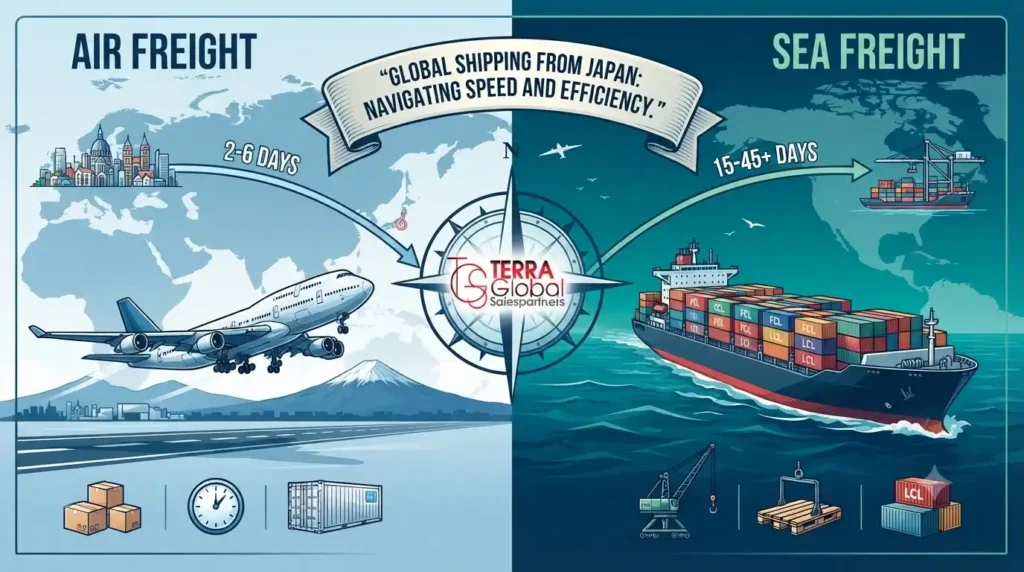
Air freight ships your goods by aircraft. Japan’s Narita International Airport and Kansai International Airport are among Asia’s busiest cargo hubs. Air freight delivers speed, reliability, and minimal handling, which is why high-value and time-sensitive products use this method almost exclusively.
Air freight excels for:
● Perishable food products requiring cold-chain management
● High-value beauty and cosmetics orders needing fast restocking
● Sample and trial orders before committing to sea freight volumes
● Urgent replenishment when inventory runs low unexpectedly
● Lightweight, high-margin products where speed justifies the cost
Air Freight: Pros and Cons
| Pros of Air Freight | Cons of Air Freight |
| Fast delivery: 2–6 business days | Higher cost per kg than sea freight |
| Reliable and predictable schedules | Size and weight limits apply per aircraft |
| Minimal cargo handling reduces damage risk | Fuel surcharges can spike costs unpredictably |
| Best for perishables and high-value goods | Not cost-effective for heavy or bulky cargo |
| Shorter inventory holding cycles | Higher carbon footprint per kg shipped |
What Is Sea Freight from Japan?
Sea freight ships your cargo by container vessel. Japan’s ports, especially Yokohama and Kobe, consistently rank among Asia’s most efficient. Sea freight is the dominant mode for Global Shipping from Japan by volume. It handles heavy, oversized, and bulk cargo at a fraction of the cost of air freight.
Sea freight is ideal for:
● Heavy machinery, equipment, and vehicles
● Bulk food and beverage orders in palletized volumes
● Construction materials, steel, and timber
● Large wholesale cosmetics and skincare restocks
● Any cargo where cost efficiency outweighs speed
Sea Freight: Pros and Cons
| Pros of Sea Freight | Cons of Sea Freight |
| Low cost per kg and per CBM | Slower: 15–45+ days depending on destination |
| Handles oversized and heavy cargo easily | Port congestion and weather can cause delays |
| FCL and LCL options suit all order sizes | Documentation and customs can be complex |
| Environmentally friendlier per unit shipped | Not suitable for short-shelf-life items alone |
| Best for large-volume wholesale orders | Port and handling charges add to landed cost |
Air Freight vs Sea Freight: Complete Side-by-Side Comparison
Global Shipping from Japan decisions become much clearer when you see both options next to each other. Here is the full comparison:
| Factor | Air Freight | Sea Freight |
| Transit Speed | 2–6 business days | 15–45+ days |
| Cost per kg | USD 4–12+ (varies by route) | USD 0.10–0.50 |
| Best Cargo Type | Small, high-value, time-sensitive | Heavy, bulk, non-urgent |
| Volume Limits | Limited by aircraft space | Up to full 40ft containers |
| Reliability | Very high, few disruptions | High, weather-dependent |
| Damage Risk | Very low, minimal handling | Low with proper packing |
| Carbon Footprint | High per kg | Low per kg |
| Documentation | Airway Bill (AWB) | Bill of Lading (B/L) |
| Insurance Cost | Lower premium needed | Higher premium advised |
| Best For | Cosmetics, food samples, dairy | Machinery, materials, bulk sauces |
Terra Global Salespartners recommends the right method for every order. We never push one option for convenience. Your cost efficiency and on-time delivery are our top priorities.
Cost Analysis: Real Shipping Estimates for Japanese Products
Cost is the biggest question in Global Shipping from Japan. Here are realistic cost estimates so you can budget your import precisely.
Air Freight Cost Estimates from Japan
| Product Example | Approx. Weight | Estimated Air Cost | Typical Destination |
| Japanese dairy snack, sample order | 10 kg | USD 80–130 | Middle East |
| Japanese skincare and beauty products | 20 kg | USD 150–230 | Europe |
| Japanese BBQ & dipping sauce samples | 15 kg | USD 100–170 | USA |
| Japanese sunscreen and serum (wholesale trial) | 25 kg | USD 180–270 | Southeast Asia |
| Japanese cheese products (small refrigerated order) | 30 kg | USD 210–300 | Australia |
Sea Freight Cost Estimates from Japan
| Product Example | Volume | Estimated Sea Cost | Typical Destination |
| Japanese agricultural machinery | 1 x 20ft FCL | USD 1,200–2,000 | South Asia |
| Japanese construction materials | 1 x 40ft FCL | USD 1,800–3,200 | Africa |
| Japanese cooking sauces (bulk wholesale) | 2 CBM LCL | USD 300–600 | Middle East |
| Used Japanese construction equipment | 1 x 40ft FCL | USD 2,000–3,500 | Southeast Asia |
| Japanese cosmetics (large wholesale restock) | 5 CBM LCL | USD 700–1,200 | Europe |
These are indicative estimates. Actual costs depend on fuel surcharges, seasonal demand, port fees, and your specific trade lane. Terra Global Salespartners provides detailed, fully itemized freight quotes for every order before you confirm.
Shipping Japanese Food Products: What You Need to Know
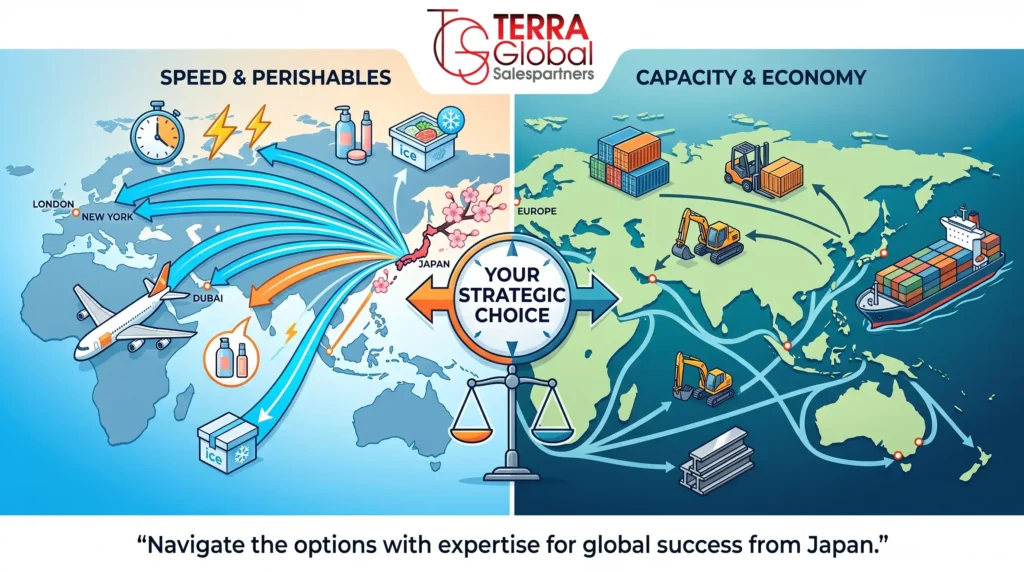
Food is one of the most popular categories in Global Shipping from Japan. Japan produces world-class condiments, dairy products, and specialty sauces that global buyers demand. Shipping food correctly requires expertise that most freight forwarders simply do not have.
Terra Global Salespartners handles Japanese food imports with the same care the manufacturers put into making them. Take our Koiwai Farm Spread Cheese, this is a premium soft, spreadable cheddar-and-fermented-butter cheese classified as processed cheese. It requires a cold-chain shipping solution. We arrange reefer air cargo or refrigerated sea containers, confirm shelf life at origin, and prepare all the necessary health certificates and food import documents for your destination country.
Our full food range includes products across all popular Japanese condiment categories. For restaurant buyers and food importers looking to stock authentic Japanese flavours, we handle Daisho Teriyaki Sauce 1.25kg in bulk volumes the kind of authentic, commercial-grade Japanese BBQ sauce that professional kitchens demand. Shipping large quantities by sea freight in LCL or FCL keeps costs competitive.
Hot pot lovers and nabe restaurant suppliers trust us for Daisho Sukiyaki Sauce 600g. We handle the full export process from Japan, including the warishita seasoning blend certification and import compliance checks for your country.
For lighter, artisan flavour profiles, our Daisho Mentsuyu Noodle Dipping Sauce Yuzu Flavour and Daisho Mentsuyu Wasabi Flavour are popular with noodle restaurants and specialty food importers. These compact 185g and 180g products often combine well into LCL sea shipments that keep cost-per-unit extremely low.
Japanese sushi and eel sauce specialists source our Daisho Grilled Eel Sauce 240g the authentic unagi kabayaki tare that turns any eel bowl into a premium dining experience. We export this alongside other Daisho products to maximize shipping efficiency.
Our salad and BBQ sauce range includes the Daisho Yuzu Dressing 150ml, a citrus-forward Japanese salad dressing loved by gourmet food importers globally. Paired with our Daisho Yuzu BBQ Sauce 185g and Daisho Wasabi BBQ Sauce 180g, these products make an excellent mixed SKU LCL shipment for specialty food distributors.
Japanese cooking wines and seasonings are essential for authentic results. Our Takara Hon Mirin 1L PET is a JAS-certified genuine mirin, the real rice wine sweetener, not a mirin-style substitute and it is available in wholesale volumes. We also supply Mizkan Honteri Mirin Style Seasoning 400ml for buyers who need an alcohol-free option for halal-certified markets.
Rounding out the cooking wine category is our Mizkan Cooking Sake 400ml, the standard Japanese ryorishu used in marinades, glazes, and simmered dishes. We batch these three liquid seasoning products together in a single LCL shipment regularly, it is one of our most popular consolidated food export arrangements.
Shipping Japanese Cosmetics: Speed Is Everything
The J-beauty wholesale import market moves fast. Trends change, new products launch, and buyers need rapid restocking to stay relevant. That is why buy Japanese skincare wholesale orders almost always travel by air freight.
Products like Shiseido Hada Labo wholesale items, Japanese sunscreen wholesale supplier orders, and Japanese face serum sheet mask wholesale shipments have high value-to-weight ratios. Air freight is cost-justified. A fast delivery also protects shelf life and lets you react to seasonal demand spikes, a key advantage in the beauty market.
Browse our full Japanese cosmetics wholesale range to see what we currently stock and export. We cover skincare, haircare, sun care, and specialty beauty items from Japan’s most trusted manufacturers.
For very large Japanese cosmetics wholesale supplier orders, especially annual buys or large promotional restocks, sea freight in LCL or FCL cuts shipping costs significantly. We help you calculate the cost-benefit break-even point between air and sea for every large cosmetics order.
Shipping Japanese Agricultural Equipment: Sea Freight Only
Heavy agricultural machinery is one area where the shipping choice is almost always sea freight. Products from our Japanese agriculture products wholesale category, including Kubota Yanmar tractor wholesale export, Japanese rice harvester import, and buy Iseki Mitsubishi farm machine Japan, are simply too heavy and too bulky for air cargo. The cost would be prohibitive.
Terra Global Salespartners has deep relationships with Japan farm machinery B2B supplier networks. We arrange RoRo (Roll-on Roll-off) shipping for wheeled machinery and flat-rack containers for oversized equipment. We handle all export documentation, machine deregistration paperwork where required, and coordination with receiving agents at your destination port.
Even used Japanese agricultural equipment, which requires additional inspection and certification, is something we manage expertly. We verify machine condition, arrange export fumigation where required, and ensure your equipment arrives safely, on time, and fully documented.
Shipping Japanese Building Equipment and Construction Materials
Our Japanese building equipment wholesale category covers some of the heaviest and most demanding cargo we ship. Komatsu Hitachi Kobelco wholesale export, Japanese excavator import wholesale, Japanese crane forklift import, all of these move exclusively by sea freight.
For structural and finishing materials, our Japanese construction materials wholesale category includes Japanese steel materials wholesale, Japanese tiles flooring import wholesale, Japan plasterboard gypsum import, and import Japanese roofing materials. These products are dense and heavy, sea freight FCL is always the right choice.
Terra Global Salespartners coordinates specialized carriers for all heavy-lift and oversized cargo. We know which ports handle which equipment types, and we arrange all the permits, certificates, and heavy transport coordination at the destination side too.
Wood Supplies from Japan: Documentation-Heavy, Sea Freight Standard
Timber and wood products from our Japanese wood supplies category always travel by sea freight. Wood requires phytosanitary certification, fumigation declarations, and in many countries, specific import permits related to deforestation regulations.
Terra Global Salespartners handles all phytosanitary documentation and ensures your timber shipment meets ISPM-15 international standards. We coordinate with Japan’s Ministry of Agriculture, Forestry and Fisheries for all required certifications, so your wood arrives at customs fully compliant and clears without delays.
FCL vs LCL: Which Container Option Is Right for You?
When you ship by sea as part of Global Shipping from Japan, you choose between two container options. Here is a clear comparison:
| FCL, Full Container Load | LCL, Less than Container Load | |
| What it means | Your cargo fills an entire container | Your cargo shares a container with others |
| Best for | Large wholesale or bulk orders | Small, trial, or mixed-product orders |
| Cost structure | Fixed per container | Per CBM or chargeable weight |
| Transit time | Faster, goes direct | Slightly slower, consolidation adds time |
| Cargo risk | Lower, no mixed cargo | Slightly higher, shared space |
| Minimum order | Approximately 15+ CBM to justify cost | From as little as 0.1 CBM |
| Example product fit | Agricultural machinery, construction steel | Japanese cosmetics, mixed food products |
Terra Global Salespartners handles both FCL and LCL shipments with equal expertise. We recommend the best option based on your exact cargo volume, budget, and timeline, not on which option is easier for us to arrange.
Transit Time Guide: Global Shipping from Japan
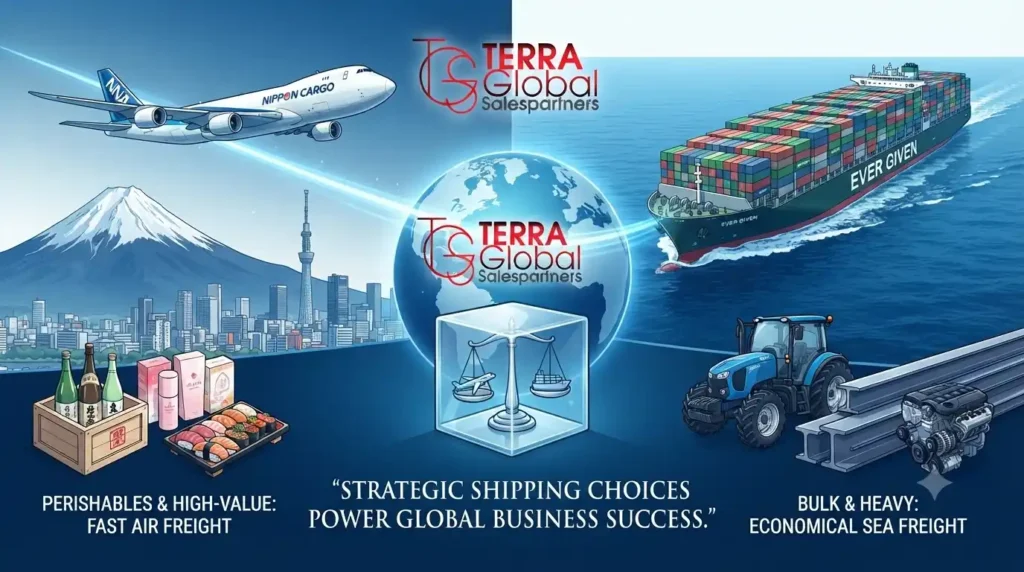
Global Shipping from Japan transit times vary significantly by destination region and shipping mode. Use this guide to plan your inventory cycle:
| Destination Region | Air Freight | Sea Freight (LCL) | Sea Freight (FCL) |
| Southeast Asia | 2–3 days | 15–25 days | 12–20 days |
| South Asia (India, Bangladesh etc.) | 3–4 days | 15–22 days | 12–18 days |
| Middle East | 3–5 days | 20–30 days | 18–25 days |
| Europe (West) | 4–6 days | 30–40 days | 25–35 days |
| USA, West Coast | 3–5 days | 18–25 days | 15–22 days |
| USA, East Coast | 4–6 days | 28–38 days | 25–35 days |
| Africa | 5–8 days | 35–45 days | 30–42 days |
| Australia / New Zealand | 3–5 days | 20–30 days | 18–25 days |
These figures are estimated transit times and exclude customs clearance at destination. Terra Global Salespartners provides realistic, port-pair-specific timelines for every shipment based on current carrier schedules.
Export Documentation: What Is Required for Global Shipping from Japan
Correct paperwork is what separates a smooth Global Shipping from Japan experience from a costly delay. Terra Global Salespartners prepares, reviews, and coordinates every document for you. Here is the standard set required:
● Commercial Invoice, itemized cargo list with declared unit values and HS codes
● Packing List, detailed breakdown of contents, weights, and package dimensions
● Bill of Lading (sea) or Airway Bill (air), the freight contract and cargo title document
● Certificate of Origin, confirms goods are manufactured in Japan; often required for preferential duty rates
● Health Certificate, required for food products including all sauces, dairy items, and beverages
● Phytosanitary Certificate, required for agricultural products, wood, and plant-based materials
● Alcohol Import Permit, required in many countries for mirin, cooking sake, and other alcohol-containing products
● Import License, specific to some destination countries for machinery, chemicals, or regulated goods
Our blog post on the import-export process from Japan, documents, costs, and timelines explained gives you a comprehensive walkthrough of every documentation step. We highly recommend reading it before your first order to understand exactly what to expect.
Why Terra Global Salespartners Leads in Global Shipping from Japans
Global Shipping from Japan requires more than a freight booking. It requires product knowledge, supplier trust, regulatory expertise, and a genuine commitment to your business success. Here is why our clients consistently choose us:
1. Verified Supplier Network
We work exclusively with verified, reputable Japanese manufacturers and wholesalers. Your products are authentic, correctly described, and ready for export before we book a single freight slot. Our blog on how to find reliable Japanese wholesale suppliers explains the verification process we apply to every supplier in our network.
2. End-to-End Service
You do not deal with a supplier, a freight forwarder, a customs broker, and a logistics company separately. Terra Global Salespartners is your single point of contact for everything, from product sourcing through to delivery at your warehouse or port.
3. Competitive and Transparent Freight Rates
Our long-term relationships with major airlines and ocean carriers mean we access volume freight rates that individual importers cannot achieve independently. We pass those savings to you. There are no hidden fees, you see the full landed cost estimate before you confirm your order.
4. Product-Specific Shipping Expertise
We know that Koiwai Farm dairy products need cold-chain management, that Japan agricultural machinery import needs RoRo documentation, and that Japanese cosmetics wholesale supplier orders often need batch-level traceability. We apply that specific knowledge to protect your cargo and your import compliance.
5. Quality Control Before Shipment
Before your goods leave Japan, we verify quality against your specifications. Our rigorous pre-shipment inspection process means you receive what you ordered. Our blog on quality control standards in Japan and what global buyers must know explains how Japanese quality systems differ from other markets, and why they work so well in your favour.
6. Global Reach Across 40+ Countries
We have handled Global Shipping from Japan to over 40 countries across Asia, the Middle East, Europe, Africa, and the Americas. Our destination-side agent network means you receive seamless support at customs, not just in Japan.
Statistics That Prove Japan Is the Right Sourcing Market
Data confirms why so many global buyers are investing in Global Shipping from Japan right now:
| Statistic | Figure / Source |
| Japan global export rank (2024) | Top 5 globally by export value |
| Annual Japanese food exports | USD 14.3 billion (2024) |
| Annual Japanese machinery exports | Over USD 120 billion |
| J-beauty global market size (2024) | USD 7.8 billion, growing 9% annually |
| Japan used equipment export value | Over USD 3.5 billion annually |
| World Bank port efficiency ranking | Japanese ports in global top 10 |
| Container terminals in Japan | Over 130 nationally |
| Japan construction equipment exports | Over USD 19 billion (2023) |
These figures make one thing clear: Japan delivers quality, volume, and global demand. Partnering with Terra Global Salespartners connects you directly to that output with the logistics expertise to get it to your market efficiently.
From Sourcing to Shipping: The Terra Global Salespartners Process
Shipping is only the final step. Before your cargo leaves Japan, our product sourcing service in Japan ensures that what you ordered is exactly what gets shipped. We source, verify, pack, document, and ship, in that order, without gaps.
Here is how our full process works from your first enquiry to final delivery:
1. Enquiry and Product Selection, You tell us what you need. We match your requirements against our verified supplier network and recommend the best product options.
2. Supplier Verification and Quality Confirmation, We verify the manufacturer, confirm product specifications, and agree on quality standards before any order is placed.
3. Order Placement and Production Confirmation, We place your order in Japan, confirm production timelines, and keep you updated at every stage.
4. Pre-Shipment Inspection, Our team inspects the goods before packing to confirm quality, quantity, and packaging compliance.
5. Export Documentation, We prepare all required export documents, commercial invoice, packing list, certificate of origin, health certificates, and any product-specific permits.
6. Freight Booking, We book air freight or sea freight based on your confirmed cargo type, budget, and deadline. We negotiate competitive rates with our preferred carriers.
7. Customs Clearance Support, We guide you through import-side customs requirements and connect you with our destination agents where needed.
8. Delivery and Follow-Up, Your goods arrive. We follow up to confirm delivery and satisfaction. We document the shipment record for your future orders.
Minimum Order Quantities and How They Affect Shipping Choice
One factor that directly influences shipping mode is your order quantity. Smaller orders typically go by air. Larger orders become more efficient by sea. Understanding MOQ, Minimum Order Quantity, for Japanese wholesale products helps you plan both your inventory and your logistics budget.
Our guide on MOQ explained for Japanese wholesale suppliers goes deep into how MOQ works across different Japanese product categories and how to negotiate it to your advantage. Understanding MOQ is key to building a shipping strategy that actually saves you money.
| Order Size | Recommended Shipping Mode | Typical Cost Range |
| Under 50 kg | Air freight — express or standard | USD 100–500+ |
| 50–300 kg | Air freight or small LCL sea | USD 300–1,500+ |
| 0.5–5 CBM | LCL sea freight | USD 200–900+ |
| 5–15 CBM | LCL sea freight | USD 600–2,000+ |
| 15+ CBM | FCL sea freight (20ft container) | USD 1,200–2,500+ |
| 25+ CBM | FCL sea freight (40ft container) | USD 1,800–3,500+ |
Deepen Your Knowledge: Resources from Our Blog
Terra Global Salespartners does not just ship goods, we share knowledge. Our blog is packed with practical guides for importers at every level. Here are resources directly relevant to your shipping and sourcing decisions:
● Import-Export Process from Japan: Documents, Costs & Timeline Explained, a step-by-step walkthrough of the entire Japan export process
● How to Find Reliable Japanese Wholesale Suppliers, our proven framework for supplier verification and relationship building
● Product Sourcing in Japan: How Terra Global Salespartners Simplifies It, understand our end-to-end sourcing service
● Quality Control Standards in Japan: What Global Buyers Must Know, why Japanese quality systems give you a competitive edge
● MOQ Explained for Japanese Wholesale Suppliers, how minimum order quantities work and how to use them to your advantage
● How Japanese Products Can Increase Your E-commerce Profit Margins, data-driven guide to profiting from Japanese product imports
Conclusion
Global Shipping from Japan is a competitive advantage when you do it right. Air freight gives you speed, reliability, and cold-chain capability for your premium and perishable Japanese products. Sea freight gives you cost efficiency and capacity for your bulk, heavy, and high-volume imports.
Terra Global Salespartners brings together verified Japanese suppliers, expert freight management, meticulous documentation, and transparent pricing to make Global Shipping from Japan as smooth and profitable as possible for your business. We handle food, cosmetics, agricultural equipment, construction machinery, building materials, and wood supplies, each with the specific expertise that the product category demands.
You do not have to figure this out alone. Contact Terra Global Salespartners today and let our team design the perfect shipping strategy for your Japanese product imports.
Frequently Asked Questions (FAQs)
1. What is the cheapest way to handle Global Shipping from Japan for bulk wholesale orders?
Sea freight FCL (Full Container Load) is the most cost-effective option for bulk orders. It dramatically reduces cost per unit and is ideal for heavy cargo like machinery, construction materials, and large food wholesale volumes.
2. How long does air freight from Japan typically take to reach my country?
Air freight from Japan takes 2–6 business days to most destinations. Southeast Asia and Australia receive goods in 2–3 days. Europe and the US East Coast typically take 4–6 days including cargo handling time at both ends.
3. Can Terra Global Salespartners ship refrigerated food products from Japan?
Yes. We arrange reefer air cargo and refrigerated sea containers for cold-chain products. We confirm shelf life at origin, manage temperature compliance, and prepare all food health certificates for your destination country.
4. What documents do I need to import Japanese products into my country?
Standard documents include a commercial invoice, packing list, bill of lading or airway bill, certificate of origin, and any product-specific permits such as health certificates or alcohol import licenses. Terra Global Salespartners prepares all of them.
5. Does Terra Global Sales partners handle both small trial orders and large wholesale shipments?
Yes. We handle everything from small LCL air or sea shipments for samples and trial orders up to multiple 40ft FCL containers for large annual wholesale restocks. Our service fully scales with your business needs and growth plans