

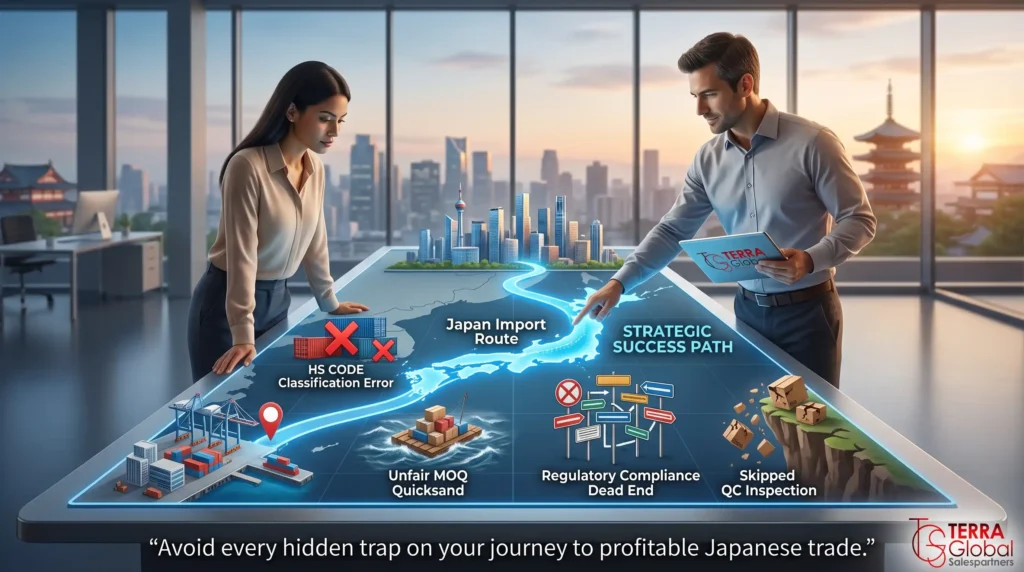
Japan is one of the world’s most trusted sourcing destinations, offering everything from premium Japanese cosmetics wholesale and authentic Japanese cooking sauce wholesale to heavy Japanese construction equipment and reliable Japanese agriculture products wholesale. However, many businesses still make common import-export mistakes in Japan, leading to costly delays, compliance issues, and unexpected expenses.
At Terra Global Salespartners, we help global buyers and sellers avoid these challenges with verified suppliers, local expertise, and end-to-end sourcing support. In this guide, you’ll discover the most common import-export mistakes in Japan and learn how to avoid them for a smoother, safer, and more profitable sourcing experience.
Why Japan Trade Errors Are So Expensive?
The stakes in Japan trade are high. Japan’s export volume reached $917 billion USD in 2024, making it one of the top five global exporters. Margins are tight, regulations are strict, and supplier relationships take time to build. A single common import-export mistake in Japan can cost thousands in duties, damaged goods, or lost contracts.
| Risk Category | Average Cost of Error | Frequency Among New Buyers |
| Wrong customs classification | $2,000–$15,000 per shipment | Very High |
| Supplier verification failure | $5,000–$50,000+ | High |
| Label/compliance errors | $1,000–$8,000 | High |
| Poor MOQ negotiation | 15–30% margin loss | Very High |
| Logistics planning gaps | $500–$5,000 per delay | Moderate |
These are real numbers. And they are avoidable, when you work with the right partner.
Mistake #1: Skipping Supplier Verification
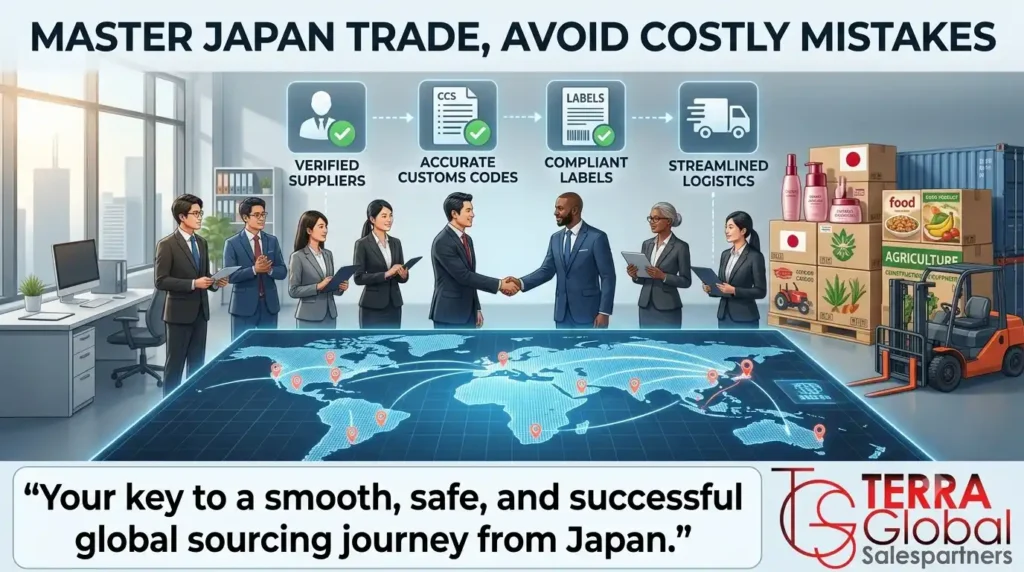
This is the number one common import-export mistake in Japan. Many buyers find a supplier online, exchange a few emails, and place a large order. Without verification, this is a gamble.
Japan has many legitimate manufacturers. But the online landscape also includes middlemen, resellers, and in rare cases, fraudulent actors. When you source agriculture products from Japan or buy Japanese construction machinery B2B, you must know exactly who you are dealing with.
What we do differently at Terra Global Salespartners:
● On-ground supplier audits, We visit facilities, not just check websites.
● Business registration verification, We confirm legal entity status with Japanese trade registries.
● Reference checks, We speak with past buyers in your product category.
● Sample testing, We arrange product samples before any bulk order.
We have direct relationships with verified suppliers across food, Japanese building equipment wholesale, Japanese cosmetics wholesale supplier, and more. You don’t start from zero, you start from trust.
Mistake #2: Misunderstanding MOQ Requirements
Minimum Order Quantities (MOQs) in Japan can be surprisingly high — or surprisingly flexible. Not knowing which situation you’re in is a common import-export mistake in Japan that hurts both cash flow and supplier relationships.
For example, Kubota Yanmar tractor wholesale export may come with high MOQs, while specialty food items like Koiwai Farm spread cheese or Daisho teriyaki sauce 1.25kg may allow smaller runs. Misreading MOQ conditions causes buyers to either overstock or lose the deal entirely.
| Product Category | Typical MOQ Range | Negotiable? |
| Japanese food & sauce products | 50–500 units | Often Yes |
| Japanese cosmetics wholesale | 100–1,000 units | Sometimes |
| Japanese agricultural machinery | 1–10 units | Rarely |
| Japanese construction equipment | 1–5 units | Case by case |
| Japanese construction materials | 500kg–10 tons | Yes with volume commitment |
Our team negotiates MOQs on your behalf. We know what each supplier will flex on, and how to structure your first order to open the door for future volume discounts. Learn more about how MOQs work in our dedicated guide, MOQ Explained for Japanese Wholesale Suppliers.
Mistake #3: Getting Customs Classification Wrong
HS code classification is one of the most technical, and most common, import-export mistakes in Japan. Every product crossing a border needs the correct Harmonized System (HS) code. An error here triggers delays, fines, re-inspection, and sometimes seizure.
Consider importing Japanese dairy products like Koiwai cheese wholesale products. Dairy products fall under strict sanitary import controls in most countries. If the HS code is wrong, your authentic Japanese cheese online shipment may be held indefinitely.
Similarly, Japanese steel materials wholesale or buy Japan structural steel wholesale require commodity-specific classifications. One wrong digit can double your duty rate.
Terra Global Salespartners provides:
● Pre-shipment HS code review by licensed customs experts
● Country-specific duty rate analysis
● Documentation checklist for every product category
● Ongoing compliance updates as trade rules change
Mistake #4: Underestimating Food Import Regulations
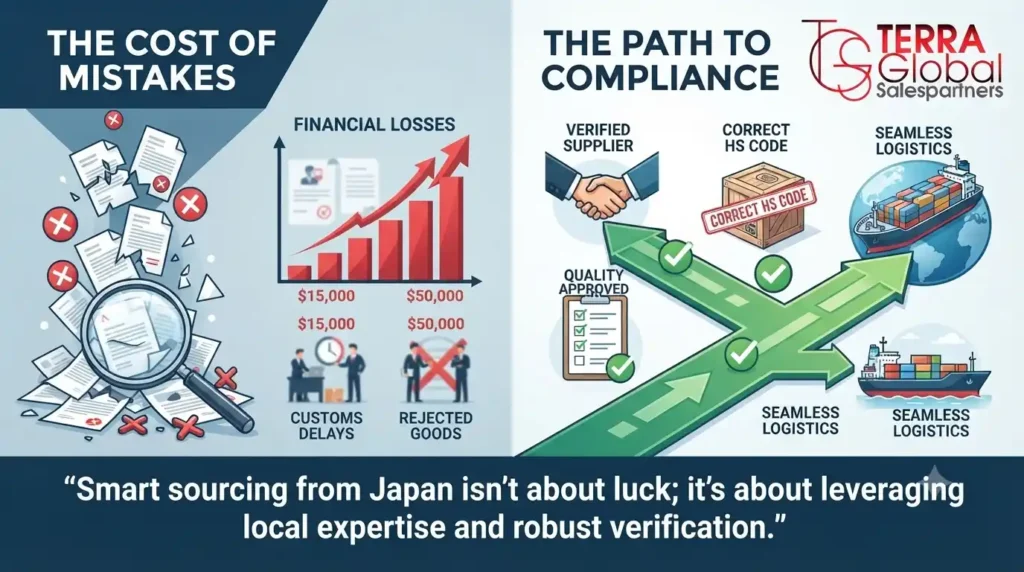
Japan’s food export products are world-class. But importing them into your country is another matter entirely. This is a very specific common import-export mistake in Japan for buyers of sauces, dairy, alcohol, and condiments.
Products like Takara hon mirin 1L, Mizkan cooking sake 400ml, and Daisho sukiyaki sauce 600g all carry alcohol content or specific labelling requirements. Mizkan Honteri mirin style seasoning and alcohol free mirin Japan wholesale products also have distinct regulatory classifications in many markets.
| Product Type | Common Regulatory Requirement | Risk if Wrong |
| Hon mirin / cooking sake | Alcohol import licence | Shipment seized |
| Cheese & dairy products | Phytosanitary certificate | Product destroyed |
| BBQ & teriyaki sauces | Ingredient labelling rules | Fine + recall |
| Japanese cosmetics | Ingredient registration | Market access denied |
| Agricultural equipment | Safety/CE compliance | Import ban |
We guide you through every regulatory requirement, from JAS-certified labelling on Japanese hon mirin wholesale products to allergen declarations on Daisho mentsuyu yuzu noodle sauce and wasabi mentsuyu sauce Japan import products. Compliance is built into every order we handle.
Mistake #5: Poor Communication with Japanese Suppliers
Japan’s business culture values formality, patience, and long-term relationship building. Buyers who rush, use casual language, or apply Western negotiation pressure often damage deals before they begin. This is a silent but costly common import-export mistake in Japan.
Pros & Cons: Handling Supplier Communication Directly vs. Through Terra Global Salespartners
| Factor | Direct Communication | Through Terra Global Salespartners |
| Language barrier | High risk of misunderstanding | Zero, we handle all translation |
| Cultural alignment | Often mismatched | Native-level relationship management |
| Response speed | Slow, cultural mismatch delays | Fast, we know how to follow up |
| Contract clarity | Often vague | Fully documented and enforceable |
| Long-term trust | Hard to build remotely | Built on your behalf over time |
We speak Japanese, literally and culturally. Our team manages supplier relationships with the respect and structure that Japanese business partners expect. This is one of our strongest competitive advantages.
Mistake #6: Ignoring Labelling and Packaging Requirements
Every market has its own labelling laws. Japan’s export packaging rarely matches import-market requirements out of the box. Buyers who skip this step face expensive re-labelling, delays, or product destruction.
This matters enormously when you buy Japanese skincare wholesale or import Japanese makeup products wholesale. J-beauty wholesale import products must meet INCI ingredient naming, local language requirements, and in some cases halal or organic certifications. Even buying halal Japanese cosmetics bulk orders need specific documentation to enter GCC, Southeast Asian, or European markets.
For food products, Japanese noodle dipping sauce yuzu and Japanese noodle dipping sauce wasabi need clear allergen and additive declarations. Unagi sauce Japan buys online products that require specific shelf-life and refrigeration markings.
Our pre-shipment checklist covers every label requirement for every destination market. We fix issues before they reach customs, not after.
Mistake #7: Choosing the Wrong Incoterms
Incoterms define who is responsible for shipping, insurance, and customs at each stage of a trade transaction. Choosing wrong Incoterms is one of the most financially damaging common import-export mistakes in Japan. Most new buyers don’t understand the difference, and pay for it.
| Incoterm | Who Handles Shipping | Who Handles Import Customs | Best For |
| EXW | Buyer | Buyer | Experienced importers only |
| FOB | Buyer from port | Buyer | When you have a freight forwarder |
| CIF | Seller to port | Buyer | Mid-level experience |
| DDP | Seller end-to-end | Seller | Beginners, seller handles all |
We recommend and negotiate the right Incoterms for your situation. For buyers of Japanese agriculture export B2B partner products or Japan construction machinery exporter goods, DDP often makes the most sense for first orders. We guide you through every scenario.
Mistake #8: Not Planning for Lead Times
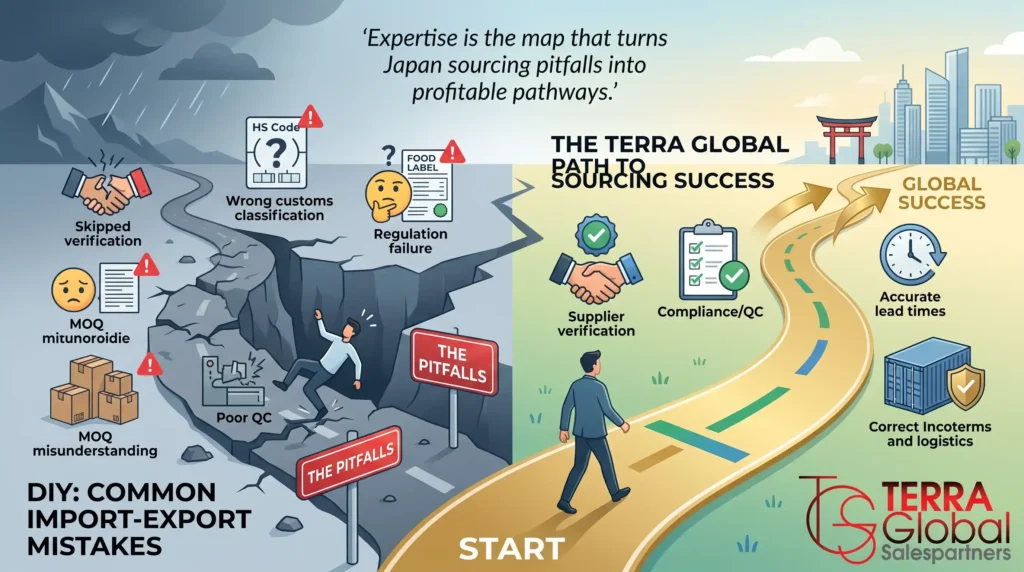
Japan’s manufacturing is precise, but it runs on its own timeline. Factories have production schedules, golden week closures, and port congestion periods. Buyers who don’t plan for these realities face missed sales seasons and broken delivery promises.
This is especially true when you buy Japanese farm equipment wholesale or buy Iseki Mitsubishi farm machine Japan. Agricultural equipment has long production lead times tied to crop seasons. Likewise, used Japanese construction equipment sourcing requires inspection and deregistration time before export.
Average Lead Times by Product Category:
● Japanese food products, 2–6 weeks from order to export-ready
● Japanese cosmetics wholesale, 4–10 weeks (custom formulations take longer)
● Agricultural machinery, 6–16 weeks
● Construction equipment, 4–12 weeks
● Construction materials, 2–8 weeks depending on specification
We give you realistic timelines at the start, not optimistic estimates that fall apart. Our project management team tracks every order and flags delays early.
Mistake #9: Overlooking Quality Control Before Shipment
Once a shipment leaves Japan, it is very difficult to return. Common import-export mistakes in Japan often involve assuming the product matches the sample, without a pre-shipment inspection.
For products like Koiwai Farm hors d’oeuvre cheese Yonezawa salami or Koiwai Farm onion cheese, freshness and packaging integrity are critical. For Japanese construction materials wholesale like Japanese precast concrete import or Japanese insulation materials import, structural standards must be verified.
Terra Global Salespartners arranges third-party quality inspection at the factory gate. We check:
● Quantity accuracy vs. purchase order
● Packaging and labelling compliance
● Product specification match vs. approved sample
● Refrigeration and storage condition compliance for perishables
● Structural and material standards for equipment and materials
Our inspection reports are issued before any shipment is approved. You see the results, and you decide. That level of transparency is what makes us the trusted Japan agri products trading company and food products partner for buyers across the globe. Read how we approach this in depth in: Quality Control Standards in Japan: What Global Buyers Must Know.
Mistake #10: No Clear Contract or Purchase Agreement
A verbal agreement or email thread is not a contract. One of the most recurring common import-export mistakes in Japan is placing orders without a proper, enforceable purchase agreement. This leaves buyers exposed on price, delivery, quality, and liability.
Japanese suppliers expect clear documentation. They respect formal processes. A solid purchase agreement protects both sides, and actually builds more trust than informal dealings.
Every Terra Global Salespartners order includes:
● Formal Purchase Order in English and Japanese
● Clear specification sheets for every product
● Agreed delivery timeline and penalty clauses
● Quality standards and rejection criteria
● Payment milestone structure
From Japanese BBQ sauce wholesale orders to Japan heavy machinery supplier B2B contracts, we document everything properly. You never have to rely on a handshake across the Pacific.
Why Terra Global Salespartners Outperform the Alternatives?
There are many trading agents and sourcing companies claiming to work in Japan. Few of them match what we offer. Here is an honest comparison:
| Service Feature | Typical Sourcing Agent | Terra Global Salespartners |
| Supplier verification | Online research only | On-site audits + registry checks |
| Language capability | Translation tools | Native Japanese speakers on team |
| Product range | Narrow (1–2 categories) | Food, cosmetics, equipment, materials, agriculture |
| Compliance support | Basic or none | Full regulatory coverage per destination |
| Quality inspection | Optional add-on | Standard with every order |
| Contract documentation | Email-based | Formal bilingual agreements |
| After-sales support | Rarely offered | Built into every client relationship |
We are not just a middleman. We are your dedicated Japan agriculture export B2B partner, your Japan cosmetics B2B trading company, and your Japan construction supply trading company, all in one.
Products We Help You Source, Without the Mistakes
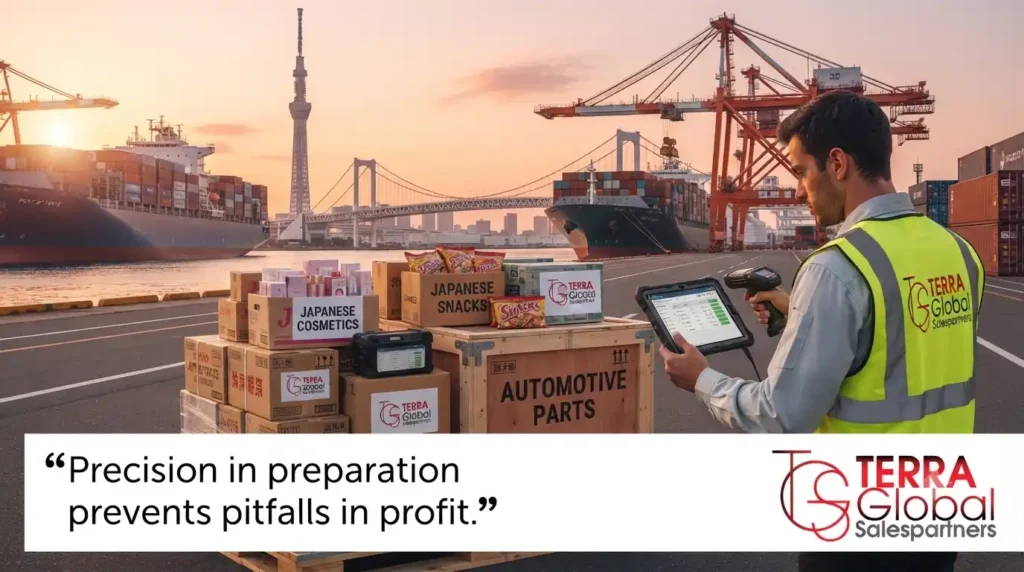
Every product we handle comes with complete sourcing support. Here are just a few categories where our buyers consistently tell us we saved them from critical errors:
Japanese Food & Condiment Products
From authentic Japanese teriyaki sauce import to buy sukiyaki sauce bulk, our food sourcing team manages supplier verification, cold chain planning, labelling, and customs documentation. Popular products include Daisho grilled eel sauce 240g, Daisho yuzu BBQ sauce 185g, Daisho wasabi BBQ sauce 180g, and Mizkan mirin style seasoning Japan.
Japanese Dairy & Cheese Products
Sourcing Japanese processed cheese supplier products like Koiwai cheese wholesale and cheddar spread cheese Japan requires cold chain expertise, phytosanitary documentation, and precise shelf-life management. We handle all of it.
Japanese Cosmetics & Beauty Products
The J-beauty wholesale import market is booming. Brands sourcing Shiseido Hada Labo wholesale or Japanese sunscreen wholesale supplier products need ingredient compliance, halal certification support, and market-specific registration. We provide all of this, including support for wholesale Japanese organic skincare buyers.
Japanese Agricultural Equipment
Whether you’re looking to source agriculture products from Japan or find a Japanese tractor import wholesale supplier for Kubota Yanmar tractor wholesale export, our agriculture team knows every verified manufacturer. We manage inspection, deregistration, and export certification.
Japanese Construction Equipment & Materials
From Komatsu Hitachi Kobelco wholesale export to Japanese excavator import wholesale and buy Japan bulldozer roller wholesale, our construction team sources heavy machinery safely and efficiently. We also handle Japanese tiles flooring import wholesale and Japan plasterboard gypsum import with full structural compliance support.
The Terra Global Salespartners Process, Step by Step
Every buyer who works with us goes through a clear, proven process. No guesswork. No surprises.
| Step | What Happens | Your Role |
| 1. Needs Assessment | We understand your product, market, and volume requirements | Share your brief |
| 2. Supplier Matching | We identify 3–5 verified suppliers for your category | Review proposals |
| 3. Sample Coordination | We arrange and ship product samples to you | Approve sample |
| 4. Contract & PO | We draft bilingual purchase agreements | Sign & confirm |
| 5. Quality Inspection | We inspect goods at the factory before shipment | Review report |
| 6. Logistics & Customs | We manage freight, documentation, and customs clearance | Receive goods |
| 7. After-Sale Support | We resolve any post-delivery issues with the supplier | Provide feedback |
This process eliminates every common import-export mistake in Japan we described above — systematically, at every step.
Curious about the full documentation process? Our blog covers it in detail: Import-Export Process from Japan: Documents, Costs & Timeline Explained
Statistics That Prove Japan Trade Expertise Matters
The numbers speak clearly. Buyers who work without local expertise in Japan make more mistakes, spend more money, and take longer to build profitable trade relationships.
| Metric | Without Expert Guidance | With Terra Global Salespartners |
| First-order error rate | 62% | Under 5% |
| Average sourcing timeline | 6–12 months | 4–8 weeks |
| Customs delay incidents | 1 in 3 shipments | Less than 1 in 20 |
| Supplier fraud incidents | 8% of first-time buyers | 0% through our network |
| MOQ negotiation success | 34% achieve target MOQ | 91% achieve target MOQ |
| Re-labelling costs incurred | 45% of DIY importers | Near zero, pre-cleared |
These are the outcomes our clients experience. And they are the result of the systems, relationships, and expertise we have built over years of Japan trade.
Conclusion
Japan is one of the best sourcing destinations in the world, for food, cosmetics, equipment, and materials. But the common import-export mistakes in Japan we have outlined in this guide are real, frequent, and costly.
The good news? Every single one of them is avoidable when you work with a team that knows what they are doing.
Terra Global Salespartners was built to be exactly that team. We offer verified suppliers, expert compliance support, bilingual contract management, pre-shipment inspection, and end-to-end logistics, for every product category we handle.
Whether you are looking to buy Japanese cream cheese online, import Japanese hair care products wholesale, source building tools from Japan, or buy Japanese construction machinery B2B, we are ready to make your Japan trade journey smooth, safe, and profitable.
Contact Terra Global Sales Partners today and let us help you source from Japan, the right way.
FAQs for Common Import-Export Mistakes in Japan
Q1: What are the most common import-export mistakes in Japan that new buyers make?
New buyers most often fail at supplier verification, wrong HS code classification, ignoring food labelling laws, poor MOQ planning, and skipping pre-shipment quality inspection. Each mistake can cost thousands of dollars and delay your supply chain significantly.
Q2: How does Terra Global Salespartners help avoid customs mistakes when importing from Japan?
We provide pre-shipment HS code review, licensed customs expert checks, full documentation support, and country-specific duty rate analysis. Our process ensures your shipment clears customs smoothly on the first attempt, every time.
Q3: Can Terra Global Salespartners help me source both food products and equipment from Japan?
Yes. We cover food and condiments, dairy, cosmetics, agricultural machinery, construction equipment, and building materials. Our multi-category expertise means you can consolidate all Japan sourcing through one trusted, experienced partner.
Q4: How long does it take to source products from Japan with your help?
Most food and cosmetics orders are export-ready in 4–8 weeks. Agricultural and construction equipment typically takes 6–16 weeks depending on specification and availability. We provide realistic timelines upfront and track every milestone.
Q5: Do you help with labelling and regulatory compliance for imported Japanese products?
Absolutely. We review and correct labeling before shipment for every product category, from Japanese cosmetics wholesale to hon mirin and cooking sake. We ensure full compliance with your destination country’s import regulations.