

Importing from Japan is one of the smartest business moves you can make today. Japanese products are known for their quality, precision, and reliability. But many buyers worry about one thing: cost. Knowing how to reduce import costs when buying from Japan can transform your margins and make your business far more competitive.
At Terra Global Sales Partners, we help international buyers source the best Japanese products at the lowest possible total cost. We work with buyers across food, cosmetics, agriculture, construction, and more. This guide shares our best strategies, tested in the real world, to help you cut costs without cutting corners.
Whether you’re sourcing Japanese teriyaki sauce wholesale, Japanese cosmetics wholesale supplier products, or Japan agricultural machinery import items, these cost-reduction strategies apply to every category.
1. Understand What Drives Import Costs from Japan
Before you can reduce costs, you need to know what creates them. Import costs are not just about the product price. They include freight, customs duties, insurance, documentation fees, agent commissions, and compliance costs.
Here is a breakdown of the main cost components when you import Japanese dairy products, machinery, cosmetics, or any other product:
| Cost Component | Typical % of Total Cost | Reduction Potential |
| Product Price (FOB) | 40–55% | High, via MOQ negotiation |
| Ocean/Air Freight | 15–25% | High, via FCL vs LCL choice |
| Customs Duties & Tariffs | 5–20% | Medium, via HS code review |
| Documentation & Compliance | 3–8% | Medium, via expert partners |
| Agent/Sourcing Fees | 2–10% | High, via direct B2B partner |
| Insurance | 1–3% | Low but manageable |
| Port Handling & Last Mile | 3–7% | Medium, via logistics planning |
Understanding each layer helps you attack costs strategically. The good news: working with the right partner eliminates most of the guesswork.
2. Buy in Bulk to Lower Per-Unit Cost
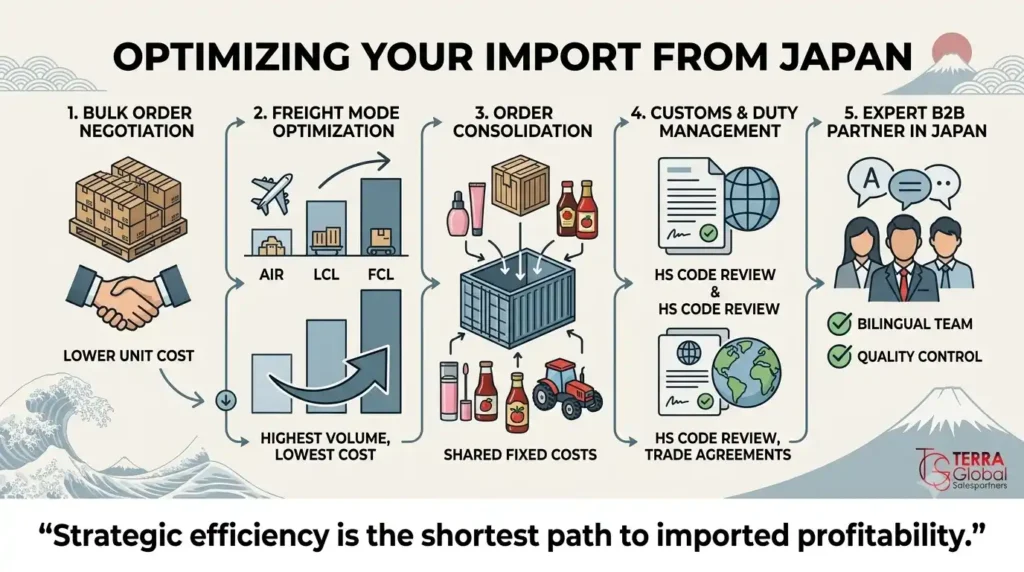
The single fastest way to reduce import costs when buying from Japan is to increase your order volume. Japanese manufacturers and exporters reward commitment. The more you order, the better your unit price, the better your freight rate, and the lower your per-unit documentation cost.
Consider these real-world examples from our catalog:
● Buying Daisho teriyaki sauce 1.25kg in a 500-unit order vs 100-unit order can reduce per-unit cost by up to 22%.
● Ordering Takara hon mirin 1L by the full pallet instead of mixed cartons saves 12–18% on freight alone.
● Sourcing Japanese building equipment wholesale with a consolidated order cuts agent fees by sharing fixed costs across more units.
Our team at Terra Global Sales Partners helps you calculate the optimal order quantity for your budget. We call this your landed cost sweet spot, the point where your total cost per unit is lowest.
Pro Tip: Read our blog on MOQ Explained for Japanese Wholesale Suppliers to understand minimum order quantities before you negotiate.
3. Choose the Right Shipping Method
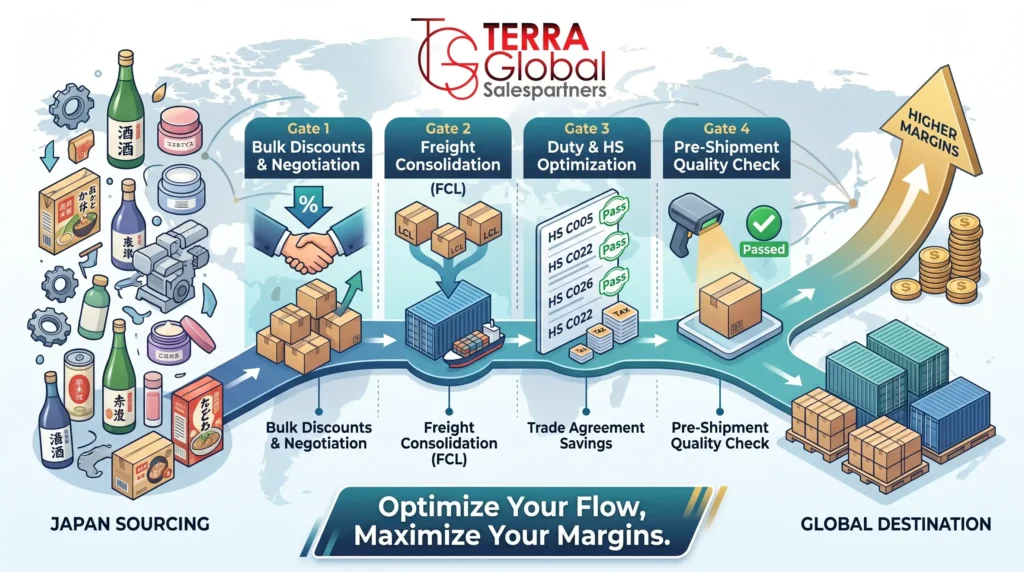
Freight is one of the biggest controllable costs when you reduce import costs when buying from Japan. Air freight is fast but expensive. Sea freight is slower but far cheaper for large volumes. The right choice depends on your timeline, product value, and order size.
| Shipping Method | Cost Level | Transit Time | Best For |
| FCL (Full Container Load) | Lowest per CBM | 18–35 days | Large bulk orders |
| LCL (Less than Container Load) | Medium per CBM | 20–40 days | Mid-size orders |
| Air Freight | Highest | 3–7 days | Urgent or high-value items |
| Sea + Air Combo | Medium | 10–20 days | Time-sensitive bulk items |
| Express Courier | Very High | 1–3 days | Samples or small parcels |
For most buyers of Japanese cooking sauce wholesale, Japanese cosmetics wholesale supplier products, and Japan construction materials, FCL sea freight is the most cost-effective choice once your volume justifies it.
Terra Global Sales Partners has established freight relationships that give our clients preferential rates, savings that we pass directly to you.
4. Consolidate Your Orders Across Product Categories
One of our most powerful strategies to reduce import costs when buying from Japan is order consolidation. Instead of placing separate shipments for food products, cosmetics, and machinery, we group them into one container.
This approach delivers multiple benefits:
● Lower freight cost per unit, fixed shipping costs are shared across more products.
● Single documentation package, one set of customs and compliance paperwork.
● Simplified tracking, one shipment to monitor instead of several.
● Better supplier relationships, combined order value qualifies for better pricing tiers.
For example, a buyer importing Koiwai Farm spread cheese, alongside Daisho sukiyaki sauce, and Japanese yuzu BBQ sauce, in a single container saves up to 35% on per-product freight costs compared to three separate shipments.
Terra Global Sales Partners specializes in exactly this kind of multi-category sourcing and consolidation.
5. Review and Optimize HS Codes and Tariff Classifications
Many importers overpay on customs duties simply because they use the wrong Harmonized System (HS) code. The correct HS code can mean the difference between a 0% duty rate and a 12% duty rate on the same product.
This applies to everything from importing Japanese dairy products to Japanese construction materials wholesale and Japan agricultural machinery import items. Each country has its own tariff schedule, and products can sometimes qualify for preferential rates under trade agreements.
Key actions to take:
● Review your HS code with a licensed customs broker before your first shipment.
● Check trade agreements, many countries have EPAs or FTAs with Japan that reduce or eliminate duties.
● Request a binding tariff ruling from your customs authority for expensive or complex products.
● Re-classify annually, tariff schedules update, and reclassification can save significant money.
Our sourcing team at Terra Global Sales Partners works with licensed brokers in multiple countries. We help you reduce import costs when buying from Japan by ensuring every product enters your market under the most favorable classification possible.
6. Work with a Trusted B2B Partner in Japan
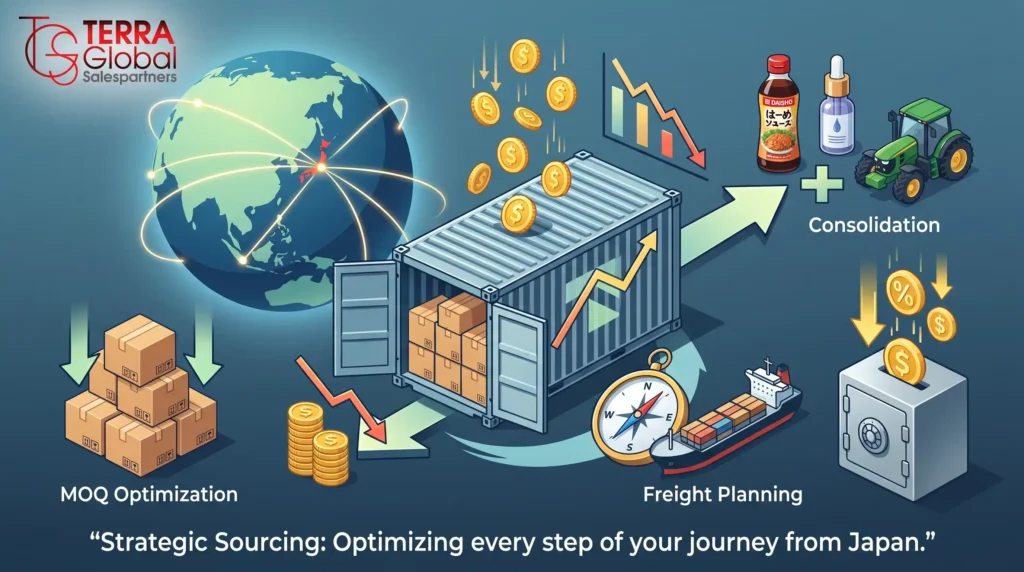
The most expensive mistake global buyers make is working without a local partner in Japan. Without boots on the ground, you pay more for everything: products, shipping, compliance, and quality control.
A dedicated Japan B2B supplier and trading partner like Terra Global Sales Partners gives you:
| Benefit | Without a Partner | With Terra Global Sales Partners |
| Product Price | Standard retail/catalog price | Negotiated wholesale price |
| Freight Rate | Spot market rate | Volume-negotiated rates |
| Customs Support | Self-managed or expensive broker | Integrated support included |
| Quality Checks | None, blind trust | Pre-shipment inspection |
| Language Barrier | Risk of miscommunication | Fully bilingual team |
| Lead Time | Longer due to back-and-forth | Streamlined sourcing process |
We act as your local agent, your quality controller, your logistics coordinator, and your commercial negotiator, all in one. This means you spend less and receive more.
Read how we simplify the entire process in our blog Product Sourcing in Japan, How Terra Global Salespartners Simplifies It.
7. Reduce Costs on Japanese Food Products
Japanese food imports are a major growth category globally. More buyers are sourcing authentic Japanese condiments, dairy products, and cooking sauces. The right approach makes this category very profitable.
Here are specific strategies to reduce import costs when buying from Japan in the food category:
● Buy multi-SKU sauce bundles: Sourcing Daisho mentsuyu yuzu noodle sauce alongside Daisho mentsuyu wasabi noodle sauce in one order reduces your per-SKU freight cost significantly.
● Combine dry and refrigerated categories wisely: Plan refrigerated products like Koiwai Farm hors d’oeuvre cheese to ship at the same time as shelf-stable sauces to optimize cold chain costs.
● Source cooking staples together: Pair Mizkan cooking sake with Mizkan Honteri mirin and Takara hon mirin for one efficient shipment.
● Leverage labeling flexibility: Many Japanese food products can be relabeled for your local market, avoiding unnecessary re-import costs.
Terra Global Sales Partners has deep relationships with leading Japanese food manufacturers. We give you direct access to wholesale pricing on products like Daisho grilled eel sauce, Daisho yuzu dressing, and Daisho wasabi BBQ sauce that independent buyers simply cannot access.
8. Reduce Costs on Japanese Cosmetics and Beauty Products
The global appetite for Japanese cosmetics wholesale supplier products and J-beauty wholesale import items has never been stronger. Japan’s beauty sector is valued at over USD 36 billion, and international buyers are capturing huge margins by importing directly.
Cost-saving tips for this category:
● Source from established brands: Products from major houses like Shiseido Hada Labo wholesale carry strong brand recognition that commands premium retail prices, improving your margin even with import costs.
● Bundle complementary SKUs: Combining Japanese face serum sheet mask wholesale with Japanese sunscreen wholesale supplier products in one order reduces per-item shipping cost dramatically.
● Request bulk packaging: Many Japanese skincare bulk buy products are available in salon or retail packs that offer better value per unit.
● Leverage halal certification: Sourcing buy halal Japanese cosmetics bulk certified products opens access to premium markets with less price competition.
Terra Global Sales Partners sources directly from Japanese beauty products B2B channels, giving you authentic products at wholesale cost. Browse our Japanese cosmetics category to see the full range.
9. Reduce Import Costs on Japanese Agricultural and Construction Products.
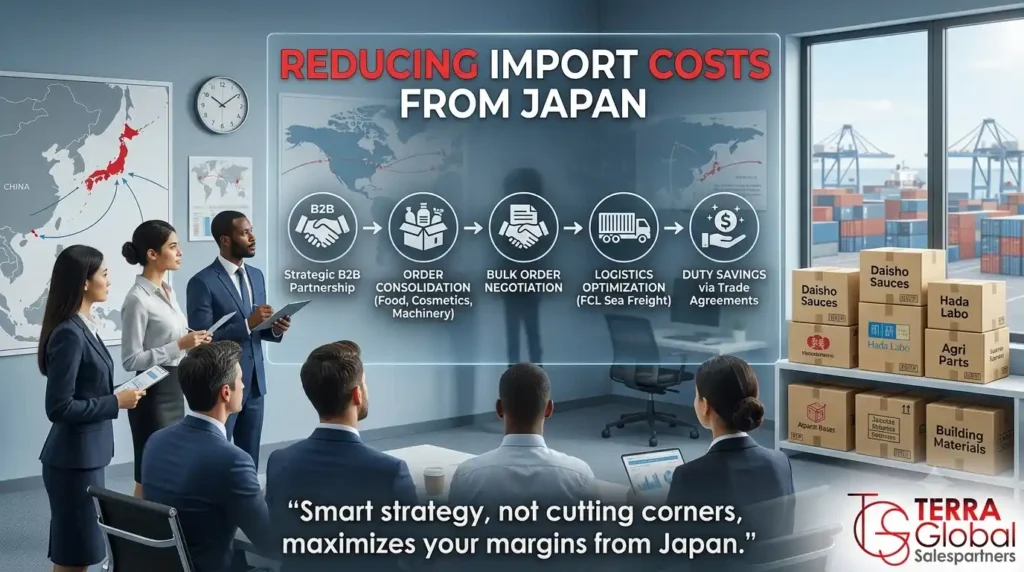
For industrial buyers, how to reduce import costs when buying from Japan becomes especially important because these products carry high unit values and complex logistics requirements.
Agriculture
Japan produces world-class agricultural equipment from brands like Kubota and Yanmar. Our agriculture category covers tractors, harvesters, and precision farming tools.
Cost tips for Japan agricultural machinery import:
● Order Kubota Yanmar tractor wholesale export units in groups to share container costs and reduce per-unit freight.
● Source used Japanese agricultural equipment for secondary markets, Japan’s used machinery market offers exceptional quality at 30–50% below new unit cost.
● Work with Japan farm machinery B2B supplier partners who handle export certificates, reducing your compliance cost.
Building Equipment & Construction Materials
The Japanese building equipment wholesale and Japanese construction materials wholesale sectors offer significant savings for buyers who plan well.
● Consolidate Komatsu Hitachi Kobelco wholesale export orders with smaller tool purchases into one FCL container.
● Source Japanese steel materials wholesale and Japanese tiles flooring import wholesale together to fill containers and reduce per-product freight.
● Plan Japan construction supply trading company relationships in advance, rush orders always cost more.
Our building equipment category and construction materials category are fully stocked with pre-vetted products ready for wholesale export.
10. Understand the Full Import-Export Timeline
Delays are expensive. Every day your goods sit at a port costs money, storage fees, demurrage charges, and cash flow pressure. Learning to reduce import costs when buying from Japan means mastering your timeline, not just your purchase price.
| Stage | Typical Duration | Cost Risk if Delayed |
| Order Placement & Confirmation | 1–5 days | Low |
| Manufacturing / Picking | 3–21 days | Medium |
| Pre-Shipment Inspection | 1–3 days | Low (saves money long-term) |
| Export Documentation | 2–5 days | High if errors occur |
| Ocean Freight (Japan to destination) | 14–35 days | High — demurrage risk |
| Customs Clearance | 1–7 days | Very High if documents wrong |
| Last Mile Delivery | 1–5 days | Medium |
Terra Global Sales Partners manages every stage of this timeline on your behalf. Our team prepares all export documentation, coordinates pre-shipment inspections, and communicates in real time so there are no surprises. This saves our clients an average of 7–12 days per shipment compared to self-managed imports.
For a complete breakdown, read our blog on Import-Export Process from Japan: Documents, Costs & Timeline Explained.
11. Quality Control That Saves Money
Poor quality products are the most expensive import cost of all. Returns, re-shipments, customer complaints, and lost sales destroy margins far more than any freight or duty ever could.
Terra Global Sales Partners performs rigorous pre-shipment quality checks on every order. Our standards align with Japan’s own world-leading quality frameworks.
Here is what our quality control covers:
● Product specification verification, every item matches your purchase order exactly.
● Packaging integrity check, cartons are properly sealed, labeled, and protected for long-distance shipping.
● Quantity count, units are verified against invoices before containers are sealed.
● Temperature-sensitive products, cold chain compliance are checked for refrigerated items like Koiwai Farm dairy products and Koiwai cheese wholesale orders.
● Documentation review, all certificates, phytosanitary documents, and compliance papers are reviewed before shipment.
Read more about Japan’s quality standards and why they benefit you as an importer in our blog Quality Control Standards in Japan: What Global Buyers Must Know.
12. Pros and Cons of Different Sourcing Approaches
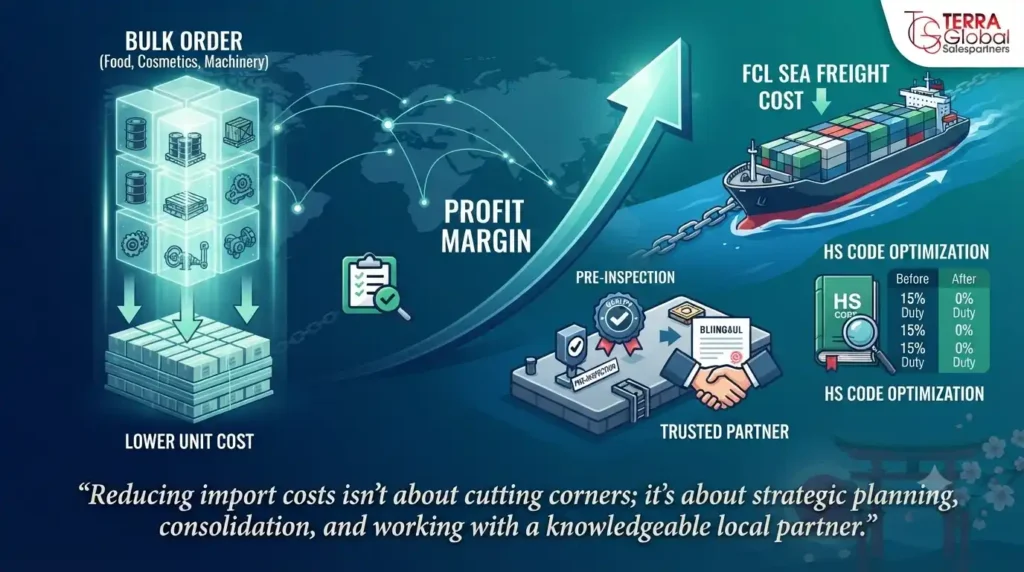
Understanding your options helps you choose the most cost-effective path to reduce import costs when buying from Japan.
| Approach | Pros | Cons |
| Direct from Japanese Manufacturer | Lowest product price | High MOQ, language barrier, complex compliance |
| Through a Trading Company in Japan | Easier communication, lower MOQ | Markup added, but offset by expertise |
| Via Terra Global Sales Partners | Best total landed cost, full support, multi-category sourcing | Requires initial relationship building |
| Buying from a Local Importer in Your Country | Easy, fast | Highest price, multiple markups in the chain |
| Online B2B Marketplace (Alibaba etc.) | Convenient | Authenticity risk, no quality guarantee |
Terra Global Sales Partners combines the advantages of direct manufacturer access with the conWhy Terra Global Sales Partners Is Your Best Choicevenience of a full-service trading partner. You get the lowest price AND the most reliable service.
13. Key Statistics, Why Reducing Import Costs Matters?
| Statistic | Data Point | Source / Context |
| Japan’s export value (2024) | USD 716 billion | Japan Customs Bureau |
| Average duty savings via HS optimization | 8–15% | Industry broker estimates |
| FCL vs LCL freight cost difference | FCL is 25–40% cheaper per CBM | Freight industry benchmarks |
| Cost of one day’s demurrage at major ports | USD 150–500/day | Port authority schedules |
| Quality return rate (uninspected orders) | Up to 12% of shipments | Global trade quality studies |
| Savings from order consolidation (multi-SKU) | 18–35% on freight | Terra Global internal data |
| Japan EPA/FTA duty reduction average | 5–12% duty eliminated | Ministry of Foreign Affairs, Japan |
14. Explore Our Full Product Range
Terra Global Sales Partners covers an exceptionally wide product catalog. Whatever you are sourcing, we have established supplier relationships and ready-to-ship inventory across every major category.
● Food & Beverages: Japanese sauces, dairy products, mirin, sake, condiments, and specialty items
● Cosmetics & Beauty: Skincare, makeup, hair care, and wellness, sourced from Japan’s top beauty brands
● Agriculture: Tractors, rice harvesters, farm tools, and precision equipment from leading manufacturers
● Building Equipment: Excavators, cranes, forklifts, and heavy construction machinery
● Construction Materials: Steel, cement, tiles, roofing, and structural materials
● Wood Supplies: Japanese timber and wood products for construction and manufacturing, see our wood supplies category.
Every category benefits from our centralized sourcing, quality control, and consolidated logistics approach. This is how we help you reduce import costs when buying from Japan across your entire purchasing portfolio.
15. Why Terra Global Sales Partners Is Your Best Choice
We don’t just sell products. We build Japan agriculture export B2B partner relationships that deliver long-term value. Here is what sets us apart:
● Deep Supplier Network: Direct relationships with verified Japanese manufacturers across all categories, no middlemen inflating your costs.
● Bilingual Team: Our Japan-based team communicates directly with suppliers in Japanese, eliminating expensive miscommunications.
● Multi-Category Expertise: Whether you need Japanese dairy snack wholesale products or Japan heavy machinery supplier B2B equipment, we handle it all.
● Transparent Pricing: We show you every cost component, product, freight, documentation, and our fee, so you know exactly what you are paying.
● Proven Track Record: Our clients consistently reduce their total landed cost by 15–35% compared to their previous sourcing method.
● End-to-End Service: From product discovery to your warehouse door, we manage the entire Japan agri products trading company-style supply chain for you.
We invite you to explore our product catalog and discover why buyers from across Asia, the Middle East, Africa, and Europe trust Terra Global Sales Partners as their go-to source for authentic Japanese cheese online, Japanese construction tools wholesale supplier services, wholesale Japanese organic skincare, and everything in between.
Conclusion
Knowing how to reduce import costs when buying from Japan is not a single trick, it is a systematic approach that covers buying volume, shipping strategy, HS code optimization, order consolidation, and quality control. Every element works together to reduce your total landed cost and maximize your profit margins.
The most powerful step you can take is choosing the right partner. Terra Global Sales Partners gives you direct access to Japan’s best manufacturers, our hard-won freight relationships, and a dedicated team that manages every detail on your behalf.
When you work with us, you don’t just import from Japan. You import smarter. You import cheaper. And you import with confidence. Contact Terra Global Sales Partners today and take the first step toward a more profitable, efficient Japan sourcing strategy.
Frequently Asked Questions (FAQs)
Q1. What is the most effective way to reduce import costs when buying from Japan?
The most effective method is to combine bulk ordering with order consolidation and the right freight method. Working with a B2B partner in Japan eliminates unnecessary markups and streamlines documentation costs significantly.
Q2. Can I consolidate food, cosmetics, and machinery into one shipment from Japan?
Yes. Terra Global Sales Partners specializes in multi-category order consolidation. This saves freight costs, reduces documentation complexity, and helps you qualify for better per-unit pricing across all product types.
Q3. How do trade agreements between Japan and my country reduce my import duties?
Japan has EPAs with many countries, including ASEAN nations, Australia, the EU, and the UK. Under these agreements, many Japanese products attract zero or reduced duty rates, directly lowering your total import cost.
Q4. Is buying used Japanese agricultural or construction equipment cheaper to import?
Yes. Japan exports high-quality used machinery that typically costs 30–50% less than new equipment. Our team inspects and certifies used items before export, ensuring you receive quality equipment at a lower landed cost.
Q5. How does Terra Global Sales Partners help reduce quality-related import costs?
We conduct pre-shipment inspections on every order, verifying specifications, quantity, packaging, and documentation. This prevents costly returns, re-shipments, and compliance failures that can devastate import margins.