
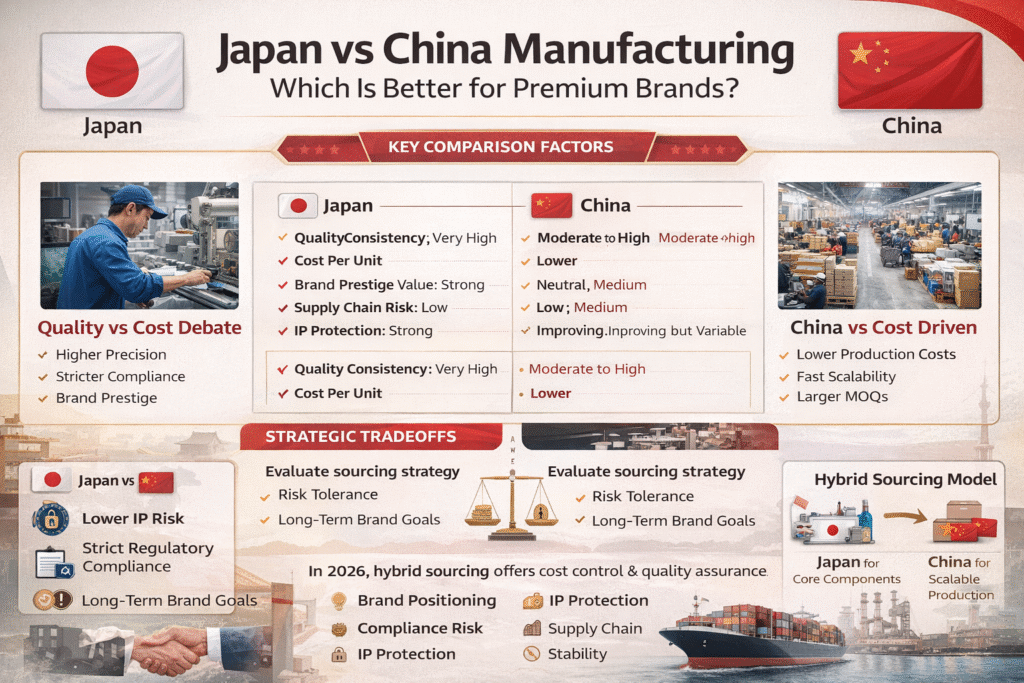
Japan vs China Manufacturing: Which Is Better for Premium Brands? Updated 2026
- Japan offers higher precision, quality control, and brand prestige.
- China provides lower production costs and massive scalability.
- Premium brands prioritize consistency, compliance, and reputation.
- Risk tolerance and positioning determine the right choice.
- Hybrid sourcing models are increasingly popular in 2026.
Is Japan or China better for premium brand manufacturing?
For premium brands prioritizing quality, compliance, and brand positioning, Japan is often the better choice. China offers lower costs and scalability, but Japan delivers stronger quality assurance, manufacturing precision, and long-term brand credibility.
Why Are Premium Brands Comparing Japan vs China Manufacturing?
Premium brands compare Japan and China to balance cost efficiency with quality consistency and brand reputation. If you’re building a premium product, your manufacturing decision directly impacts:
- Product durability
- Compliance standards
- Customer perception
- Return rates
- Brand trust
China dominates global mass production. Japan, however, is associated with craftsmanship, engineering precision, and strict quality culture.Premium brands don’t just sell products, they sell experience and reliability.
So the real question isn’t just cost. It’s: What aligns with your long-term brand positioning?
Japan = Quality-driven.
China = Cost-driven.
Your brand strategy determines which matters more.
Is Japan Better Than China for Manufacturing Quality?
Yes, Japan generally delivers higher manufacturing consistency, defect control, and quality management systems.
Japan’s Strengths in Quality
- Kaizen continuous improvement culture
- Strict ISO and compliance adherence
- Advanced automation and robotics
- Lower defect rates in precision industries
- Strong supplier accountability
Japanese OEM factories often specialize in:
- Electronics
- Automotive components
- Cosmetics
- Premium consumer goods
- High-end packaging
Quality in Japan is not a feature — it’s embedded in the production philosophy.
China’s Manufacturing Quality Reality
China’s quality varies significantly depending on:
- Factory tier
- Supplier vetting
- Price level
- Inspection processes
Top-tier Chinese manufacturers can produce excellent quality. However, lower-cost factories often compromise materials and consistency. This creates variability risk, something premium brands must manage carefully.
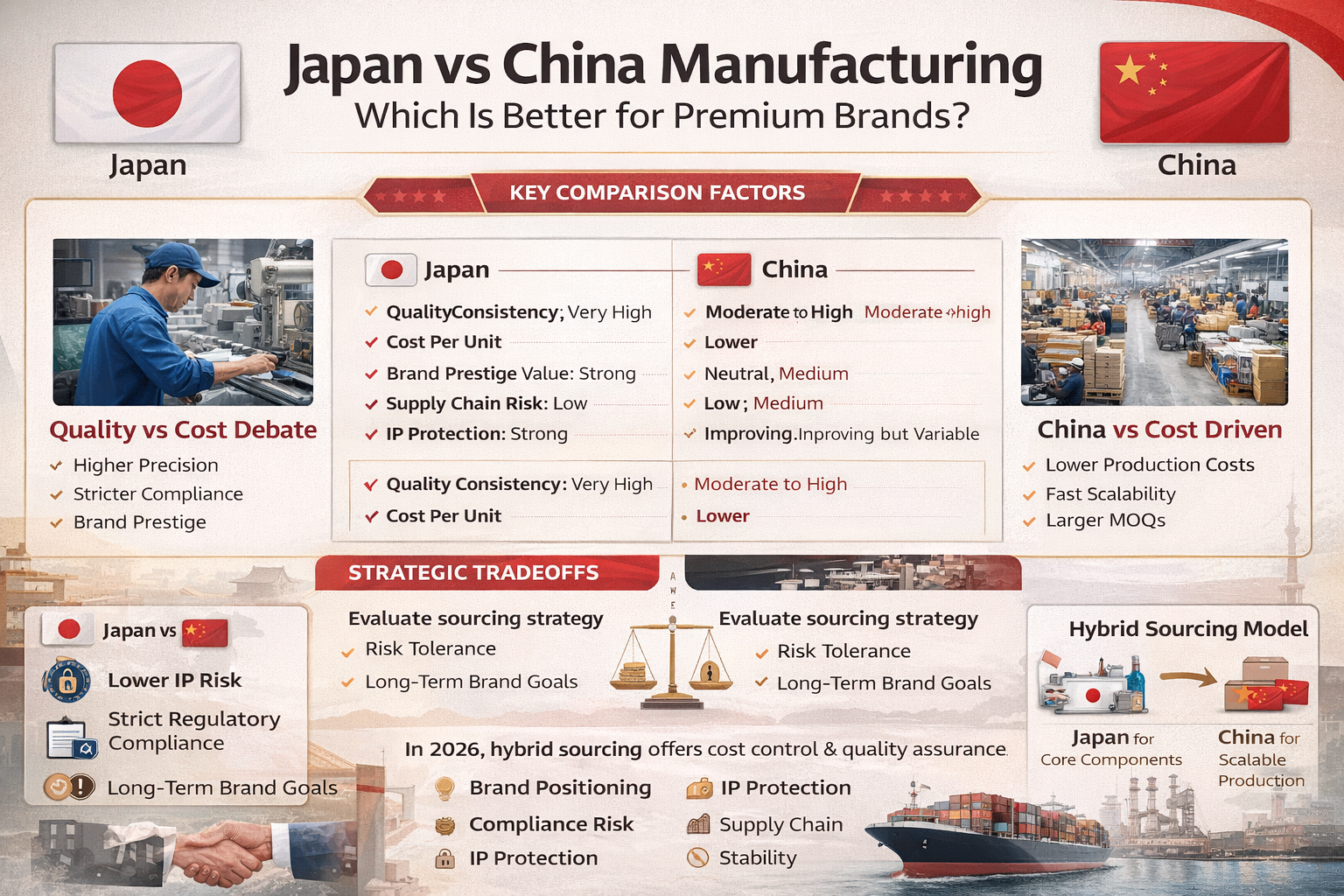
Comparison Table of Japan vs China Manufacturing for Premium Brands
| Factor | Japan | China |
| Quality Consistency | Very High | Moderate to High |
| Cost Per Unit | Higher | Lower |
| Minimum Order Quantity | Moderate | Very Flexible |
| Compliance Reliability | Strong | Varies by supplier |
| Brand Prestige Value | High | Neutral |
| Production Speed | Moderate | Very Fast |
| Supply Chain Risk | Low | Medium |
If your brand promise depends on flawless consistency, Japan often wins.
Is China Cheaper Than Japan for Production?
Yes, China generally offers significantly lower production costs due to scale and labor advantages. China remains the world’s largest manufacturing hub because of:
- Large industrial clusters
- Competitive labor costs
- Extensive raw material supply chains
- Fast production cycles
- Flexible MOQs
For startups or mid-tier brands prioritizing margin over prestige, China offers strong financial advantages. However, premium brands must calculate hidden costs, including:
- Quality inspections
- Rework and defect management
- Return logistics
- Brand reputation damage
Lower unit cost does not always mean lower total cost. Here’s what matters, True manufacturing cost = Production + Risk + Brand Impact.
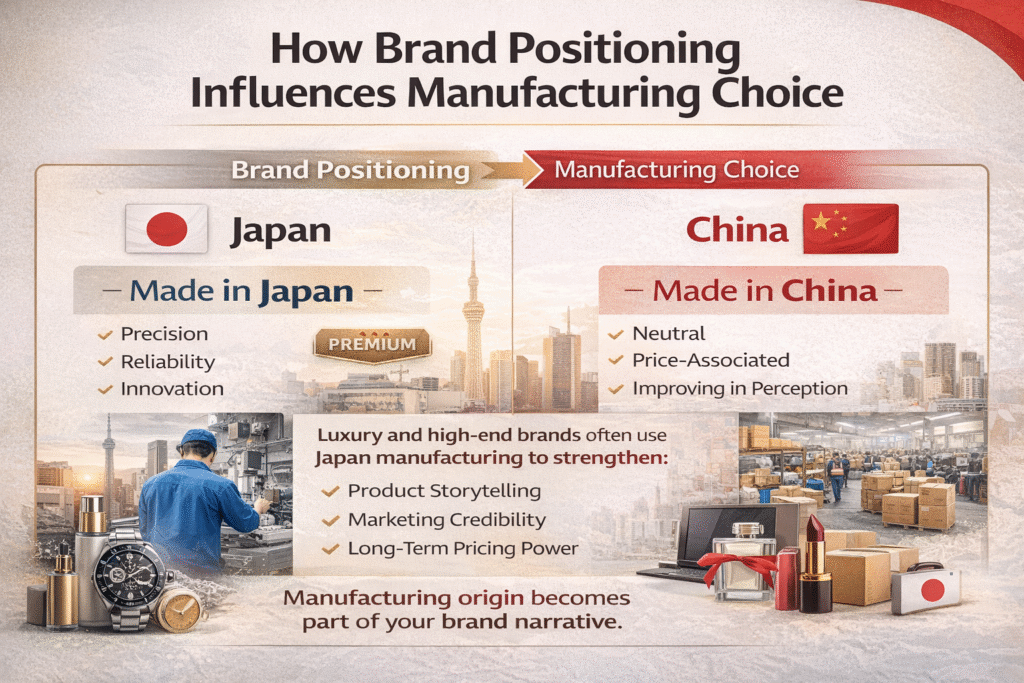
How Does Brand Positioning Influence Manufacturing Choice?
Premium positioning often requires manufacturing origins aligned with quality perception and consumer trust. Consumers associate “Made in Japan” with:
- Precision
- Reliability
- Innovation
- Authentic craftsmanship
In contrast, “Made in China” is often neutral or price-associated — though improving in perception globally. Luxury and high-end brands often use Japan manufacturing to strengthen:
- Product storytelling
- Marketing credibility
- Long-term pricing power
In short, manufacturing origin becomes part of your brand narrative.
How Does Compliance and Regulatory Risk Compare?
Japan provides stricter regulatory enforcement and transparent compliance systems, while China requires deeper supplier vetting and monitoring. Compliance is critical for premium brands, especially in:
- Cosmetics
- Food & supplements
- Electronics
- Automotive parts
- Medical devices
Japan Compliance Advantage
Japan operates under highly regulated industrial standards, including:
- Strict quality certification processes
- Government-enforced safety compliance
- Transparent documentation requirements
- Lower risk of regulatory shortcuts
Japanese manufacturers typically adhere to:
- ISO standards
- GMP certifications
- Export compliance documentation
This reduces post-import inspection risk and product recall probability. For premium brands selling in North America or Europe, this matters significantly.
China Compliance Considerations
China has modernized its compliance framework, but enforcement consistency varies by region and factory tier. Common risks include:
- Documentation inconsistencies
- Material substitutions without disclosure
- Varying export compliance accuracy
- Factory subcontracting without transparency
This doesn’t mean China lacks compliance, it means verification must be stronger. Japan reduces compliance monitoring load. China increases the need for ongoing inspection.
Which Country Offers Better Intellectual Property (IP) Protection?
Japan generally offers stronger IP enforcement and lower risk of design replication compared to China. For premium brands developing:
- Proprietary formulations
- Unique industrial designs
- Custom tooling
- Patented innovations
IP security is not optional, it’s strategic.
Japan IP Environment
Japan has,
- Strong patent enforcement
- Clear legal recourse mechanisms
- Cultural emphasis on contractual integrity
- Low counterfeiting rates
This creates confidence for high-investment R&D brands.
China IP Reality
China has improved IP protection significantly in recent years. However:
- Enforcement may require local legal engagement
- Counterfeit ecosystems still exist in certain sectors
- Supply chain leakage risk is higher
Premium brands often mitigate risk through,
- Split manufacturing models
- Strict NDA contracts
- Multiple supplier structures
Japan = Lower IP risk exposure.
China = Manageable but higher vigilance required.
How Stable Is the Supply Chain in Japan vs China?
China offers scale and speed, while Japan provides stability and predictability in production cycles. Supply chain stability became a major concern after:
- COVID disruptions
- Geopolitical tensions
- Shipping volatility
- Raw material fluctuations
Premium brands now prioritize resilience over pure speed.
China’s Scale Advantage
China benefits from:
- Massive supplier ecosystems
- Integrated industrial clusters
- Fast tooling turnaround
- Large labor force
This allows rapid scaling from 1,000 units → 100,000+ units efficiently. For fast-growth brands, this scalability is unmatched.
Japan’s Stability Advantage
Japan focuses on,
- Long-term supplier relationships
- Predictable lead times
- Consistent quality outputs
- Lower operational surprises
Production growth may be slower, but reliability is higher. Premium brands selling high-margin, lower-volume goods often prefer this model.
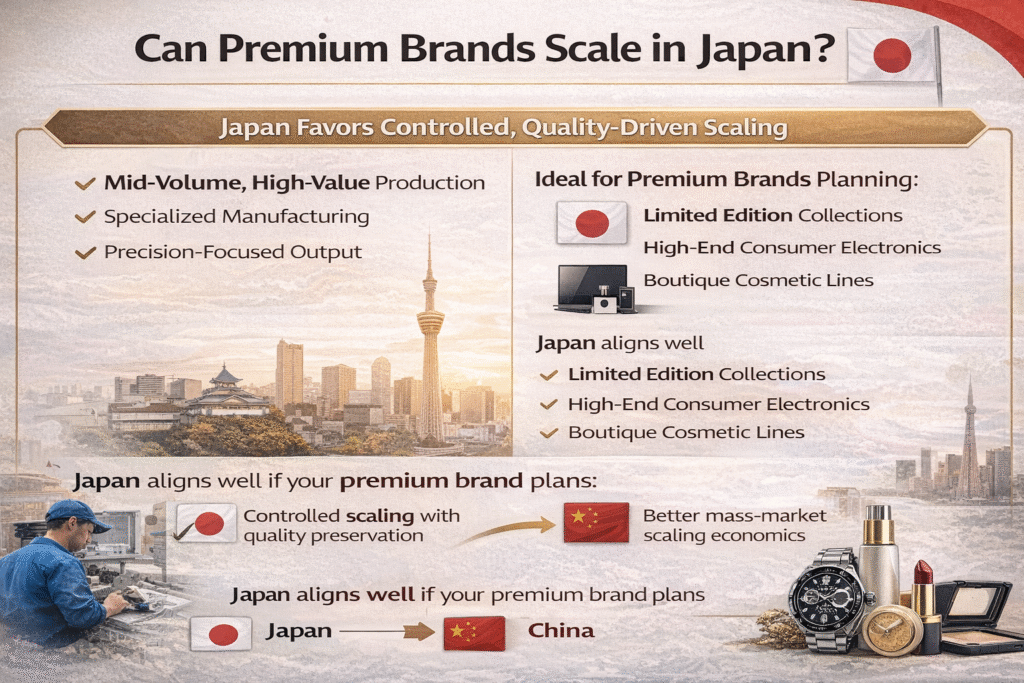
Can Premium Brands Scale in Japan?
Yes, but Japan prioritizes controlled scaling with quality preservation over rapid volume expansion. Japan’s manufacturing ecosystem favors:
- Mid-volume, high-value production
- Specialized manufacturing
- Precision-focused output
If your premium brand plans,
- Limited edition collections
- High-end consumer electronics
- Boutique cosmetic lines
Japan aligns well. If your strategy is mass-market premium expansion, China may offer better scaling economics.
Comparison on Risk & Scalability
| Factor | Japan | China |
| IP Protection | Strong | Improving but variable |
| Compliance Transparency | High | Moderate |
| Scaling Speed | Moderate | Very High |
| Supply Chain Stability | High | High but sensitive to global shifts |
| Risk Monitoring Need | Low to Moderate | Moderate to High |
Japan reduces strategic risk. China increases growth flexibility.
Which Country Is Better for Luxury Brands Specifically?
Japan is generally better for luxury brands due to quality precision, lower defect risk, and strong brand perception. Luxury brands sell:
- Trust
- Durability
- Exclusivity
- Craftsmanship
Japan’s manufacturing culture aligns closely with these attributes. Consumers associate Japan with:
- Engineering excellence
- Authentic craftsmanship
- Strict quality discipline
- Technological innovation
For high-margin brands, even minor defects can damage reputation. Japan reduces that exposure. China, however, works well for:
- Accessible luxury
- Premium-but-scalable categories
- Fast seasonal product launches
Luxury-first positioning → Japan
Speed-first premium → China
When Does a Hybrid Manufacturing Strategy Make Sense?
A hybrid model combines Japan for core premium components and China for scalable production efficiency. Many 2026 premium brands use:
- Japan for formulation or high-precision components
- China for packaging, accessories, or bulk production
This model balances:
- Cost control
- Risk management
- Brand prestige
- Scalability
For example:
- Cosmetics brand → Formula in Japan, packaging in China
- Electronics brand → Core component in Japan, assembly in China
Hybrid sourcing reduces over-dependence on a single ecosystem. Here’s what matters, Strategic allocation of production tasks maximizes margin and minimizes risk.
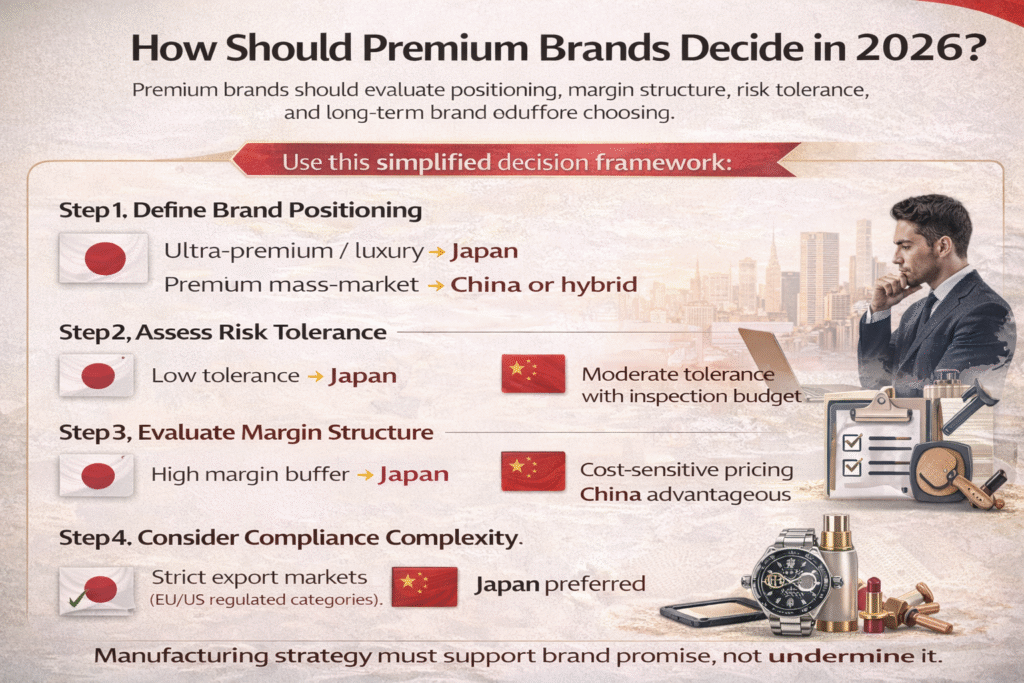
How Should Premium Brands Decide in 2026?
Premium brands should evaluate positioning, margin structure, risk tolerance, and long-term brand equity before choosing.
Use this simplified decision framework:
Step 1: Define Brand Positioning
- Ultra-premium / luxury → Japan
- Premium mass-market → China or hybrid
Step 2: Assess Risk Tolerance
- Low tolerance → Japan
- Moderate tolerance with inspection budget → China
Step 3: Evaluate Margin Structure
- High margin buffer → Japan feasible
- Cost-sensitive pricing → China advantageous
Step 4: Consider Compliance Complexity
- Strict export markets (EU/US regulated categories) → Japan preferred
Manufacturing strategy must support brand promise, not undermine it.
Final Comparison
| Strategic Goal | Recommended Choice |
| Luxury positioning | Japan |
| Cost leadership | China |
| IP protection priority | Japan |
| Fast volume expansion | China |
| Balanced risk & cost | Hybrid |
If you’re evaluating Japan manufacturing for premium positioning, we provide:
- OEM partner sourcing
- Importer of Record compliance
- Supplier due diligence
- End-to-end global shipping
Explore our sourcing solutions here. Build a manufacturing strategy aligned with your brand equity.
Final Takeaway
Japan vs China manufacturing is not a simple cost comparison. It is a strategic decision about, Brand positioning, Long-term trust, Risk tolerance, and Market expansion strategy. For premium brands in 2026, the real advantage lies in aligning manufacturing origin with brand identity. If your brand promise is excellence, your manufacturing strategy must reflect it.
FAQs
1. Is Japan better than China for high-quality manufacturing?
Yes. Japan typically offers stronger quality consistency, stricter compliance enforcement, and lower defect rates compared to China.
2. Why do luxury brands manufacture in Japan?
Luxury brands value Japan’s precision, craftsmanship culture, and strong IP protection, which reinforce premium brand perception.
3. Is manufacturing in China always cheaper?
Generally yes, due to labor scale and industrial clusters. However, total cost must include inspection, defect management, and risk mitigation.
4. Can premium brands use both Japan and China?
Yes. Hybrid sourcing models allow brands to combine Japan’s precision with China’s scalability for optimal efficiency.
5. Which country is safer for intellectual property?
Japan typically provides stronger enforcement and lower counterfeiting risk compared to China.