

Understanding japanese business culture is the first step to building strong trade relationships with Japan. For international buyers, entering the Japanese market without this knowledge leads to costly misunderstandings. Japan holds unique values rooted in respect, precision, and long-term trust. These values shape every business interaction, from the first email to the final contract.
Terra Global Sales Partners has spent years navigating japanese business culture on behalf of global clients. We know what Japanese suppliers expect. We know what buyers often overlook. And we make sure the gap between them disappears. Whether you are sourcing Japanese cosmetics wholesale, Japanese construction materials wholesale, or authentic Japanese teriyaki sauce import products, we prepare you for every step of the journey.
This guide gives you a practical, thorough overview of doing business in japan. Use it to approach Japanese suppliers with confidence, close deals faster, and build partnerships that last.
Why Japanese Business Culture Is Different?
Japan is not like most trading nations. Japanese business etiquette for foreigners begins with understanding that relationships come before transactions. Japanese suppliers do not rush into deals. They assess your intent, reliability, and professionalism first.
Key differences include:
● Hierarchy is respected. Titles matter. Speaking directly to a senior person without introduction can be seen as disrespectful.
● Silence is a form of communication. A pause does not mean confusion. It often means careful thought.
● Group decision-making is common. Decisions are rarely made by one person. Expect a longer approval process.
● Face (mentsu) matters greatly. Avoid putting suppliers on the spot or criticising them in public.
● Punctuality is non-negotiable. Being late is seen as deeply disrespectful.
Terra Global Sales Partners acts as your cultural bridge. We communicate with Japanese suppliers in ways that build trust, not friction. Our team understands the unspoken rules that most foreign buyers miss.
Cultural Business Style Comparison
| Aspect | Western Business Style | Japanese Business Style |
| Decision Speed | Fast, often individual | Slow, collective (Nemawashi) |
| Communication | Direct and explicit | Indirect and contextual |
| Relationship Priority | Transaction first | Relationship first |
| Hierarchy | Often flat | Strictly respected |
| Contract Role | Legally binding emphasis | Trust-based, flexible |
| Meeting Purpose | Often to decide | Often to confirm |
The Importance of Meishi, Business Card Exchange
One of the most iconic parts of japanese business culture is the business card exchange, called Meishi Koukan. This ritual carries real weight. How you handle a business card reflects how you will handle business.
Rules for Meishi Exchange
● Present and receive cards with both hands. Bow slightly when doing so.
● Study the card before putting it away. Read the name and title carefully.
● Never write on a card in front of the person.
● Place cards on the table during a meeting, in the order people are seated.
● Never put a card in your back pocket or fold it.
When working with Terra Global Sales Partners, we prepare you before every interaction. We brief you on supplier backgrounds, preferred communication styles, and appropriate greeting customs. You never walk into a meeting blind.
How to Do Business in Japan as a Foreigner, A Step-by-Step Approach?

How to do business in japan as a foreigner requires patience and preparation. Follow these stages to build a relationship that moves toward a successful deal.
Stage 1: Introduction Through a Trusted Party
Cold outreach rarely works in Japan. A warm introduction from a trusted intermediary like Terra Global Sales Partners changes everything. We have established relationships with verified suppliers across food, cosmetics, agriculture, construction, and more. Our introduction opens doors that others cannot.
Stage 2: Initial Meeting and Trust Building
The first meeting is not about closing a deal. It is about showing respect and sincerity. Come prepared, dress professionally, and let the Japanese side lead the pace. Expect small talk before business topics arise. This is intentional, they are assessing your character.
Stage 3: Nemawashi, The Consensus Process
Before any decision, Japanese businesses practise Nemawashi, a process of informal consultation. Decisions are circulated among all stakeholders before a formal meeting. This takes time. Pushing for fast decisions can break trust permanently. We coach our clients to embrace this process.
Stage 4: The Formal Proposal
Once trust is established, a detailed written proposal is expected. It must be precise, professionally formatted, and respectful in tone. Terra Global Sales Partners prepares all proposals on behalf of clients when needed, ensuring they meet Japanese standards of quality and formality.
Stage 5: Contract and Long-Term Partnership
Japanese contracts are detailed, but they are built on trust, not just legal terms. Japanese suppliers value long-term relationships over one-time buyers. Consistent orders, honest communication, and respectful conduct keep partnerships strong for years.
To avoid the most frequent pitfalls, read our detailed guide: Common Import-Export Mistakes When Sourcing from Japan.
Japanese Business Etiquette for Foreigners: Do’s and Don’ts
Mastering japanese business etiquette for foreigners protects your reputation and your deals. Here is a clear breakdown of what to do and what to avoid.
Dos and Don’ts in Japanese Business
| Do’s | Don’ts |
| Bow when greeting | Avoid a firm Western handshake unless offered |
| Use honorifics (San after names) | Never use first names without being invited |
| Bring a gift for first meetings | Do not give gifts in sets of four (death number) |
| Be on time or early | Never be late, even by one minute |
| Listen carefully and take notes | Do not interrupt speakers |
| Confirm everything in writing | Avoid verbal-only agreements |
| Respect hierarchy in seating | Do not sit before being directed |
| Use formal polite language | Avoid casual slang or humour too early |
Gift-Giving in Japanese Business Culture
Gift-giving is a respected practice in japanese business culture. It shows appreciation and strengthens bonds. However, it follows specific rules.
● Give gifts wrapped neatly, but not in black or white paper, which are associated with mourning.
● Gifts are often not opened immediately. This is normal and considered polite.
● Food gifts are widely appreciated. Premium products like Koiwai Farm dairy products or gourmet Japanese sauces make excellent presents.
● Avoid giving four or nine items, as these numbers are considered unlucky in Japan.
● Accept gifts with both hands and express sincere gratitude.
Terra Global Sales Partners helps clients select culturally appropriate gifts for supplier visits. We know what impresses and what to avoid.
Communication Style in Japanese Business Settings
In japanese business culture, communication is often indirect. Japanese professionals say what they mean, but not always in a direct way. Reading between the lines is an important skill.
Key Communication Tips
● Silence is positive. Do not rush to fill it. Let the other party think.
● “That would be difficult” often means “no.” Never push after hearing this.
● Agreement in a meeting does not always mean final approval. It may mean “I hear you.”
● Written follow-ups are essential. Always summarise meetings in writing and send them promptly.
● Email is preferred for formal matters. Keep emails concise, polite, and professional.
Our team at Terra Global Sales Partners handles all supplier communications for clients who prefer full support. We translate not just language, but culture, making sure every message lands exactly right.
Statistics show that cultural misunderstandings are responsible for over 70% of failed international B2B negotiations. Our service eliminates this risk by representing you with full cultural competency.
Key Statistics, Japanese Trade and Culture Impact
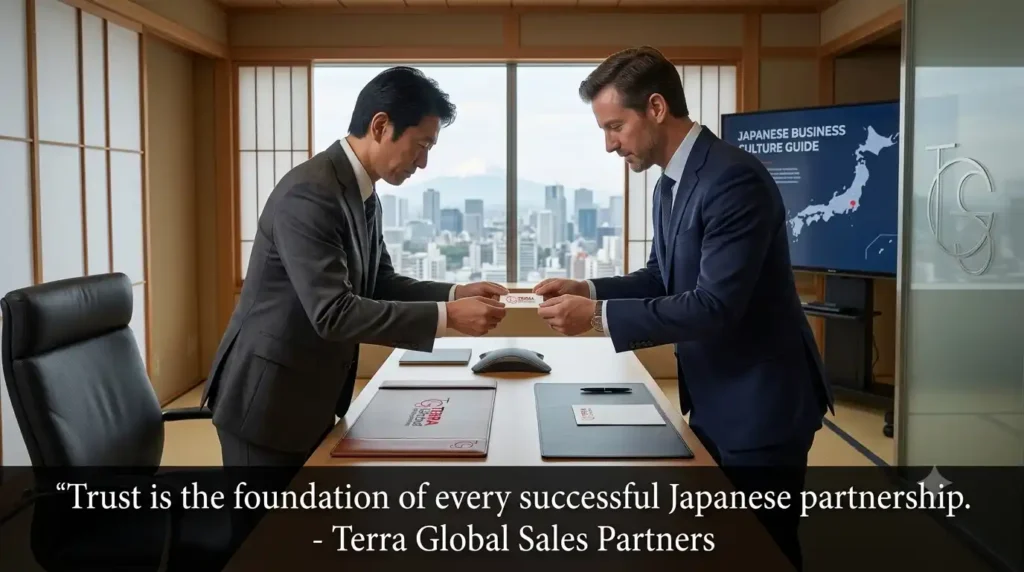
Cultural Intelligence in Japanese B2B Trade
| Metric | Data / Insight |
| Failed B2B negotiations due to cultural gaps | Over 70% globally |
| Average relationship-building period before deal | 3 to 6 months |
| Japan global export ranking | Top 5 worldwide |
| Japanese food & beverage export growth (2023-2025) | +18% year-on-year |
| Japanese cosmetics export value (2024) | USD 5.3 billion |
| International buyers preferring a local Japan agent | 82% in B2B surveys |
Industry-Specific Cultural Norms in Japan
Different industries in Japan carry their own cultural expectations. Here is what international buyers should know across key sectors that Terra Global Sales Partners covers.
Food and Beverage Imports
Japanese food producers take immense pride in quality. When sourcing products like Daisho teriyaki sauce 1.25kg or authentic Japanese eel sauce, buyers must demonstrate respect for the product’s heritage. Do not push for lower-grade alternatives. Japanese producers will often decline rather than compromise quality. Our team sources from trusted brands like Daisho, Mizkan, Takara, and Koiwai Farm, brands that carry decades of manufacturing integrity.
Explore our Daisho Teriyaki Sauce 1.25kg product page to see one of our most popular wholesale food items.
Agriculture and Farm Equipment
When buying Japanese agricultural machinery import or Kubota Yanmar tractor wholesale export products, relationships with dealers matter as much as price. Japanese agriculture brands value buyers who show long-term interest and respect for equipment maintenance standards. Visit our agriculture category page to see what we currently offer.
Construction and Building Equipment
The Japanese building equipment wholesale and Komatsu Hitachi Kobelco wholesale export sector operates through highly structured procurement channels. These companies favour buyers with verified business credentials and proper import licences. We handle full compliance verification for all clients. Browse our building equipment category.
Cosmetics and Beauty
The Japanese cosmetics wholesale supplier industry is built on brand trust and ingredient authenticity. Shiseido Hada Labo wholesale and similar brands operate under strict distribution agreements. Our access to verified wholesale channels ensures you receive authentic, compliant products every time. Visit our cosmetics category page.
Construction Materials
For Japanese construction materials wholesale and Japanese steel materials wholesale, precision specs are critical. Japanese manufacturers expect buyers to provide exact technical requirements. Our team compiles precise product briefs for every materials enquiry. See our full range at our construction materials category page.
Pros and Cons of Doing Business in Japan
Advantages and Challenges of the Japanese Market
| Pros | Cons |
| World-class product quality | Long relationship-building period required |
| Highly reliable delivery timelines | Complex language and communication barriers |
| Strong IP protection and legal standards | High initial cost of supplier visits |
| Trusted global brand recognition | Conservative approach to new buyers |
| Wide product range across all industries | Indirect communication style can confuse buyers |
| Stable long-term partnerships | Cultural mistakes can end relationships permanently |
The cons listed above are exactly why buyers work with Terra Global Sales Partners. We eliminate each of these challenges through our expert local team, verified supplier network, and cultural fluency. To understand quality benchmarks better, read our blog on Quality Control Standards in Japan: What Global Buyers Must Know.
How Terra Global Sales Partners Makes Japanese Business Easy?
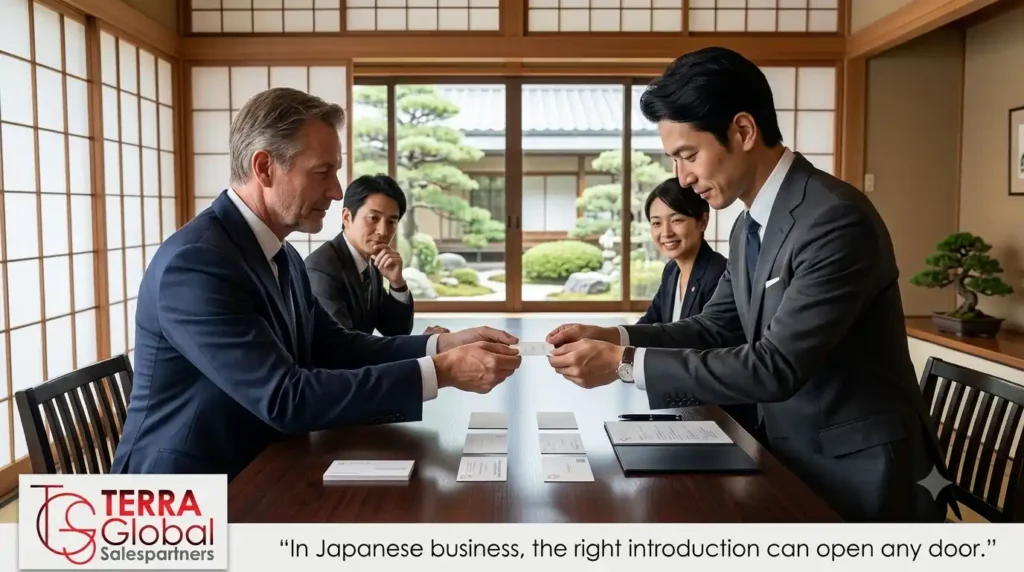
We do not just share knowledge about japanese business culture. We apply it every day. Our team operates from Japan. We speak the language. We understand the customs. And we have spent years building supplier relationships that our clients can immediately access.
Here is how we deliver results:
● Supplier Sourcing: We find verified, high-quality Japanese suppliers matched to your exact product requirements.
● Cultural Mediation: We represent you with full cultural competency, preventing costly misunderstandings.
● Product Negotiation: We negotiate prices, MOQs, and terms using cultural knowledge that gets better outcomes.
● Logistics Support: From factory to port, we coordinate shipping, documentation, and customs compliance.
● Quality Inspection: Every shipment is inspected before departure to our standards and yours.
For buyers wanting to understand the full import process, our blog on Customs Clearance in Japan: Your Complete Importer Guide is essential reading.
Our service covers all major product categories: food and beverage, Japanese cosmetics wholesale supplier products, used Japanese agricultural equipment, Japanese building equipment wholesale, and more. Whatever you need from Japan, we source it with precision.
Negotiation Tactics Unique to Japanese Business Culture
Negotiating in Japan is nothing like negotiating in Western markets. Japanese business culture places long-term harmony above short-term gains. Use these tactics to succeed.
● Start with high respect, not high demands. Your first meeting should never open with aggressive price negotiations.
● Show you are a serious, long-term buyer. Share your business history, growth plans, and import capacity.
● Allow time. Do not set artificial deadlines. They signal bad faith.
● Use written summaries after each meeting. This keeps expectations aligned and shows professionalism.
● Offer reasonable concessions. Aggressive bargaining damages trust. Small, gracious concessions work better.
Terra Global Sales Partners leads all negotiations for our clients. We know when to speak, when to wait, and when to push gently. Our approach consistently delivers better prices and terms than buyers achieve alone.
Seasonal and Ceremonial Awareness in Japanese Business
Understanding Japan’s business calendar is an underrated part of doing business in japan. Key periods affect supplier availability and communication pace.
Key Japanese Business Calendar Periods
| Period | Dates | Business Impact |
| Golden Week | Late April to Early May | Most factories and offices are closed |
| Obon Festival | Mid-August | Reduced operations, minimal communication |
| Year-End (Nenmatsu) | Late December | Invoices settled, budget cycles reset |
| New Year (Shogatsu) | January 1 to 7 | Offices fully closed |
| Spring Fiscal Start | April 1 | New budgets approved, ideal time for proposals |
Our team alerts clients to these periods in advance. We schedule negotiations and shipments around the calendar to prevent delays. This proactive planning is part of the service standard at Terra Global Sales Partners.
Product Spotlight: The Quality That Defines Japanese Exports
When buyers understand japanese business culture, they also understand why Japanese products command premium respect worldwide. Here are key products we source for global buyers:
● Koiwai Farm Spread Cheese 90g, Premium Japanese dairy loved for its smooth texture and clean flavour. Perfect for gourmet retailers. See the product page.
● Koiwai Farm Hors d’Oeuvre Cheese Yonezawa Salami 42g, A refined Japanese cheese and salami snack ideal for specialty food importers. View the product listing.
● Takara Hon Mirin 1L, JAS-certified cooking mirin used in professional kitchens globally. Explore the product page.
● Daisho Sukiyaki Sauce 600g, Authentic Japanese hot pot sauce for restaurants and retailers. View the product page.
● Mizkan Cooking Sake 400ml, A staple ingredient for Japanese cuisine, ideal for food importers. See the listing.
● Daisho Yuzu BBQ Sauce 185g, A standout gourmet product for specialty food retailers. Browse the product page.
● Daisho Grilled Eel Sauce 240g, Authentic kabayaki sauce loved by Japanese restaurant suppliers worldwide. See the product listing.
● Daisho Mentsuyu Yuzu Noodle Dipping Sauce 185g, A premium citrus noodle sauce for restaurant and retail buyers. Explore the product page.
Every product we carry reflects the quality standards that japanese business culture demands. We work only with reputable manufacturers whose products meet global import standards.
Why International Buyers Choose Terra Global Sales Partners?
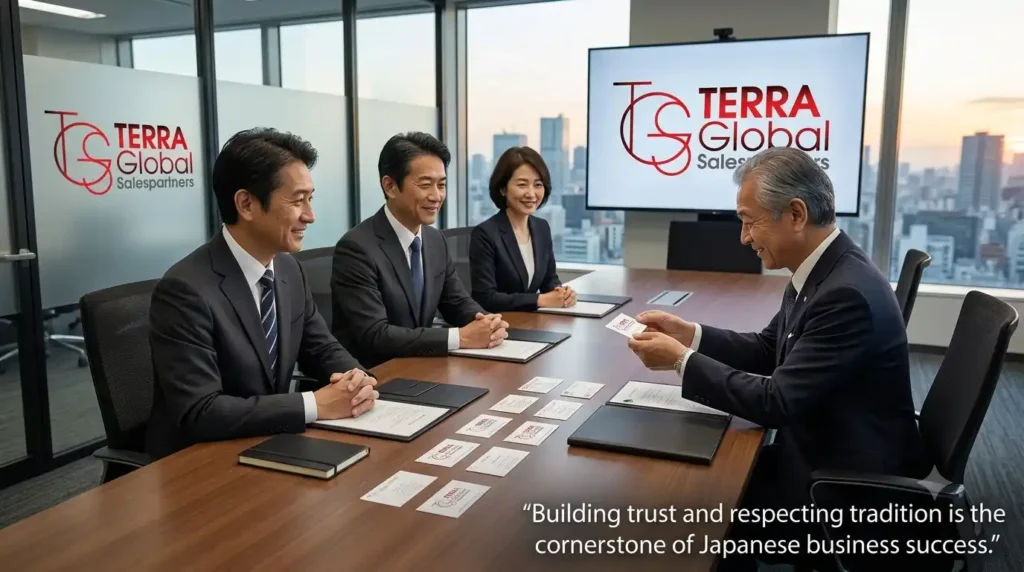
We are not a generic trading company. We are cultural specialists and product sourcing experts built specifically for international buyers who want access to the best of Japan.
Our Service Advantage at a Glance
| Feature | What It Means for You |
| Japan-based team | Real-time supplier access and on-the-ground support |
| Verified supplier network | No risk of scams or substandard products |
| Cultural fluency | Negotiations handled with precision and respect |
| Multi-industry coverage | Food, cosmetics, agriculture, construction, and more |
| Logistics coordination | Seamless door-to-port management |
| Quality inspection service | Every shipment checked before departure |
| Regulatory compliance support | We handle documentation and customs requirements |
We also help clients understand how to reduce import costs. Read our practical guide: How to Reduce Import Costs When Buying from Japan.
Buyers looking to grow their e-commerce business with Japanese products will also benefit from reading our guide: Increase E-commerce Profit with Japanese Products.
Conclusion
Mastering japanese business culture unlocks one of the world’s most reliable and high-quality trading markets. It requires patience, preparation, and a deep respect for Japanese values. But the rewards, superior products, stable partnerships, and global brand credibility, make every effort worthwhile.
Terra Global Sales Partners is your expert guide through every dimension of japanese business culture. From sourcing Japanese agriculture products wholesale to negotiating with leading cosmetics brands, we bring the knowledge, relationships, and execution that global buyers need. We do not just tell you how doing business in japan works, we do it for you.
Contact us today to start your Japan sourcing journey with a partner that knows every rule of the game.
Frequently Asked Questions
1. What is the most important rule in japanese business culture for foreign buyers?
Respect for hierarchy and relationship building are most critical. Japanese suppliers prioritise trust over quick transactions. Never rush a deal or skip the relationship-building stage. Terra Global Sales Partners guides you through every stage.
2. How long does it take to do business in japan as a foreigner before closing a deal?
It typically takes three to six months of relationship-building before a Japanese supplier commits to a formal deal. Working with Terra Global Sales Partners can significantly shorten this timeline through established supplier trust.
3. Is japanese business etiquette for foreigners difficult to learn?
The basics can be learned quickly, but deep cultural fluency takes years. Working with a Japan-based partner like Terra Global Sales Partners removes this burden entirely, allowing buyers to focus on growth instead.
4. Can Terra Global Sales Partners source products across multiple categories?
Yes. We source across food and beverage, cosmetics, agriculture, construction materials, building equipment, and wood supplies. Our verified supplier network spans all major Japanese export industries.
5. What is the best way to approach a Japanese supplier for the first time?
Always approach through a warm introduction. Prepare formal materials, dress professionally, and let the supplier lead the pace. Using a local partner like Terra Global Sales Partners ensures your first impression is strong and culturally correct.