

Wholesale Buying & Importing from Japan & Complete Risk-Reduction Guide (2026 Update)
Summery
- Yes, Japan is one of the safest countries for wholesale sourcing due to strict quality control and regulatory compliance.
- Importing requires commercial invoice, packing list, bill of lading, HS code classification, and customs documentation.
- Shipping from Japan typically takes 3–14 days (air) and 20–40 days (sea).
- The safest way to source is through verified suppliers or an Importer of Record (IOR).
- Risk reduction depends on supplier verification, contract clarity, and compliance management.
Is Japan Good for Wholesale Buying?
Yes, Japan is good for wholesale buying because it offers high product quality, strict manufacturing standards, reliable logistics infrastructure, and transparent business regulations. For B2B buyers, Japan means consistency, compliance, and long-term supplier stability.
Why Do Global Buyers Prefer Japan for Wholesale?
Japan offers reliability, quality control, and strong regulatory systems that reduce sourcing risk for international buyers.
Japan is globally recognized for:
- Precision manufacturing
- Advanced quality control systems
- Ethical supplier practices
- Stable trade environment
When businesses source from Japan, they are not just buying products, they are buying process discipline and quality assurance.
Advantages of Wholesale Buying from Japan
| Factor | Japan Advantage | Why It Matters |
| Quality Control | Strict QC standards | Fewer defects & returns |
| Compliance | Clear export laws | Lower customs risk |
| Infrastructure | Advanced ports & airports | Faster shipping |
| Supplier Stability | Long-term business culture | Predictable partnerships |
Japan reduces uncertainty, which is critical for scaling import businesses.
Entity-Based Insight
When importing from Japan, buyers often interact with:
- Japan Customs
- HS Code classification systems
- Incoterms (FOB, CIF, DDP)
- Certificate of Origin documentation
Using correct classification and documentation prevents shipment delays and penalties.
What Makes Japan Different from Other Sourcing Countries?
Japan prioritizes precision and compliance over cost-cutting, making it ideal for premium, regulated, and long-term wholesale operations.
Unlike low-cost sourcing markets, Japan focuses on:
- Engineering accuracy
- Consistent material standards
- Transparent supplier documentation
- IP protection
This makes Japan especially attractive for:
- Health & wellness products
- Automotive parts
- Electronics
- Premium consumer goods
Japan is good for wholesale buying because it minimizes product defects, reduces compliance errors, and ensures predictable logistics timelines. For businesses prioritizing brand reputation, Japan offers safer scaling.
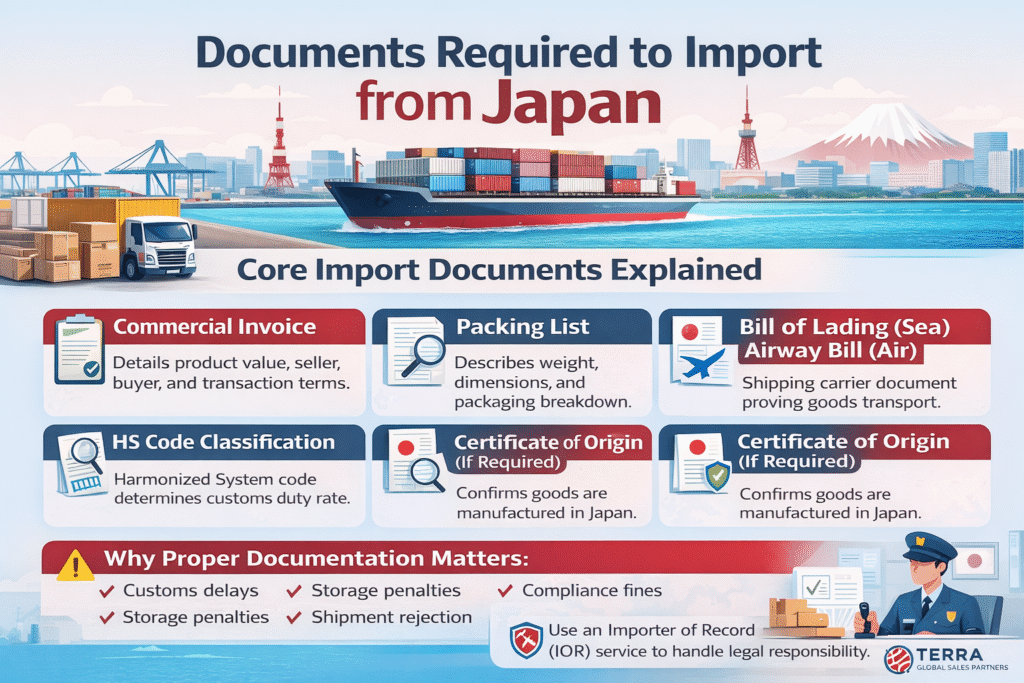
What Documents Are Needed to Import from Japan?
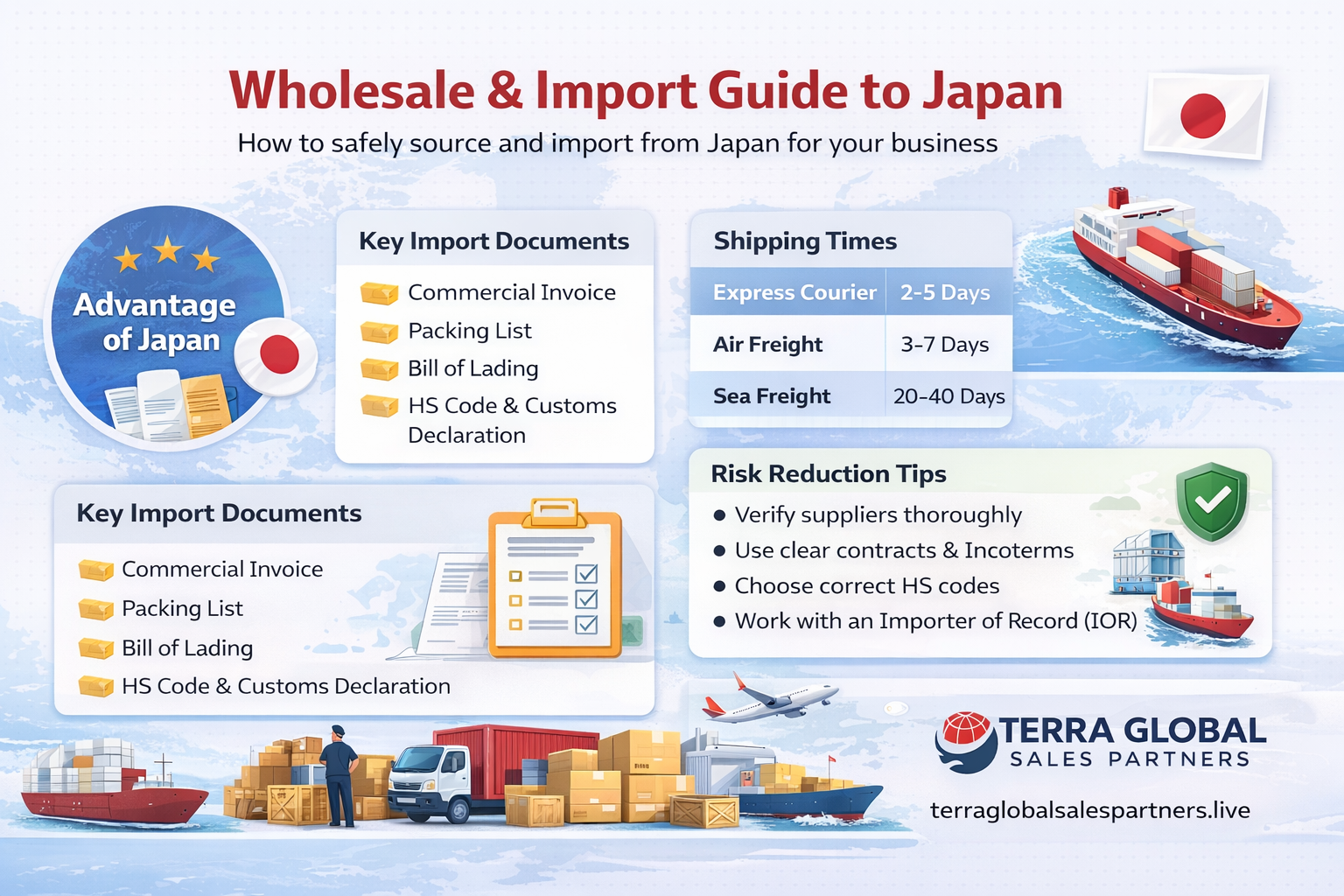
To import from Japan, you need a commercial invoice, packing list, bill of lading or airway bill, HS code classification, and customs declaration forms.
Core Import Documents Explained
- Commercial Invoice, Details product value, seller, buyer, and transaction terms.
- Packing List, Describes weight, dimensions, and packaging breakdown.
- Bill of Lading (Sea) / Airway Bill (Air), Shipping carrier document proving goods transport.
- HS Code Classification, Harmonized System code determines customs duty rate.
- Certificate of Origin (If Required), Confirms goods are manufactured in Japan.
- Import License (Country Specific), Required for regulated categories.
Why Proper Documentation Matters?
Incorrect paperwork can result in:
- Customs delays
- Storage penalties
- Shipment rejection
- Compliance fines
This is why many global buyers use an Importer of Record (IOR) service to handle legal responsibility.
How Long Does Shipping from Japan Take?
Shipping from Japan typically takes 3–7 days by air freight and 20–40 days by sea freight, depending on destination country, customs clearance speed, port congestion, and chosen Incoterms. Express courier options can deliver in 2–5 days for small commercial shipments.
Shipping Time by Method
| Shipping Method | Average Transit Time | Best For | Cost Level |
| Express Courier (DHL/FedEx) | 2–5 days | Samples, small urgent orders | High |
| Air Freight | 3–7 days | Medium-value, time-sensitive goods | Medium-High |
| Sea Freight (FCL/LCL) | 20–40 days | Bulk wholesale shipments | Low |
Air freight is faster but expensive; sea freight is economical but slower for bulk wholesale shipments.
What Affects Shipping Duration?
Shipping timelines from Japan are influenced by:
- Port congestion (Tokyo, Yokohama, Osaka)
- Customs clearance efficiency
- Documentation accuracy
- Seasonal demand (Golden Week, year-end peak)
- Incoterms (FOB, CIF, DDP)
For example, under FOB (Free On Board) terms, buyers manage freight, which may affect coordination speed. Under DDP (Delivered Duty Paid), logistics and duties are pre-managed, reducing uncertainty.
Shipping time is predictable when documentation and logistics are professionally handled.
What Is the Safest Way to Source from Japan?
The safest way to source from Japan is through verified suppliers, structured contracts, third-party inspections, and a professional sourcing partner that manages compliance and quality control.
1. Work with Verified Supplier Networks
Japan has strong supplier standards, but verification is still necessary.
Safe sourcing includes:
- Company registration validation
- Factory audits
- Sample testing
- Business credit checks
Professional sourcing partners maintain established supplier networks, reducing trial-and-error risks.
2. Use Clear Contracts & Incoterms
Every wholesale deal should clearly define:
- Product specifications
- Payment terms
- Delivery schedule
- Dispute resolution
- Incoterm responsibility
Ambiguity creates risk. Structured agreements reduce miscommunication.
3. Conduct Quality Inspection Before Shipment
Even in Japan’s high-quality environment, inspection ensures:
- Product matches agreed specs
- Packaging integrity
- Labeling compliance
- Quantity accuracy
Pre-shipment inspection avoids costly return logistics.
4. Use an Importer of Record (IOR)
An Importer of Record legally assumes responsibility for:
- Customs clearance
- Duty payment
- Regulatory compliance
- Documentation accuracy
This significantly reduces legal exposure for foreign buyers.
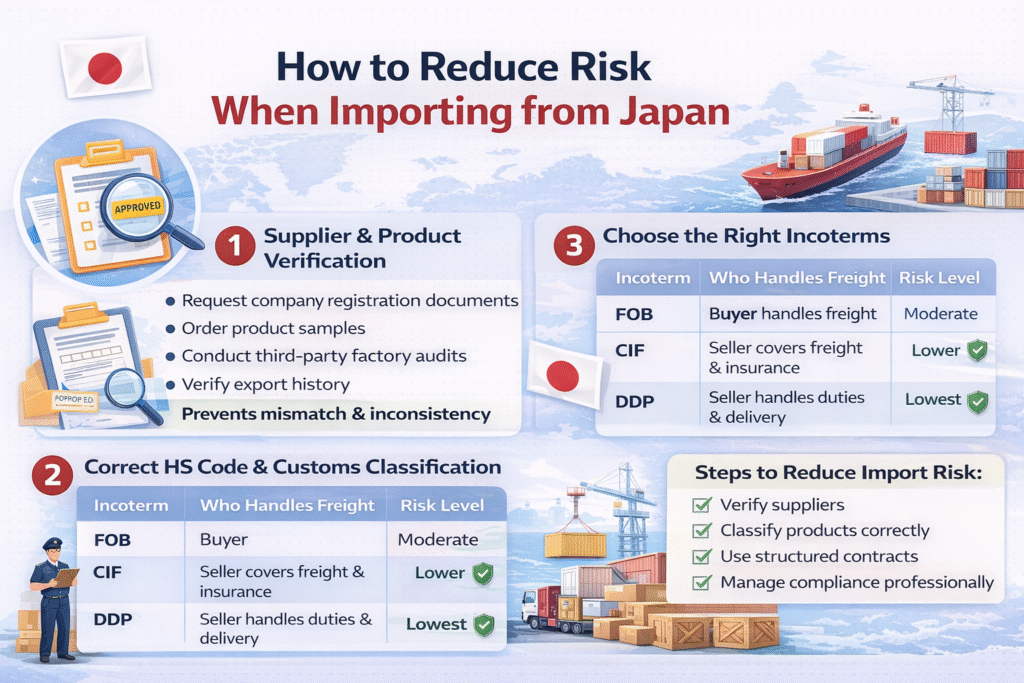
How to Reduce Risk When Importing from Japan?
You can reduce risk when importing from Japan by verifying suppliers, using clear contracts and Incoterms, ensuring accurate HS code classification, managing customs compliance through an Importer of Record, and conducting pre-shipment inspections to prevent financial, legal, and quality-related issues.
Supplier & Product Verification
Validate company registration, inspect samples, and confirm manufacturing capability before placing large wholesale orders. Risk reduction starts before payment. Best practices:
- Request company registration documents
- Order product samples
- Conduct third-party factory audits
- Verify export history
This prevents supplier mismatch and quality inconsistency.
Correct HS Code & Customs Classification
Incorrect HS codes increase duties, delay customs clearance, and may trigger compliance penalties. The Harmonized System (HS) code determines:
- Import duty rate
- Regulatory requirements
- Required certifications
Misclassification is one of the most common import risks. Proper tariff classification protects profit margins.
Choose the Right Incoterms
| Incoterm | Who Handles Freight | Risk Level |
| FOB | Buyer | Moderate |
| CIF | Seller covers freight & insurance | Lower |
| DDP | Seller handles duties & delivery | Lowest |
DDP offers maximum simplicity, while FOB provides control but requires experienced logistics management. Selecting the correct Incoterm aligns responsibility and reduces unexpected costs.
Payment Risk Management
Safer payment options include:
- Letter of Credit (LC)
- Escrow services
- Staged milestone payments
Avoid paying 100% upfront without inspection safeguards.
Work with an Importer of Record (IOR)
An Importer of Record assumes legal responsibility for:
- Customs documentation
- Duty compliance
- Regulatory clearance
- Product legality
This minimizes legal exposure for international buyers unfamiliar with Japanese export regulations. To reduce risk when importing from Japan:
- Verify suppliers
- Classify products correctly
- Use structured contracts
- Choose safe payment terms
- Manage compliance professionally
Here’s what matters: structure reduces uncertainty.
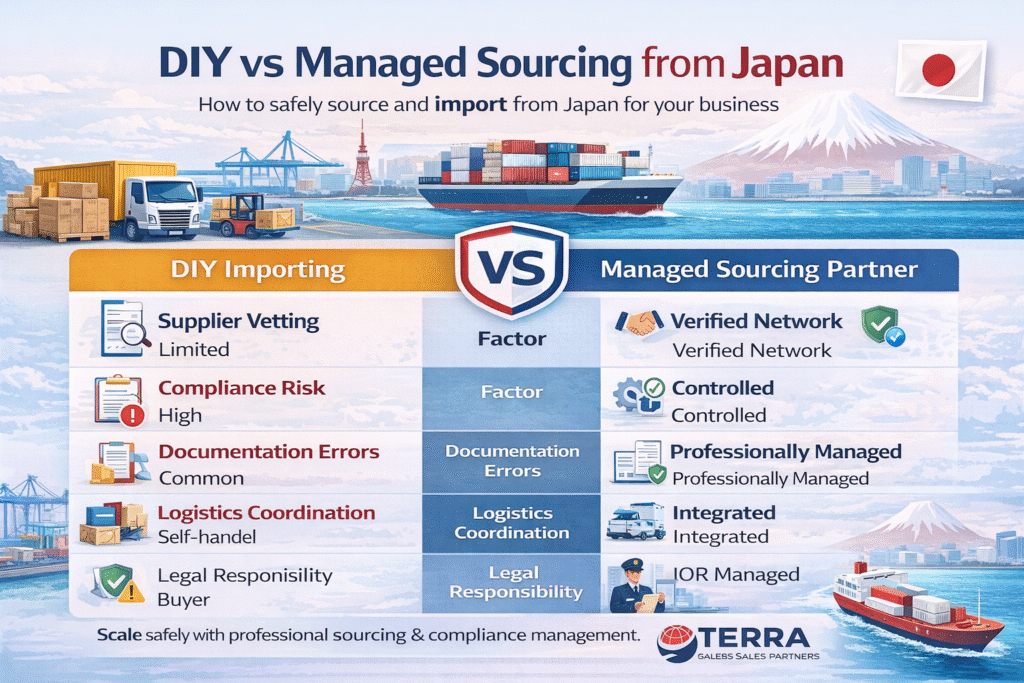
DIY vs Managed Sourcing
| Factor | DIY Importing | Managed Sourcing Partner |
| Supplier Vetting | Limited | Verified Network |
| Compliance Risk | High | Controlled |
| Documentation Errors | Common | Professionally Managed |
| Logistics Coordination | Self-handled | Integrated |
| Legal Responsibility | Buyer | IOR Managed |
Bottom line: Professional sourcing reduces operational and legal risk while improving scalability.
Final Takeaway
Japan is one of the safest and most structured wholesale sourcing markets globally. However, safety depends not just on the country, but on execution.
With correct documentation, supplier verification, structured Incoterms, and compliance management, importing from Japan becomes predictable and scalable.
For businesses seeking long-term stability and premium product standards, Japan offers a strong foundation, and professional sourcing support turns that opportunity into sustainable growth.
FAQs
1. Is Japan expensive for wholesale buying?
Japan may have higher unit costs than low-cost markets, but quality consistency reduces defect losses and long-term replacement costs.
2. What is the safest payment method when importing from Japan?
Letters of Credit and milestone-based payments are considered safest because they protect both buyer and supplier.
3. Do I need an import license to buy wholesale from Japan?
It depends on your country and product category. Regulated goods often require import permits and certifications.
4. How can beginners safely source from Japan?
Beginners should work with verified sourcing partners, request samples, and ensure documentation accuracy before scaling orders.
5. Can a sourcing partner reduce customs risk?
Yes. A sourcing partner or Importer of Record ensures compliance, correct documentation, and smooth customs clearance.
Looking to source from Japan safely? Contact Terra Global Salespartners for structured wholesale and import support.