
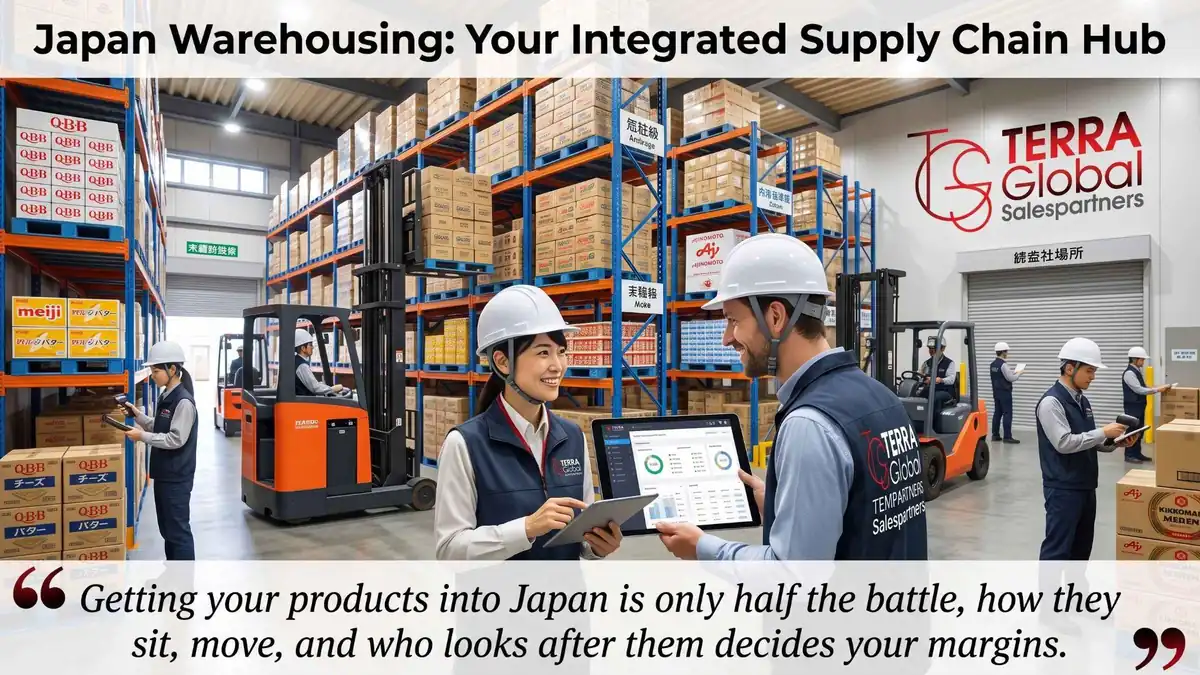
Getting your products into and out of Japan is only half the battle, where they sit, how they move, and who looks after them in between decides your margins. Japan warehousing gives importers a compliant, efficient home base within Japan for storage and delivery, from pallet-in receiving to final shipment. Whether you sell food, beauty, or machinery, careful planning around warehouse operations is what separates smooth market entry from expensive improvisation.
This guide breaks down what Japan warehousing costs, which options fit which cargo, and what to demand from a provider. Terra Global Sales Partners handles warehousing in Japan as part of its end-to-end sourcing service, storage management, cargo handling, customs clearance, and international shipping under one roof, so you deal with one accountable partner instead of five vendors.
How Warehousing in Japan Fits Your Logistics Strategy
A warehouse is not just a box with shelves; it is the control point of your supply chain. In Japan, where operational standards run high and delivery windows run tight, your logistics operations live or die on what happens inside the four walls: receiving, put-away, inventory management, pick-and-pack, and dispatch. Get Japan warehousing right and every downstream step, from cross-border documentation to last-mile courier handoff, gets cheaper and faster.
Start with your go-to-market plan. Are you feeding e-commerce orders daily, supplying retailers on weekly cycles, or staging seasonal inventory? Your market approach dictates the warehouse footprint: a fulfillment-oriented site near Tokyo or Osaka for speed, or a lower-cost regional site for bulk staging. Market research on where your buyers actually are should drive the decision, Japanese consumers expect fast, flawless delivery, and logistics services built around that expectation win repeat orders.
Related: Japan 3PL Services: How Third-Party Logistics Works for Global Importers · Acecook Super Cup 1.5x Tonkotsu Ramen 111g
Warehouse Options in Japan: What Companies in Japan Actually Use
Companies in Japan choose from several distinct warehouse formats, and picking wrong is an expensive lesson. Ambient dry warehouses suit shelf-stable FMCG, think instant noodles, sauces, and confectionery. Bonded warehouses let you defer duties until goods clear customs, a classic cost-effective move for high-value imports. Refrigerated and frozen sites handle dairy, fresh food, and pharmaceutical products under strict regulations.
Location matters as much as format. The Kanto region (Tokyo/Yokohama) offers density and port access; Kansai (Osaka/Kobe) often prices lower with excellent west-Japan coverage. Japan warehousing providers in either hub can serve nationwide distribution, but local partners with regional networks cut transit times to your actual buyers. For importers entering the Japanese market, a provider that already serves key industries, food, beauty, electronics, brings proven workflow templates instead of guesswork.
| Warehouse type | Best for | Watch out for |
|---|---|---|
| Ambient dry storage | Shelf-stable FMCG, general goods | Humidity control in summer |
| Bonded warehouse | Duty deferral, re-export | Customs paperwork discipline |
| Temperature-controlled | Dairy, fresh food, pharma | Higher per-pallet rates |
| Fulfillment center | E-commerce pick-and-pack | Per-order fees add up fast |
Japan warehousing works best when the format matches the cargo: store chilled goods like Meiji Hokkaido butter only in temperature-controlled space, and keep ambient lines like jams and noodles in dry storage to avoid paying for cooling you do not need.
Related: Quality Control Standards in Japan: What Global Buyers Must Know · Meiji Hokkaido Butter 200g
Warehouse Management Systems, The Engine Behind Modern Logistics
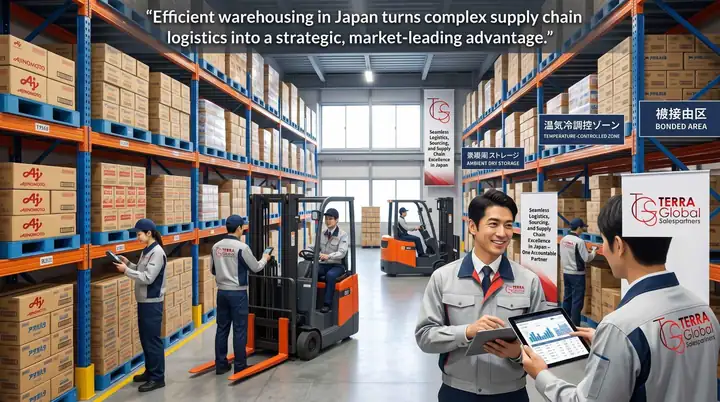
The difference between a shed and a strategic asset is the warehouse management layer. A modern management system, a warehouse management system (WMS), tracks every unit from inbound receipt to outbound shipment, and Japan offers some of the most advanced deployments in Asia. Look for cloud-based platforms with real-time inventory systems, barcode or RFID scanning, and automation for put-away and picking.
AI-powered forecasting is a growing emphasis among top-tier logistics providers, it predicts stock levels, flags slow movers, and helps you optimize reorder points so capital is not trapped on shelves. When you leverage these management solutions, managing warehouse space across two regions feels like running one. Ask any Japan warehousing provider for a live demo of their inventory management dashboard before you sign, if they cannot show you your stock in real time, walk away. A warehouse management system is the backbone of accountable logistics operations.
Related: Most Profitable Japanese Products to Import in 2026 Ajinomoto Hondashi Japanese Dashi Stock 1kg
Freight In, Shipment Out, Connecting Air Freight and Ocean Freight to Your Warehouse
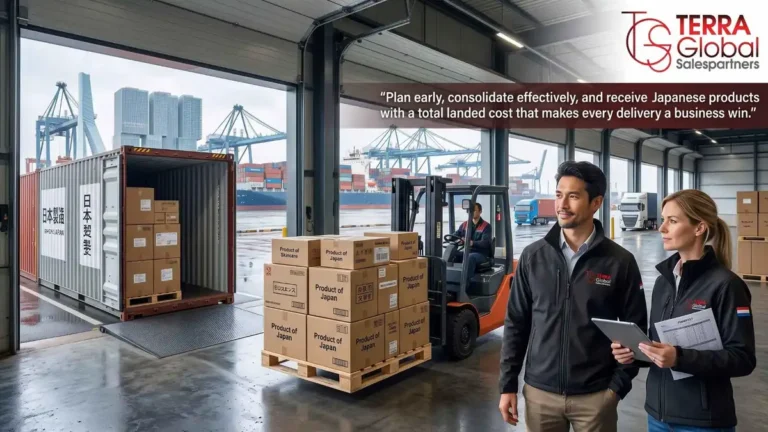
Your warehouse is only as good as the freight feeding it. Air freight buys speed for launches and urgent restocks; ocean freight buys economy for planned, high-volume replenishment. Smart importers run both: sea for the baseline, air for the buffer. Either way, the handoff from port or airport to warehouse receiving, drayage, deconsolidation, inspection, is where delays hide, so confirm your provider controls that leg.
Japan warehousing providers worth their fees coordinate inbound freight and outbound shipment as one motion: containers de-stuffed, pallets checked against the packing list, and goods system-received the same day. Global trade runs on rhythm, and a provider that syncs logistics services with your sales calendar prevents both stockouts and overstock. Pair this with a clear returns workflow, e-commerce returns in Japan are low, but they still need to navigate inspection, restock, or disposal decisions quickly.
Japan warehousing also simplifies cross-border complexity when one partner owns the chain end to end. Terra’s team, for example, moves goods from supplier pickup through freight forwarding, customs, warehousing, and final delivery, reading how air freight vs sea freight trade-offs play out in practice.
Related: Global Shipping from Japan: Air Freight vs Sea Freight Aohata Spoon-Free Strawberry Jam 165g
What Warehousing in Japan Costs, and How to Keep Operational Costs Down?
Japan warehousing pricing typically combines storage fees (per pallet or per square meter), inbound/outbound handling, and value-added services like labeling or kitting. Operational costs run higher than in Southeast Asia, labor, land, and energy all cost more, but the trade-off is reliability: fewer errors, fewer losses, and quality control baked into daily routines. Budget for forklift moves, palletizing, and system transactions, not just the rack space.
Control costs with readiness: forecast demand before you ship, consolidate inbound loads, and negotiate tiered rates as volume grows. Storing slow-moving bulk lines, like foodservice-size Daisho teriyaki sauce, in economical regional space while keeping fast movers near the port is classic cost-effective planning. A good Japan warehousing partner shows you the full fee schedule upfront and helps you optimize the mix, so there are no surprise line items at month-end.
| Cost component | What drives it | How to control it |
|---|---|---|
| Storage (per pallet) | Location, temperature zone | Match format to cargo; go regional for bulk |
| Inbound handling | Pallet count, inspection level | Consolidate shipments, pre-label cartons |
| Outbound/pick-pack | Order volume, complexity | Forecast; simplify packaging |
| Value-added services | Labeling, kitting, QC checks | Bundle with a full-service partner |
Related: How to Reduce Import Costs When Buying from Japan Daisho Teriyaki Sauce 1.25kg
Related Categories of Logistics, Storage, Cargo Handling, and 3PL Services
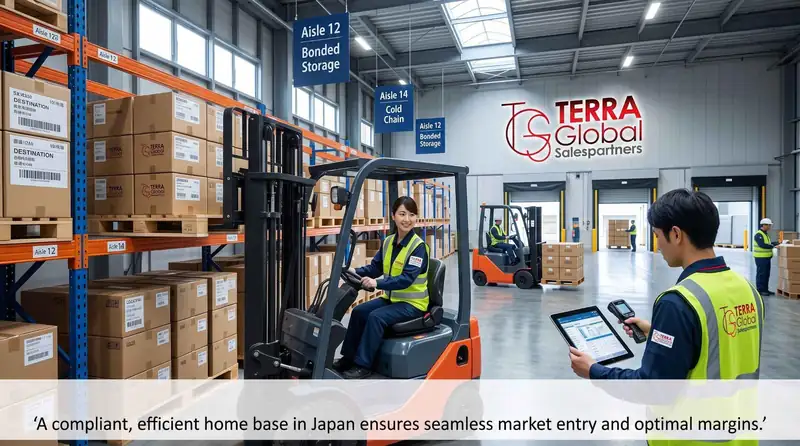
Warehousing sits inside broader related categories of logistics, transport, cargo handling, customs brokerage, and distribution, and the handoffs between them create most logistics challenges. A 3PL (third-party logistics) provider that owns several of these categories removes the finger-pointing: one contract covers receiving, storage management, cargo handling, and dispatch. That integration is the core of real supply chain optimization.
When you evaluate providers, map every touchpoint your goods will cross and ask who owns each one. Gaps between a forwarder, a warehouse, and a courier are where cartons go missing. Japan warehousing works hardest for you inside a bundled 3PL relationship, where the same team that clears your goods also stores and ships them, fewer handoffs, fewer errors, faster answers when something needs attention. Compare forwarders carefully before you commit.
Related: How to Choose a Freight Forwarder in Japan: 7 Things to Check First Ajinomoto Pure Select Mayonnaise 400g
Localization and Customer Support, What B2B Buyers Should Expect?
Localization is not translation, it is adapting your logistics to how Japan actually works. Documentation formats, labeling rules, delivery appointment systems, and returns handling all follow local business norms. Strong customer support means a bilingual team that bridges those norms for you: they explain business etiquette (why the delivery slot matters), translate business practices (why the invoice looks different), and tailor customization to your specific needs as a B2B buyer.
For Japan warehousing, expect your provider to act as your local eyes and ears: confirming deliveries with carriers, resolving receiving discrepancies in Japanese, and escalating issues before they become claims. This localization layer is where many foreign importers stumble, not on strategy, but on a hundred small frictions. A partner like Terra Global Sales Partners, built around B2B importers, absorbs that friction so your team focuses on selling. Even small comforts matter: properly stored goods, from pantry staples to Aohata Verde melonpan-style toast spread, arrive in retail-ready condition because someone local cared about the details.
Related: Japanese Business Culture: What International Buyers Must Know, Aohata Verde Melonpan-Style Toast Spread 100g
Workflow, Data Protection, and Compliance Requirements in Japanese Warehouses
Every warehouse runs on workflow, the documented sequence from dock to dispatch, and the best Japan warehousing partners run the tightest versions in the industry. Ask to see the standard operating procedures for receiving, put-away, cycle counts, and dispatch, plus how exceptions get handled. Quality control checkpoints at receiving catch supplier mistakes before they enter your inventory systems, which is far cheaper than catching them at the customer’s door.
Compliance requirements deserve equal scrutiny. Japan enforces strict regulations on food, alcohol, cosmetics, and pharmaceutical goods, and your provider must understand the regulatory landscape for your category, permits, labeling, lot traceability, and recall procedures. Data protection matters too: your inventory systems feed may carry customer data, so confirm access controls and retention policies meet both Japanese law and your own regulatory standards. Alcohol importers face layered rules, so regulatory compliance is non-negotiable for products like Kikkoman Manjo rich aged mirin: licensed storage, correct documentation, and lot-level traceability. Your provider should track changing regulatory requirements for your category and alert you before new rules take effect. Providers who help you navigate the complexities of permits and inspections, matched to your specific requirements, earn their keep many times over. Learn the logistics fundamentals so you can audit any provider’s claims with confidence.
Related: Customs Clearance in Japan: Your Complete Importer Guide Kikkoman Manjo Rich Aged Mirin 300ml
Temperature-Controlled and Bonded Storage for Special Cargo
Some cargo cannot live in a dry room. Temperature-controlled warehouses hold chilled and frozen goods within tight bands, dairy, fresh foods, and healthcare services products like pharmaceutical supplies, with backup power and continuous monitoring. For importers of Japanese food, this is non-negotiable: a Camembert that warms in transit is a write-off, which is why items like QBB 6P Camembert cheese move only through certified cold-chain warehouse space.
The best cold-chain provider offers specialized programs with lot traceability and FEFO (first-expired, first-out) rotation. There is also a growing emphasis on sustainable logistics: energy-efficient refrigeration, solar-assisted sites, and green logistics routing that cut both emissions and power bills. Ask for temperature logs with every outbound shipment, a provider confident in its cold chain will share them proudly. The warehouse as a concept has evolved far beyond simple storage, and Japan’s cold-chain sites prove it.
Related: Why Japanese FMCG Products Lead in Global Markets QBB 6P Camembert Cheese 90g
Why Outsource Warehousing to Terra Global Sales Partners?
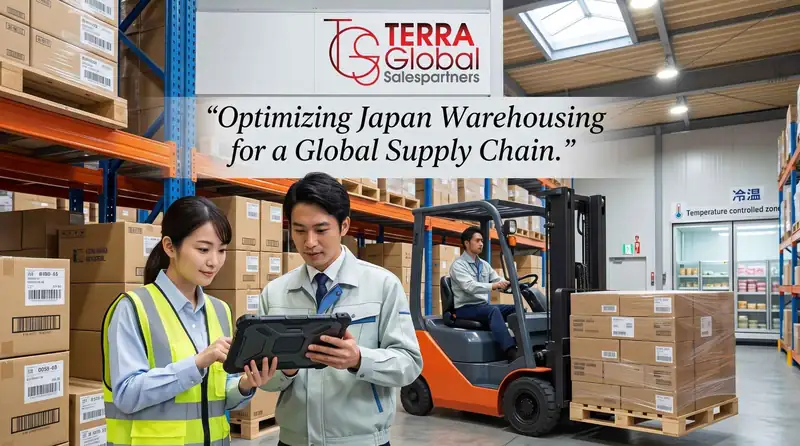
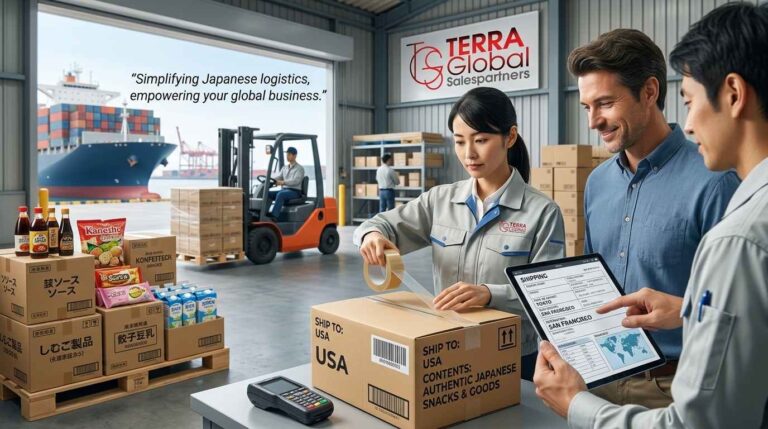
Running your own warehouse in Japan means leases, labor contracts, systems, and licenses, a heavy lift before your first sale. To outsource is to convert all of that into one predictable monthly invoice while specialists handle the complexity. Japan warehousing through Terra Global Sales Partners goes further: you get comprehensive solutions spanning sourcing, quality control, customs, storage, and international shipping, with bilingual local support at every step.
| Approach | Pros | Cons |
|---|---|---|
| In-house warehouse | Full control, brand immersion | High fixed cost, hiring burden, slow setup |
| Outsourced 3PL | Fast market entry, scalable, expert workflow | Less day-to-day control |
| Terra end-to-end | Sourcing + warehousing + shipping in one partner | — |
Terra’s team already moves the products you want to sell, from everyday snacks like Asahi Ippon Manzoku protein bars to regulated goods, so your inventory arrives at the warehouse retail-ready. One partner, one dashboard, one accountable team: that is what supply chain peace of mind looks like. See supply chain thinking applied to real Japan trade operations.
Related: Why Terra Global Sales Partners Is a Trusted Trading Partner in Japan Asahi Ippon Manzoku Bar Protein Chocolate 39g
Conclusion
Japan warehousing done well turns logistics from a cost center into a competitive edge: the right format, the right location, tight warehouse management, and a provider who owns the details. Japan warehousing through Terra Global Sales Partners bundles all of it, storage, compliance, and shipping, into comprehensive solutions built for importers entering the Japanese market. Start with a clear go-to-market plan, choose a partner with proven workflow and real local support, and your supply chain will carry you instead of slowing you down.
Planning storage for your goods in Japan? See our warehousing in Japan service or request a warehousing quote from Terra Global Salespartners.
FAQs
How much does warehousing in Japan cost?
Storage runs per pallet or square meter, plus handling fees. Regional sites cost less than Tokyo or Osaka, refrigerated space costs more than ambient.
Should I choose a bonded warehouse in Japan?
Yes, if you import high-value goods or re-export. Bonded storage defers duties until customs clearance, which improves cash flow significantly.
What should I check before signing with a warehouse provider?
Verify licenses, WMS capabilities, temperature controls, compliance procedures, insurance, and request client references in your product category.
Can one partner handle sourcing, warehousing, and shipping?
Yes. Terra Global Sales Partners bundles product sourcing, warehousing, customs clearance, and international shipping under one roof.
Do I need temperature-controlled storage for Japanese food imports?
For dairy, fresh, or frozen goods, absolutely. Ambient products like noodles and sauces store safely in standard dry warehouses.