
Most guides on Japan 3PL services either drown you in jargon or just scratch the surface. That is not what this guide is. Instead, this is a practical, experience-backed breakdown of how third-party logistics works in Japan, and why partnering with the right Japan fulfillment center can transform your import business.
If you are sourcing Japanese food wholesale, consumer electronics, beauty products, or FMCG goods and shipping them across borders, this guide is written for you.
What Are Japan 3PL Services?
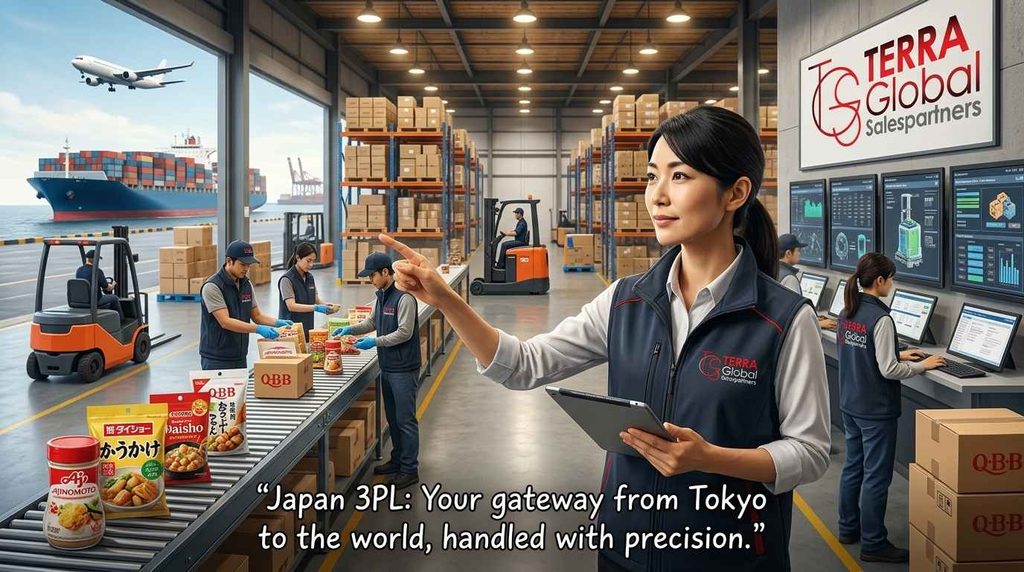
Japan 3PL services refer to outsourced logistics operations managed by a third-party logistics provider in Japan. Instead of managing your own Japan warehousing, fleet, and order fulfillment processes, you hand those tasks to a specialist.
A reliable 3PL logistics partner in Japan handles:
- Warehouse receiving and storage
- Pick and pack fulfillment and dispatch
- Cross-border fulfillment and customs documentation
- B2B order fulfillment for wholesale clients
- Ecommerce fulfillment for platforms like Amazon and Shopify
- Reverse logistics and returns management
The goal is simple. You focus on selling. Your Tokyo logistics or Japan B2B fulfillment partner handles everything else.
Why Japan Is the Right Sourcing Country for Your Business
Before understanding Japan 3PL services, it helps to understand why Japan is worth the investment in the first place.
Japan is not just a production hub. It is a quality benchmark. Japanese manufacturers set global standards in consistency, packaging, and food safety. According to the Japan External Trade Organization (JETRO), Japan exported over ¥99.2 trillion in goods in 2023, a record high.
| Factor | Japan | China | South Korea |
| Quality consistency | ★★★★★ | ★★★★ | ★★★★ |
| Regulatory compliance | ★★★★★ | ★★★ | ★★★★ |
| Premium brand perception | ★★★★★ | ★★★ | ★★★★ |
| MOQ flexibility | ★★★ | ★★★★★ | ★★★★ |
| Logistics infrastructure | ★★★★★ | ★★★★ | ★★★★ |
If you are an Amazon FBA seller, Shopify brand, or B2B distributor, Japan gives you margin. Customers globally pay more for Japanese-origin goods. That price premium, combined with cross-border 3PL efficiency, creates real profit.
For a deeper look, read our analysis on why Japanese FMCG products lead in global markets.
How Third-Party Logistics Actually Works in Japan?
Here is the order fulfillment process from the moment your goods leave a Japanese manufacturer to when they reach your customer or warehouse abroad.
Step 1, Procurement and Sourcing
A Japan sourcing company or buying agent identifies and negotiates with manufacturers or wholesalers on your behalf. This includes verifying product compliance, checking quality control standards, and confirming MOQ terms.
Terra Global SalesPartners handles this step directly. We work across categories including refrigerated dairy, sauces, instant noodles, condiments, beverages, and more.
Step 2, Inbound Logistics and Japan Warehouse Storage
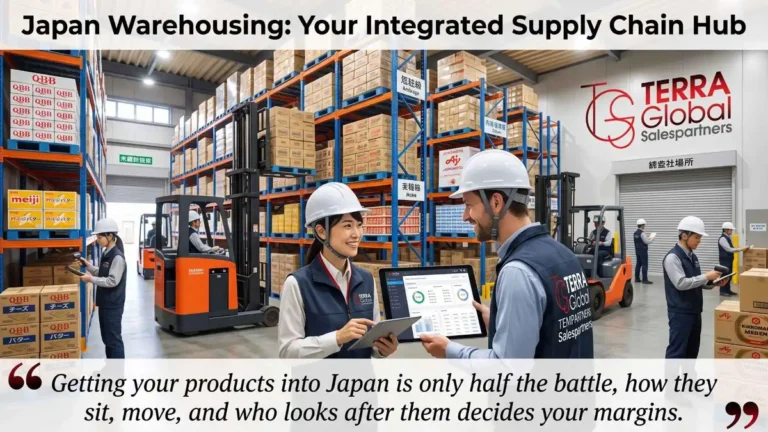
Once goods are produced or purchased, they move into Japan warehouse storage. A reliable Japan fulfillment center receives your inventory, inspects it, and logs it into a warehouse management system (WMS).
Inbound logistics includes:
- Pallet breakdown and unit counting
- Temperature-controlled storage for refrigerated goods
- Barcode labeling and product cataloguing
- Documentation preparation for export
Step 3, Order Processing and Pick and Pack
When an order arrives, the fulfillment center picks items from shelves, packs them according to specification, and prepares them for dispatch. This is the heart of 3pl fulfillment services.
For ecommerce pick and pack clients, this can be individual unit orders. For B2B distribution clients, this involves bulk pallet shipments to retailers or distributors.
Step 4, Global Shipping from Japan
Global shipping from Japan involves two main options, air freight and sea freight.
| Shipping Mode | Transit Time | Cost Level | Best For |
| Air freight | 3–7 days | High | Perishables, high-value goods |
| Sea freight | 20–45 days | Low | Bulk orders, FMCG, ambient products |
| Express courier | 1–4 days | Very High | Small parcel ecommerce |
For most importers, sea freight logistics is the most cost-effective choice for regular restocking. Air logistics works better for seasonal launches or high-margin SKUs.
Step 5, Customs Clearance in Japan
Before goods leave Japan, customs documentation must be in order. This includes:
- Commercial invoice and packing list
- Certificate of origin
- Phytosanitary or food safety certificates (for food products)
- HS code classification for accurate duty calculation
An experienced Japan export agent handles this efficiently and reduces delays. Errors here cause costly holdups at the destination port.
Step 6, Importer of Record (IOR) Responsibilities
Once goods arrive in the destination country, the Importer of Record (IOR) takes legal responsibility. The IOR ensures the correct duties are paid and all regulatory requirements are met.
Understanding your IOR obligations is critical. Many importers underestimate this step, and face fines or seizure of goods as a result.
Terra Global SalesPartners, Japan’s Trusted B2B Fulfillment Partner
Terra Global SalesPartners is not a generic logistics service provider. We are a Japan-based trading company and procurement agent that bridges the gap between Japanese manufacturers and global buyers.
Here is what sets us apart:
Our Capabilities at a Glance
| Service | What We Offer |
| Product sourcing | Direct access to verified Japanese manufacturers |
| Japan warehousing | Ambient and refrigerated warehouse storage |
| Export documentation | Full customs and compliance support |
| B2B fulfillment | Wholesale pallet and case-level dispatch |
| Ecommerce fulfillment | Pick, pack, and ship per unit for Amazon/Shopify |
| OEM production | Custom label manufacturing with Japanese suppliers |
| Quality control | Pre-shipment inspection and product testing |
We carry a curated product catalog spanning hundreds of SKUs. From Meiji Hokkaido Butter to Ajinomoto Hondashi Stock, our Japan warehouse storage holds fast-moving consumer goods ready for export.
Product Categories We Fulfill From Japan
Our Japan 3PL services cover a wide range of product categories. Each category has dedicated sourcing relationships and tested supply chain workflows.
Japanese Food and Grocery
This is our strongest category. We fulfill:
- Sauces and condiments, Daisho Teriyaki Sauce, Daisho Sukiyaki Sauce, Daisho Grilled Eel Sauce
- Mirin and cooking sake, Takara Hon Mirin, Mizkan Cooking Sake, Hinode Cooking Sake
- Dashi and umami seasonings, Ajinomoto Hondashi Konbu, Ajinomoto Iriko Dashi
- Instant ramen, Acecook Super Cup Tonkotsu, Acecook Super Cup Miso
- Spreads and jams, Aohata Spoon Free Jam Strawberry, Aohata Verde Toast Spreads
- Protein bars, Asahi Ippon Manzoku Protein Bar
Japanese Dairy and Refrigerated Products
Cold chain management is one of the most complex aspects of Japan warehouse storage. We handle it. Our refrigerated categories include:
- QBB 6P Cheese Camembert
- Meiji Hokkaido Tokachi Camembert with Black Pepper
- Snow Brand 6P Gouda Cheese
- Koiwai Farm Hors d’Oeuvre Cheese
- Snow Brand Hokkaido Butter
Beverages and Specialty Drinks
We source and fulfill beverages including Fanta Melon Soda, a Japan-exclusive product that commands strong demand from diaspora communities and specialty retailers globally.
Consumer Electronics and Accessories
Our catalog also includes select electronics like the iconic G-Shock Watch, a product with proven global demand and strong resale margin on Amazon and Shopify.
The Real Costs of Japan 3PL Services
Let us be transparent. Japan 3PL services are not the cheapest option globally. Japan’s labor costs, quality standards, and regulatory environment mean logistics here costs more than sourcing from Southeast Asia.
But here is the honest trade-off:
Pros of Using a Japan 3PL Provider
✅ World-class quality control at the source
✅ Regulatory compliance built into the supply chain
✅ Premium product perception adds retail margin
✅ Established infrastructure for global fulfillment
✅ Reliable fulfillment partner with low error rates
✅ Strong track record in ecommerce logistics
✅ Cold chain capabilities for refrigerated goods
Cons to Be Aware Of
❌ Higher per-unit fulfillment cost than China-based 3PLs
❌ MOQ requirements from Japanese suppliers can be strict
❌ Japanese business culture requires relationship investment
❌ Lead times for specialty items can be longer
❌ Language barriers without a local procurement agent
The net verdict: if your business sells premium goods where quality justifies a 20–40% price premium, Japan is the right origin. The fulfillment cost is absorbed by margin.
Japan 3PL vs. China 3PL, Which One Is Right for You?
| Criteria | Japan 3PL | China 3PL |
| Product quality | Exceptional, consistent | Variable by factory |
| Fulfillment accuracy | Very high | High |
| Cost per unit | Higher | Lower |
| Retail price premium | Yes, customers pay more | Less differentiation |
| Regulatory complexity | Manageable with right partner | Complex for food/health goods |
| Cold chain capability | Available | Limited |
| Brand building potential | Strong, “Made in Japan” carries weight | Harder to build premium perception |
For Amazon FBA sellers, boutique retailers, and specialty food importers, Japan is the better long-term play.
Key Statistics That Show Why Japan 3PL Matters
Understanding the scale of Japanese trade helps you see why professional Japan 3PL services are a necessity, not an option.
📦 Japan’s logistics market was valued at approximately ¥25.8 trillion in 2024 (Ministry of Land, Infrastructure, Transport and Tourism)
🌍 Japan ranks #1 globally for food safety regulatory standards (Global Food Safety Initiative benchmarking data)
🛒 Japanese FMCG exports grew by over 14% between 2020 and 2024
📈 Cross-border ecommerce involving Japanese goods grew 22% year-on-year in Southeast Asia in 2023
🏭 Japan has over 400,000 registered food manufacturers, creating vast sourcing options for global buyers
What to Look for in a Japan 3PL Provider
Not all logistics service providers in Japan are equipped for international trade. Here is what to verify before committing:
1. Export License and Compliance Track Record
Your Japan export agent must hold proper export licenses. Ask for examples of past shipments to your target country.
2. Cold Chain Capability
If you are importing refrigerated goods, dairy, fresh produce, or fermented products, verify that the Japan warehouse storage facility has certified temperature control.
3. WMS Integration
A proper warehouse management system gives you real-time visibility into stock levels, order status, and dispatch timelines. This is non-negotiable for ecommerce fulfillment.
4. Customs Documentation Experience
Customs clearance in Japan requires specific documents for each product category. Your 3PL logistics partner must have in-house expertise, not just forwarded paperwork.
5. MOQ Flexibility
Some Japanese wholesale suppliers impose high minimum order quantities. A good procurement agent negotiates on your behalf and helps you meet MOQ without overstocking.
6. Communication in English
Japanese business culture is detail-oriented and formal. Without a bilingual partner, critical information gets lost in translation. This alone is a major reason to work with Terra Global SalesPartners.
For a full breakdown, read our guide on how to find reliable Japanese wholesale suppliers.
How Terra Global SalesPartners Simplifies Japan 3PL for You?
We built our model around one goal: making Japan accessible for global buyers without the usual friction.
Here is how our process works in practice:
Our Workflow
Step 1: You tell us what you need
Step 2: We source from verified Japanese suppliers
Step 3: We handle quality inspection and compliance checks
Step 4: Goods enter our Japan fulfillment center
Step 5: We prepare export documentation
Step 6: We ship via your preferred freight method
Step 7: We support customs clearance at your end
Step 8: You receive clean, compliant, market-ready goods
We have supported importers across Southeast Asia, the Middle East, Europe, and North America. Each market has its own import rules, and we know them.
For sellers using Amazon FBA specifically, we prepare goods to Amazon’s exact labeling and packaging specifications. Read our full guide on Amazon FBA with Japanese products for details.
Common Mistakes Importers Make With Japan 3PL
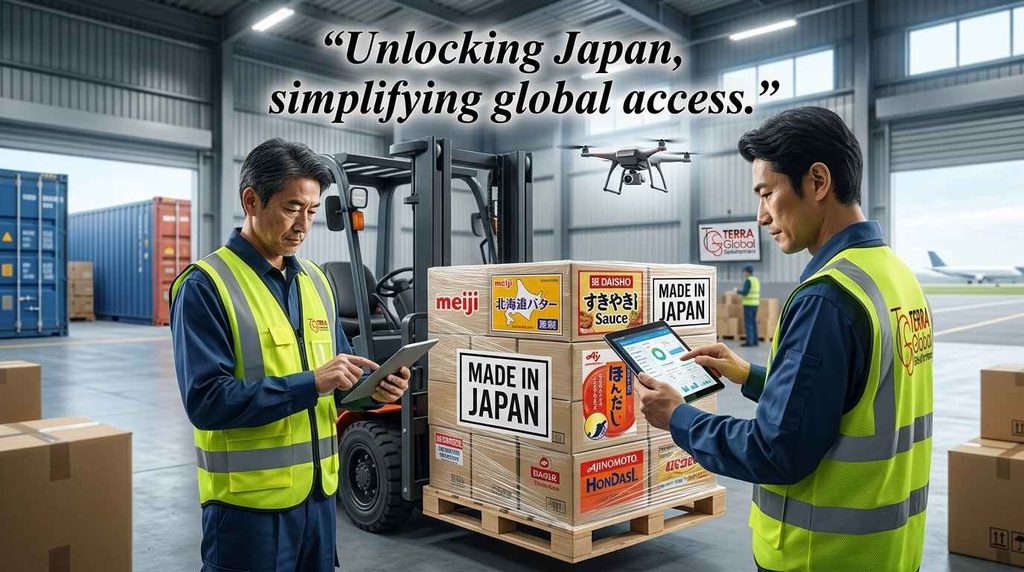
Even experienced importers make costly errors when working with Japanese suppliers. Here are the most common ones, and how we help you avoid them.
Mistake 1: Underestimating Documentation Requirements
Japan has strict export documentation rules. Missing a certificate or using the wrong HS code triggers customs delays that cost money and time.
Our solution: We prepare all documentation in-house. Nothing ships without a complete document pack.
Mistake 2: Ignoring Cold Chain Requirements
Importers sourcing dairy or refrigerated goods sometimes skip proper cold chain logistics planning. Product arrives damaged or non-compliant.
Our solution: We offer certified refrigerated Japan warehouse storage and cold-chain freight coordination.
Mistake 3: Ordering Without Market Research
Buying popular Japanese SKUs without checking whether they are approved for import in your target country is a common trap.
Our solution: We cross-check regulatory compliance before placing any order.
Mistake 4: Working Without a Local Agent
Japanese suppliers prefer long-term relationships and local trust. Without a Japan procurement agent, you are negotiating blind.
Our solution: We act as your in-country representative, building supplier relationships that lower your costs over time.
For a complete breakdown, read our post on common import-export mistakes when sourcing from Japan.
Types of Businesses That Benefit From Japan 3PL Services
Japan 3PL services are not just for large corporations. The following business types benefit most:
Amazon and Shopify Sellers
If you sell on Amazon FBA or run a Shopify store, you need reliable pick and pack fulfillment with fast turnaround. Our ecommerce 3PL services handle this at scale.
Specialty Food Importers
Japanese condiments, dairy, and snacks are in demand globally, especially in Asian supermarkets, specialty grocery chains, and online food stores. Our Japanese food wholesale network gives you direct access.
B2B Distributors and Wholesalers
If you supply retailers and hospitality businesses, B2B order fulfillment from Japan requires bulk handling, pallet dispatch, and accurate supply chain documentation. That is our core strength.
OEM and Private Label Brands
Japanese manufacturers accept OEM production for private label brands. We coordinate the entire workflow from factory to finished product to fulfillment center.
Restaurant and Hotel Procurement Teams
Japanese ingredients are a premium choice for high-end food service. Our team sources, inspects, and delivers directly to procurement teams abroad.
Air Freight vs. Sea Freight: Choosing the Right Option
One of the most common questions we receive is about global shipping from Japan, specifically whether to use air freight or sea freight.
When to Use Air Freight
- You are launching a new product and need stock quickly
- Your goods are perishable or have a short shelf life
- The order volume is small but high-value
- You are replenishing Amazon FBA stock urgently
Air freight from Japan to most global destinations takes 3–7 days. Cost ranges from $4 to $12 per kilogram depending on route and service.
When to Use Sea Freight
- You are making regular bulk orders
- Your goods are ambient (no refrigeration needed in transit)
- You have 3–6 weeks of lead time built into your inventory plan
- Cost efficiency is a priority
Sea freight from Japan to Southeast Asia takes 10–20 days. To Europe or North America, expect 25–45 days. Cost runs significantly lower per cubic meter than air.
For a full breakdown of both options, read our guide on global shipping from Japan, air freight vs sea freight.
How to Reduce Import Costs When Buying From Japan?
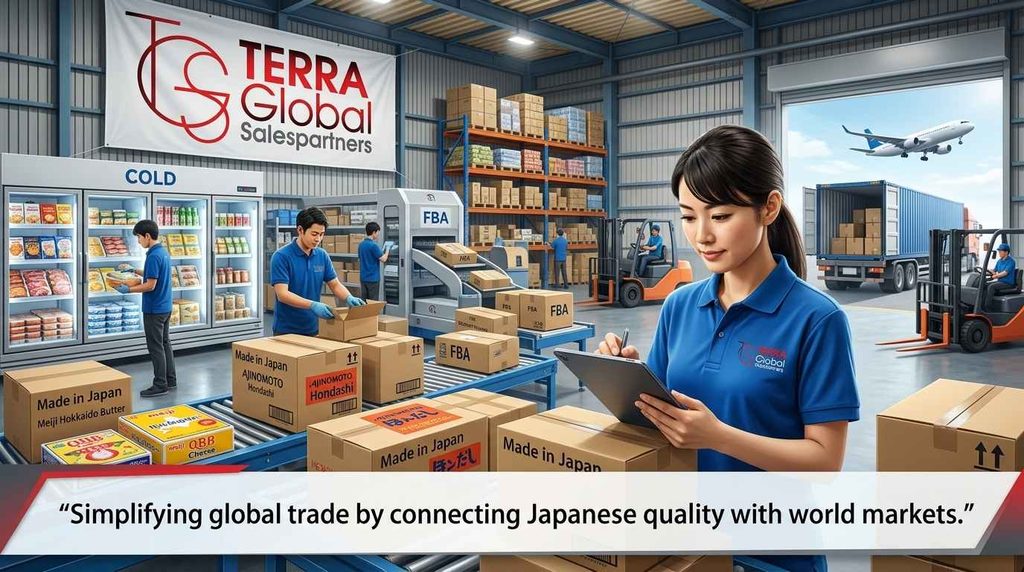
Cost management is critical when building a sustainable Japan import business. Here are proven strategies:
Consolidate Shipments
Instead of shipping small orders frequently, consolidate into larger shipments. This lowers your per-unit freight logistics cost significantly.
Use a Buying Agent to Negotiate MOQ
Japanese wholesale suppliers often have high MOQs. A procurement agent negotiates terms that let you order what you actually need.
Plan for Seasonal Demand
Japanese food products often have seasonal peaks, especially for gifting SKUs. Planning orders 2–3 months in advance gives you sea freight pricing instead of emergency air freight rates.
Leverage Multi-SKU Shipments
Combining multiple product lines into a single container or airfreight consignment reduces handling fees and maximizes container utilization.
Choose the Right Incoterms
Understanding Incoterms (FOB, CIF, DDP) affects who pays what and when. Our team advises you on the most cost-effective structure for your business model.
Why “Made in Japan” Is Your Brand’s Competitive Advantage?
This is the part most logistics service providers do not talk about, because it goes beyond logistics.
The phrase “Made in Japan” carries a brand promise. Global consumers associate it with:
- Precision and attention to detail
- Food safety and hygiene
- Authentic flavor and cultural credibility
- Premium quality worth paying more for
This perception directly translates to margin. Japanese cheese, condiments, and specialty foods routinely command 25–60% higher retail prices than equivalent products from other origins.
When you work with Terra Global SalesPartners, you are not just importing products. You are importing brand equity, and that is a sourcing strategy, not just a logistics decision.
Our Product Spotlight, Best-Selling Items We Fulfill
Here are some of our highest-demand products with strong global export performance:
| Product | Category | Why It Sells |
| Ajinomoto Pure Select Mayonnaise 400g | Condiments | Cult following in Southeast Asia |
| Ariake Gourmet Royal Beef Curry 210g | Ready meals | Premium restaurant-quality retort pouch |
| QBB Premium Baby Cheese Truffle 4pcs | Dairy snacks | Unique flavor, strong gift market appeal |
| Daisho BBQ Sauce Yuzu Flavour 185g | Sauces | Trending globally with Japanese food wave |
| Asahi Ippon Manzoku Giga Protein Bar 65g | Health/snacks | Strong ecommerce demand in fitness market |
| Ariake Tonkotsu Ramen Soup Base 1.8L | Soup bases | B2B demand from restaurant chains |
| Aohata Verde Choco Whip 100g | Spreads | Retail shelf appeal, strong repeat purchase |
| Kikkoman Manjo Rich Aged Mirin 300ml | Cooking ingredients | Essential for Japanese cuisine globally |
Understanding Japan’s Logistics Infrastructure
Japan’s logistics operations infrastructure is among the world’s most advanced. Here is a quick breakdown:
Port Infrastructure
Japan has five major international ports: Tokyo, Yokohama, Nagoya, Osaka, and Kobe. Together they handle over 700 million tonnes of cargo annually. This gives exporters multiple routing options depending on their destination market.
Air Cargo Hubs
Narita International Airport (Tokyo) and Kansai International Airport (Osaka) are the two primary air freight hubs for international shipments. Narita handles approximately 2 million tonnes of cargo per year.
Domestic Trucking and Last-Mile
Japan’s domestic trucking network is highly reliable. Inbound logistics from factories to fulfillment centers operate on just-in-time principles, the same efficiency extends to export preparation.
Temperature-Controlled Cold Chain
Japan has an extensive perishable logistics network, including refrigerated warehouses, reefer containers, and certified cold-chain freight forwarders. This is essential for our dairy and refrigerated product categories.
How to Get Started With Terra Global SalesPartners?
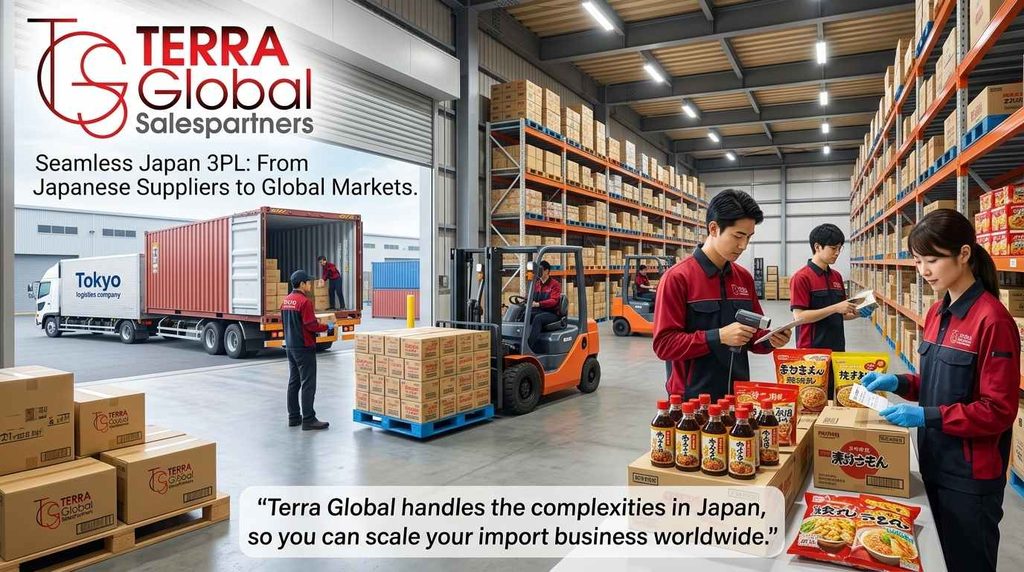
Starting your Japan sourcing journey with us is straightforward. Here is what happens when you reach out:
- Initial consultation, You share your product requirements, target market, and budget
- Sourcing proposal, We identify suitable suppliers and prepare a sourcing report
- Sample procurement, We arrange product samples for your approval
- Commercial order, Once approved, we place the order and manage quality inspection
- Export preparation, We handle all documentation, labeling, and customs clearance paperwork
- Shipment, Your goods depart Japan on the agreed schedule
- Ongoing partnership, We manage restocking, new product additions, and supplier relationships
There is no guesswork. Every step is managed by our team in Japan, with English-language communication at every stage.
Conclusion
Japan 3PL services are not just logistics. They are the infrastructure behind a profitable, scalable import business. The right Japan fulfillment center handles your stock, paperwork, and shipping, so you can focus on growing your brand and market reach.
Terra Global SalesPartners brings together sourcing, warehousing, quality control, and global fulfillment under one roof. Whether you are sourcing Japanese dairy, condiments, protein bars, or specialty beverages, we give you direct access to verified suppliers and a seamless supply chain from Japan to your destination market.
The “Made in Japan” premium is real. The logistics expertise to deliver it efficiently is what we provide.