
Importing from Japan is a profitable move. But it comes with a detailed process that every buyer must understand. Customs clearance in Japan sits at the center of that process. If you handle it right, your shipment moves fast. If you miss a step, delays and fines follow.
At Terra Global Salespartners, we have supported importers across the globe. We know exactly what it takes to clear goods from Japan without trouble. This guide walks you through the entire process, documents, duties, timelines, tips, and more.
Customs clearance in Japan is not just a formality. It is a legal requirement. The Japan Customs authority oversees every shipment. Compliance is mandatory. And the process rewards those who prepare well.
What Is Customs Clearance in Japan?
Customs clearance in Japan is the official process of getting your imported or exported goods approved by Japan Customs (Japan’s customs authority). Every shipment that enters or leaves Japan must pass through this process.
Japan Customs operates under the Customs Act. It applies to all goods, food, cosmetics, machinery, construction materials, and more. The process involves:
● Filing a declaration form
● Paying applicable import duties and consumption tax
● Submitting required documents
● Passing physical or documentary inspection
Many importers underestimate how structured this system is. Japan runs one of the most efficient customs systems in the world, but only if you follow the rules precisely.
Why Japan Customs Compliance Matters for Your Business?
Japan is one of the top trading nations. In 2023, Japan’s total imports exceeded ¥110 trillion. That means competition for smooth clearance is high. Delays cost money.
| Impact Area | With Proper Clearance | Without Proper Clearance |
| Shipment Speed | 2–5 business days | Up to 30+ days |
| Cost Control | Predictable duty payment | Unexpected fines & storage fees |
| Business Reputation | Reliable delivery schedule | Customer complaints & cancellations |
| Compliance Risk | Zero legal exposure | Penalty or goods confiscation |
| Supplier Relations | Smooth repeat orders | Friction and broken trust |
This table shows why proper customs clearance in Japan is a business strategy, not just a paperwork task.
Key Documents Required for Customs Clearance in Japan
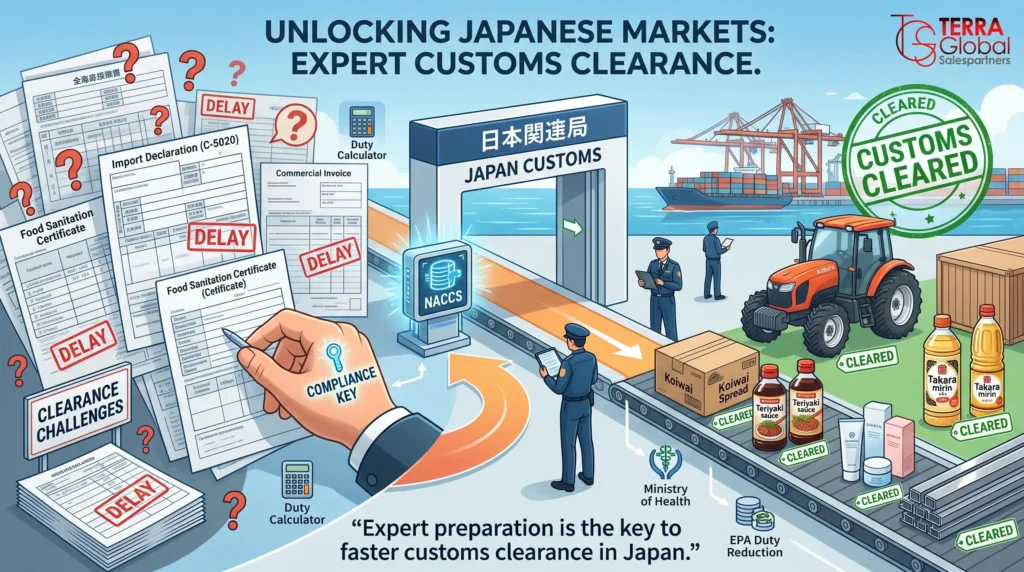
Documents are the backbone of customs clearance in Japan. Missing even one document can stop your shipment. Below is a complete checklist.
| Document | Purpose | Required For |
| Import Declaration (Customs Form C-5020) | Official import filing | All shipments |
| Commercial Invoice | Shows transaction value | All shipments |
| Packing List | Details goods in shipment | All shipments |
| Bill of Lading (B/L) or Airway Bill (AWB) | Proof of cargo shipment | Sea / Air freight |
| Certificate of Origin | Verifies production country | Duty-reduced goods |
| Import Permit or License | For regulated product categories | Food, cosmetics, chemicals |
| Phytosanitary Certificate | For agricultural products | Farm/plant-based goods |
| Food Sanitation Certificate | Health and safety compliance | Food & dairy products |
| Dangerous Goods Declaration | For hazardous cargo | Chemicals, flammables |
When you import Japanese dairy products like Koiwai Farm spread cheese, food sanitation and import permits are especially critical. Our team at Terra Global Salespartners prepares all of this before your order ships.
Step-by-Step: The Customs Clearance Process in Japan
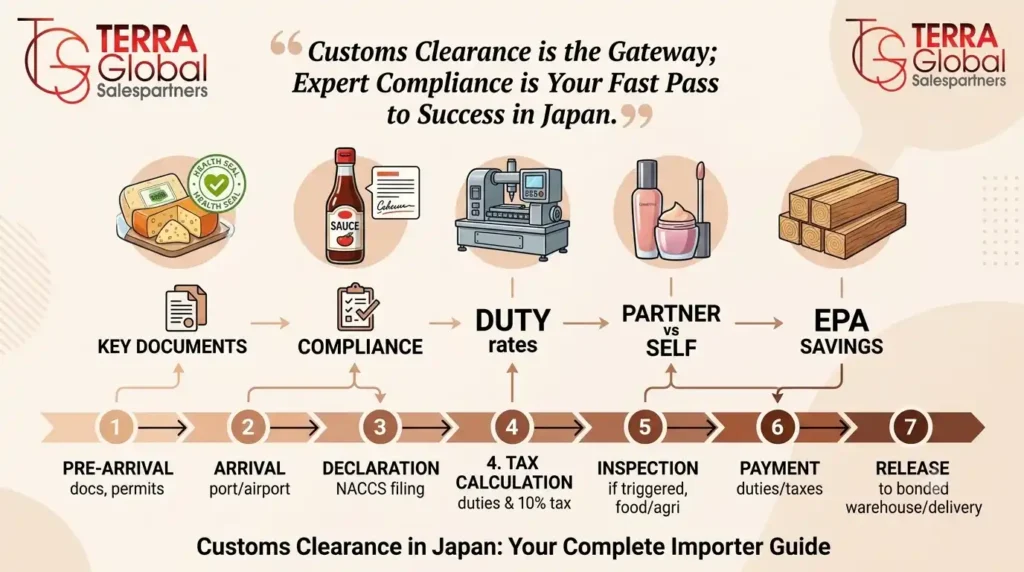
Customs clearance in Japan follows a structured flow. Here is how it works from start to finish.
Step 1, Pre-Arrival Preparation
Before your goods arrive in Japan, you must prepare all the documents. This includes the commercial invoice, packing list, and any permits for regulated goods. Our sourcing team verifies these before departure.
Step 2, Arrival at Port or Airport
Your shipment lands at a Japanese port or airport. Common entry points include Narita, Haneda, Osaka, Kobe, and Yokohama. The customs authority receives the cargo manifest from the carrier.
Step 3, Import Declaration Filing
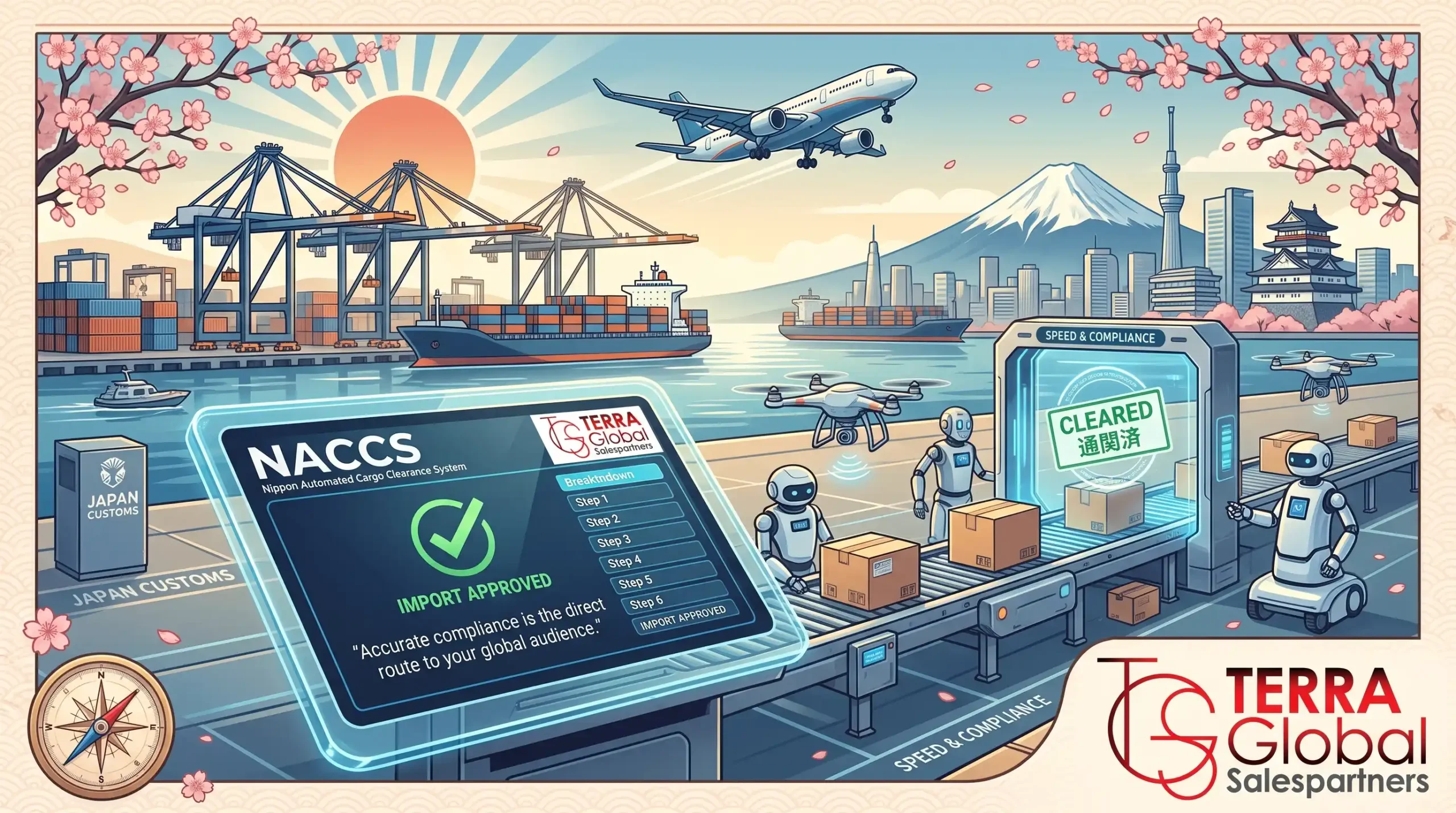
The importer or a licensed customs broker files the import declaration using Japan’s NACCS system (Nippon Automated Cargo Clearance System). This is an electronic system. Speed and accuracy are critical at this stage.
Step 4, Duty and Tax Calculation
Japan Customs calculates import duties, anti-dumping duties (if applicable), and the 10% consumption tax. Duty rates vary by HS (Harmonized System) code. We help you classify goods correctly to minimize costs.
Step 5, Inspection (If Triggered)
Customs may select your shipment for physical or documentary inspection. Food items and Japanese agriculture products wholesale orders often go through inspection by the Ministry of Health and the Plant Protection Station.
Step 6, Duty Payment
Once approved, you pay the assessed duties and consumption tax. Payment can be made electronically or at the customs office. Delays in payment delay your release.
Step 7, Release and Delivery
After payment and final approval, your goods are released. They move to the bonded warehouse or directly to your freight forwarder for final delivery.
Our full guide on the import-export process from Japan goes deeper into timelines and costs at each stage.
Import Duty Rates in Japan, What to Expect?
Japan’s duty rates vary widely by product category. Knowing your rate before you order saves money and avoids surprises during customs clearance in Japan.
| Product Category | Typical Duty Rate | Additional Notes |
| Food Products (processed) | 0% – 25% | Varies by type; cheese may have quota duties |
| Agricultural Machinery | 0% – 3.9% | Often duty-free under FTAs |
| Construction Equipment | 0% – 3.3% | Heavy machinery often at 0% |
| Building Materials (steel) | 0% – 6% | Steel may attract anti-dumping measures |
| Cosmetics | 0% – 6.5% | Depends on formulation and HS code |
| Cooking Sauces & Condiments | 6% – 17% | Higher for fermented/seasoned products |
| Mirin & Cooking Sake | 0% – 15% | Alcohol content affects rate |
| Wood & Timber Supplies | 0% – 6% | Treated lumber may vary |
Note: Japan has free trade agreements (FTAs) with over 20 countries under EPA (Economic Partnership Agreements). If your country qualifies, you may import at reduced or zero duty rates.
Product Categories We Export, And How We Handle Clearance
Terra Global Salespartners handles customs clearance in Japan across a wide range of product categories. Each category has unique customs requirements. We know them all.
Japanese Food & Dairy Products
Our food products include the Koiwai Farm hors d’oeuvre cheese Yonezawa salami,Koiwai Farm onion hors d’oeuvre cheese, and several Japanese processed cheese supplier items. Food imports into Japan require prior notification to the Ministry of Health, Labour and Welfare. Our team files this before your shipment departs Japan.
Japanese Sauces & Condiments
We export Daisho teriyaki sauce 1.25kg,Daisho sukiyaki sauce,Daisho mentsuyu yuzu noodle sauce,Daisho mentsuyu wasabi sauce,Daisho grilled eel sauce,Daisho yuzu dressing,Daisho yuzu BBQ sauce, and Daisho wasabi BBQ sauce. All liquid food products are subject to labeling and sanitation checks. We ensure full compliance for Japanese cooking sauce wholesale orders.
Mirin & Cooking Sake
Alcohol-based products face stricter customs rules. Our Takara hon mirin 1L,Mizkan Honteri mirin style seasoning, and Mizkan cooking sake shipments are always prepared with the correct alcohol content declarations and import licenses. Japanese cooking mirin supplier buyers trust us to handle this precisely.
Agriculture Products & Machinery
We source and export a wide range of Japanese agriculture products wholesale. This includes Kubota Yanmar tractor wholesale export and other Japanese farming equipment distributor items. Plant-based products require phytosanitary certificates. Machinery must pass safety and weight compliance checks.
Building Equipment & Construction Materials
Our Japanese building equipment wholesale exports include excavators, forklifts, and cranes. Japanese construction materials wholesale shipments include steel, tiles, and insulation. Heavy goods often require pre-import inspection and special port handling. We coordinate all of this for our B2B clients.
Cosmetics & Skincare
Japan’s Japanese cosmetics wholesale supplier products are globally in demand. But J-beauty wholesale import shipments face strict pharmaceutical and cosmetic ingredient checks in destination countries. We ensure full ingredient disclosure and proper labeling for every, buy Japanese skincare wholesale order.
Pros and Cons of Handling Customs Clearance Yourself vs Using a Partner
| Factor | Self-Managed Clearance | With Terra Global Salespartners |
| Document Preparation | Time-consuming, error-prone | Handled by our expert team |
| Duty Classification | Risk of wrong HS codes | Accurate classification every time |
| Compliance Knowledge | Must study changing regulations | We track all updates for you |
| Speed of Release | Slower due to rejections | Faster, pre-checked documents |
| Language Barrier | Japanese forms are complex | We bridge the language gap |
| Cost Predictability | Unexpected fees are common | Transparent cost breakdown upfront |
| Supplier Communication | Difficult without local contacts | We have direct supplier relationships |
The comparison speaks clearly. Working with Terra Global Salespartners removes risk, saves time, and reduces costs associated with customs clearance in Japan.
Japan Trade and Customs Performance
Numbers tell the real story. Here is why customs clearance in Japan deserves full attention, and why our clients choose expertise over guesswork.
● Japan processed over 9.5 million import declarations in 2023 (Japan Customs Annual Report)
● Average customs clearance time in Japan: 2.5 days for air cargo, 3.9 days for sea cargo
● Over 60% of shipment delays in Japan are caused by incomplete or incorrect documents
● Japan has EPAs with 22 countries, qualifying importers save up to 100% on import duties for specific goods
● Food import rejection rate in Japan: approximately 1.2% annually, mostly due to labeling or residue violations
● Used Japanese construction equipment is the fastest-growing import category in Southeast Asia and Africa (2024 data)
● Japanese cosmetics market export value exceeded ¥400 billion in 2023
These statistics confirm what our clients already know: customs clearance in Japan requires specialist knowledge. That is exactly what Terra Global Salespartners delivers.
Why Terra Global Salespartners Is Your Best Import Partner
We are not just a trading company. We are a full-service Japan agriculture export B2B partner, a Japan construction machinery exporter, and a trusted Japanese beauty products importer. We serve buyers across multiple industries with the same commitment to excellence.
Here is what sets us apart:
● Deep regulatory knowledge: We follow every update in Japan Customs rules so you do not have to.
● End-to-end support: From product sourcing to customs declaration to final delivery, we manage the full chain.
● Multilingual team: We communicate in Japanese with local suppliers and in English with global buyers.
● Verified supplier network: Every product in our catalog comes from verified, trustworthy Japanese manufacturers.
● Transparent pricing: No hidden fees. We give you a full cost breakdown before you commit.
● Fast response time: Our team responds within 24 hours for all trade-related inquiries.
Want to know more about how we find the right suppliers? Read our guide on how to find reliable Japanese wholesale suppliers.
Common Mistakes During Customs Clearance in Japans, And How We Prevent Them
Even experienced importers make costly errors. Customs clearance in Japan has specific rules that catch unprepared buyers off guard. Here are the most common mistakes, and how our team prevents each one.
| Mistake | Consequence | How We Prevent It |
| Wrong HS Code classification | Overpayment of duties or penalty | We verify HS codes with Japan Customs guidelines |
| Missing Food Sanitation Notification | Shipment held or destroyed | We file all notifications in advance |
| Incorrect invoice valuation | Customs audit and re-assessment | We prepare invoices to Japan Customs standards |
| No Certificate of Origin for EPA products | Full duty rate applied instead of reduced | We source correct COOs from suppliers |
| Ignoring labeling requirements | Product rejected at entry | We check labels before goods are packed |
| Late import declaration filing | Storage fees and shipment delay | We pre-file using Japan’s NACCS system |
Quality Standards and Product Safety in Japan Exports
Japan is known globally for its high quality control standards. When you source agriculture products from Japan or buy Japanese construction machinery B2B, you are getting products that meet strict JIS (Japan Industrial Standards) and JAS (Japan Agricultural Standards) requirements.
Our blog post on quality control standards in Japan covers exactly how these standards protect your customers and strengthen your brand.
Every item we export has passed supplier quality checks. We do not ship anything that does not meet our own internal standards. And we stand behind every shipment we facilitate.
Understanding HS Codes for Japan Customs
Every product you import or export must be assigned an HS (Harmonized System) code. This code determines:
● The duty rate payable
● Whether an import permit or license is required
● Whether the product qualifies for EPA duty reduction
● Which ministry handles inspection
Getting the HS code wrong is one of the most expensive mistakes in customs clearance in Japan. For example, authentic Japanese teriyaki sauce import and Japanese BBQ sauce teriyaki bulk products can fall under different HS codes depending on their ingredient composition.
Our team classifies every product in our catalog with the correct HS code before you place your order. We double-check against Japan Customs’ tariff schedule to ensure accuracy.
Expected Timeline for Customs Clearance in Japan
| Shipment Type | Document Check | Declaration Processing | Inspection (If Required) | Total Estimated Time |
| Air Cargo | 1 day | 1 day | 1–2 days | 2–4 business days |
| Sea Cargo (FCL) | 1–2 days | 1–2 days | 2–5 days | 4–9 business days |
| Sea Cargo (LCL) | 1–2 days | 2–3 days | 3–5 days | 6–10 business days |
| Bonded Warehouse Entry | 1 day | 1 day | 1–3 days | 3–5 business days |
These timelines apply when all documents are complete and correct. Our team ensures that is always the case, so your goods move at maximum possible speed through customs clearance in Japan.
Japan Economic Partnership Agreements, Save on Import Duties
Japan’s EPA network is one of the most extensive in the world. If your country has an active EPA with Japan, you could pay zero or reduced import duties on qualifying goods.
Key EPAs that benefit our clients include:
● ASEAN–Japan Comprehensive Economic Partnership (AJCEP)
● Japan–Australia Economic Partnership Agreement (JAEPA)
● Japan–EU Economic Partnership Agreement (Japan-EU EPA)
● Comprehensive and Progressive Agreement for Trans-Pacific Partnership (CPTPP)
● Regional Comprehensive Economic Partnership (RCEP)
To benefit from EPA rates, you must present a valid Certificate of Origin with your import declaration. We source these directly from our Japanese manufacturer partners for every eligible shipment.
Regulated and Restricted Products, What You Must Know?
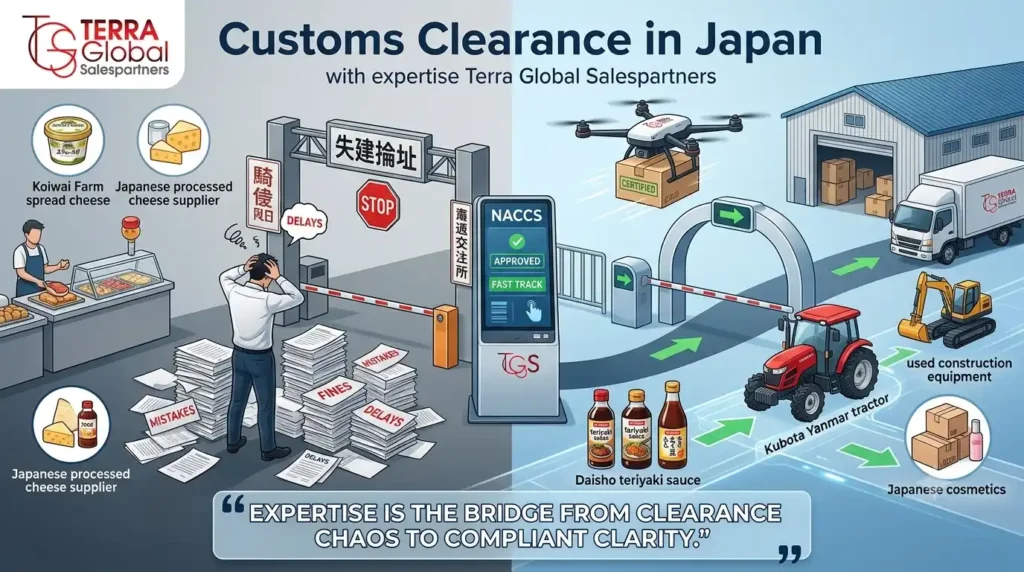
Some product categories face additional oversight during customs clearance in Japan. These include:
● Food products: Require Food Sanitation Act compliance and prior notification
● Cosmetics and quasi-drugs: Require Pharmaceutical and Medical Device Act compliance
● Agricultural products and plants: Require Plant Protection Law clearance
● Alcohol-containing products (mirin, sake): Require liquor import registration in some countries
● Used construction and agricultural equipment: May require pre-shipment inspection certificates
Our team handles compliance for all of these categories. Whether you buy Japanese construction machinery B2B or import Japanese dairy products, we make sure every regulated requirement is met before your shipment moves.
Conclusion
Customs clearance in Japan is the gateway to one of the world’s most reliable and high-quality export markets. Handle it correctly and you gain a competitive advantage. Handle it poorly and you lose time, money, and supplier trust.
Terra Global Salespartners exists to make sure every client handles it correctly. We combine deep product knowledge, strong supplier relationships, and customs expertise into one seamless service.
Whether you are sourcing Japanese agriculture products wholesale, placing a Japanese cosmetics wholesale supplier order, or buying Japanese building equipment wholesale in bulk, we are your most reliable partner from Japan.
Contact us today. Let us remove the complexity of customs clearance in Japan from your plate, and replace it with results.
Frequently Asked Questions (FAQs)
Q1. What documents are required for customs clearance in Japan?
You need a commercial invoice, packing list, Bill of Lading or Airway Bill, import declaration, and permits specific to your product type such as food sanitation certificates or phytosanitary documents depending on the goods.
Q2. How long does customs clearance in Japan take for imported goods?
Air cargo typically clears in 2–4 business days. Sea cargo takes 4–10 business days. Timelines depend on product type, document accuracy, and whether customs selects your shipment for physical inspection.
Q3. Do I need a licensed customs broker for customs clearance in Japan?
Japan does not legally require a broker for all shipments, but using one is strongly recommended. Licensed brokers ensure accurate HS code classification, faster filing via NACCS, and full compliance with Japan Customs regulations.
Q4. How can I reduce import duties when clearing goods through Japan Customs?
Use Japan’s EPA agreements with your country. Present a valid Certificate of Origin with your import declaration. Qualifying goods from EPA countries may receive zero or significantly reduced duty rates at Japan Customs.
Q5. What happens if my goods fail customs inspection in Japan?
Goods that fail inspection may be held, returned to origin, or destroyed at the importer’s cost. Terra Global Salespartners prevents this by ensuring full document compliance and product certification before every shipment departs Japan.