
Most guides on this topic list definitions and call it done. That is not what this is.
At Terra Global Sales Partners, we work with international buyers every week, importers sourcing Japanese food wholesale, Amazon FBA sellers testing new SKUs, and B2B buyers managing bulk container shipments from Japan. We have seen what happens when buyers choose the wrong service. Shipments stall. Customs clearance fails. Costs spike. Relationships break.
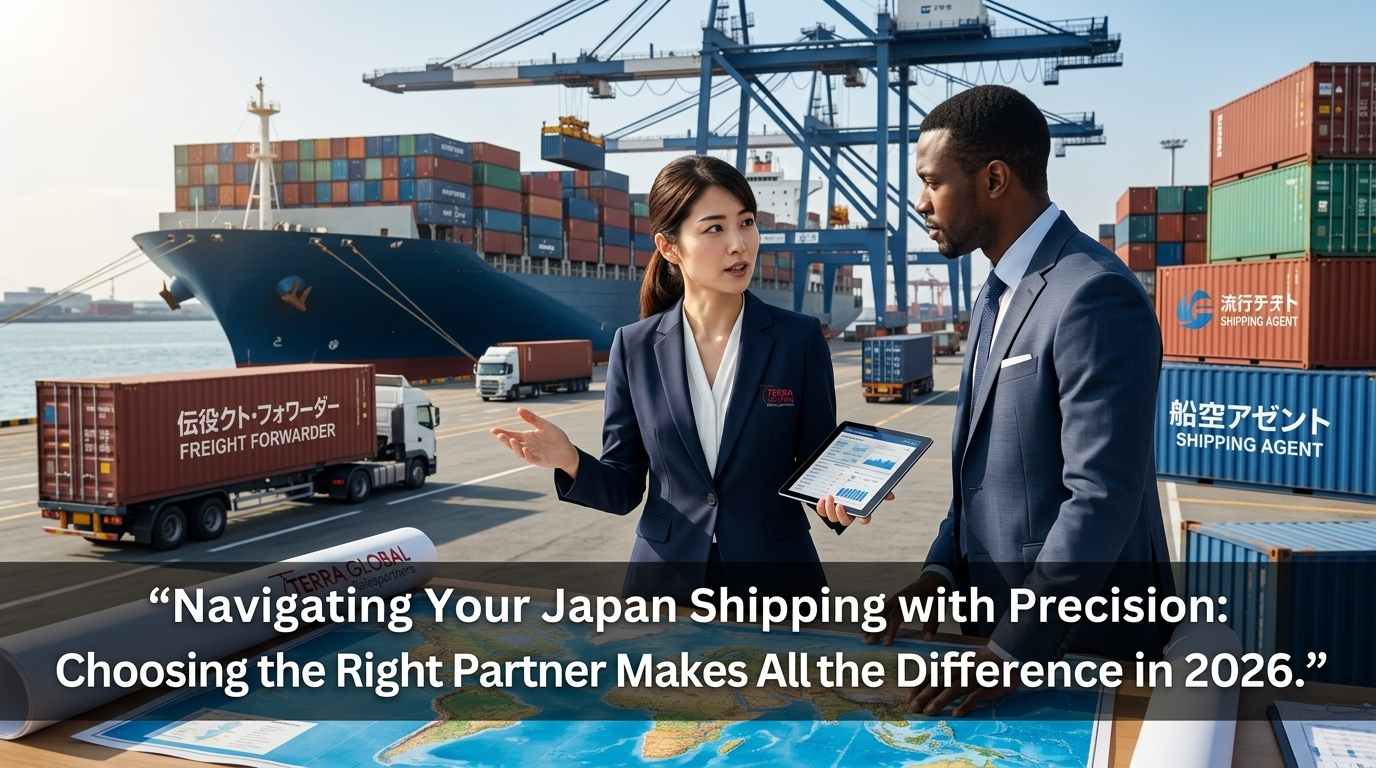
This guide exists to stop that. We will walk you through the real difference between a shipping agent and a freight forwarder, when each one makes sense, what they actually cost, and why the right partner in Japan makes all the difference. By the time you finish reading, you will know exactly which service fits your operation, and how Terra Global Sales Partners fills both roles better than most single-service providers can.
What Is a Shipping Agent?
A shipping agent, sometimes called a Japan cargo agent, port agent, or ship parcel to a different agent service, is a local representative that operates on behalf of a vessel owner or cargo owner at a specific port. Traditionally, port agency services sit at the heart of maritime operations: coordinating vessel arrivals, handling port formalities, liaising with harbor authorities, and managing cargo documentation.
In modern B2B import/export contexts, the term Japan shipping agent has expanded. Buyers now use it to describe any local operator in Japan who physically handles, consolidates, or ships goods on their behalf. That includes:
- Japan buying agents who source and forward goods
- Japan cargo agents who consolidate shipments for LTL shipping or less than truckload shipping scenarios
- Local forwarding desks inside larger general steamship agencies
This overlap creates real confusion. A buyer searching for the cheapest shipping agent on Reddit or comparing shipping agents tariffs responsibility customs duties may be looking at services that operate very differently under the same label.
The key question: Does the agent act as your representative in Japan, or as an intermediary who takes legal responsibility for the shipment?
That distinction is where freight forwarders come in.
What Is a Freight Forwarder?
A freight forwarder is a licensed third-party logistics provider that organizes the full movement of cargo between countries. They do not own planes, ships, or trucks. Instead, they negotiate rates with carriers, book space, arrange documentation, coordinate customs clearance in Japan, and act as the hub connecting every party in the supply chain.
When buyers ask how to ship freight or how to send freight internationally, a freight forwarder is almost always the practical answer. They handle:
- International shipping documentation (commercial invoice, packing list, bill of lading, certificate of origin)
- Freight class determination and freight classification for carriers
- Carrier selection for air freight vs sea freight from Japan
- LTL shipping consolidation for smaller loads
- Customs broker functions or coordination with licensed brokers
- Importer of Record (IOR) services in destination countries
- Transshipment routing when direct routes are unavailable
A well-structured freight forwarder essentially becomes your logistics department for international trade. They can answer how to get a freight quote, how to calculate shipping costs, and how to figure shipping rates, all before you commit to a purchase.
Shipping Agent vs Freight Forwarder, Head-to-Head Comparison
| Feature | Shipping Agent | Freight Forwarder |
| Primary Role | Port/local representative | End-to-end cargo logistics |
| Customs Handling | Limited or none | Full customs broker coordination |
| Documentation | Partial | Complete (BL, CI, PL, COO, etc.) |
| Rate Negotiation | Local port fees | Global carrier rate negotiation |
| Insurance | Rarely arranged | Typically arranged |
| Break bulk cargo | Yes, common | Yes, with LTL options |
| Transshipment routing | Limited | Yes |
| Container tracking | Basic | Full container tracking |
| Best For | Local Japan port ops | Multi-leg global shipments |
| Cost Structure | Port fees + agent commission | All-in or modular pricing |
How Shipping Costs Actually Work?
How much does freight shipping cost from Japan? The honest answer depends on four variables: freight class, cargo volume, route, and service type. Here is a realistic breakdown based on current Japan export patterns.
Air Freight from Japan
How much does air freight cost varies significantly by weight break and urgency. Typical rates from major Japanese airports (NRT, KIX):
| Weight | Economy Air (per kg) | Express Air (per kg) |
| Under 45 kg | $8–$15 | $18–$30 |
| 45–100 kg | $5–$9 | $12–$20 |
| 100–300 kg | $3.50–$6 | $9–$15 |
| 300+ kg | $2.50–$5 | $7–$12 |
How long does express shipping take from Japan? Typically 2–4 business days to most destinations. How long does economy shipping take? Usually 7–14 business days depending on route.
Sea Freight from Japan
How much does it cost to ship freight by sea from Japan depends on container type and destination:
| Route | 20ft Container (FCL) | LCL (per CBM) |
| Japan → USA (West Coast) | $900–$2,200 | $65–$120 |
| Japan → Europe | $1,400–$3,500 | $90–$160 |
| Japan → Southeast Asia | $350–$900 | $40–$85 |
| Japan → Middle East | $800–$1,800 | $60–$110 |
| Japan → Australia | $700–$1,600 | $55–$100 |
Note: These are approximate 2026 market rates. Actual quotes vary by carrier, season, and commodity type.
How to Determine Freight Class?
Understanding what is freight class helps you estimate costs accurately. Freight classification in Japan follows NMFC standards for road legs and IATA density rules for air. Here is how to calculate freight class:
Freight Class Formula:
Density (PCF) = Weight (lbs) ÷ [Length × Width × Height (inches) ÷ 1728]
| Density (PCF) | Freight Class |
| Over 50 | Class 50 |
| 35–50 | Class 55 |
| 22.5–35 | Class 60 |
| 15–22.5 | Class 65 |
| 13.5–15 | Class 70 |
| 12–13.5 | Class 77.5 |
| Under 1 | Class 500 |
How do I determine freight class in practice? Measure your cargo accurately, calculate density, and match to the table above. Alternatively, Terra Global Sales Partners calculates this for every shipment we handle, so buyers never overpay because of freight classification errors.
What Is a Japan Buying Agent, And How Does It Overlap?
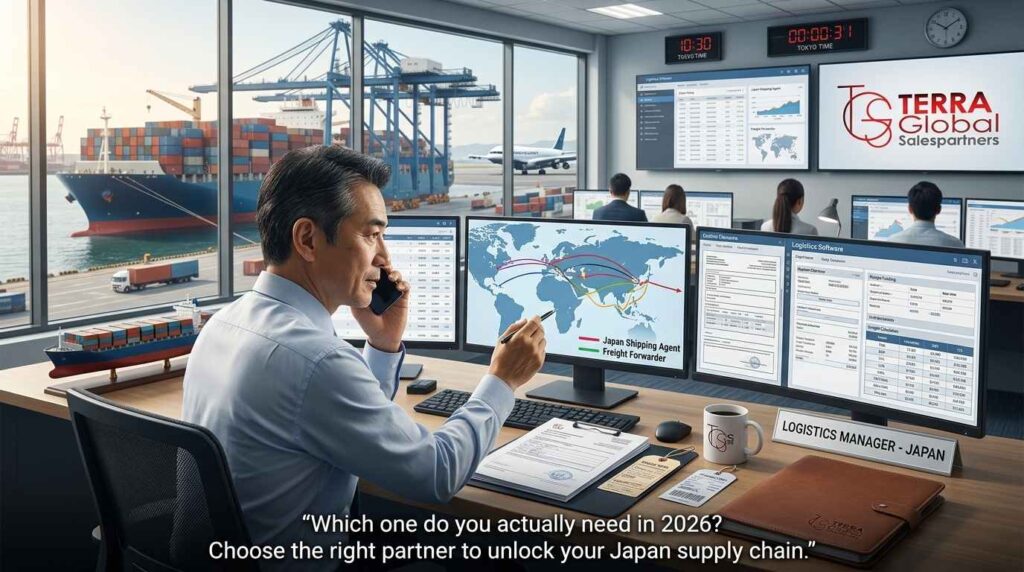
A Japan buying agent is a local sourcing and procurement specialist who helps foreign buyers find, verify, purchase, and export Japanese products. The Japan buying agent role often combines sourcing, quality control, and shipping coordination in one service.
The overlap with shipping agents and freight forwarders creates a spectrum:
Japan Buying Agent → Sources + purchases + arranges shipping
Japan Shipping Agent → Handles local logistics + port operations
Freight Forwarder → Manages full international cargo movement
Terra Global Sales Partners operates across all three layers. When a buyer asks how to source products from Japan for their Amazon FBA store, we handle sourcing from verified Japanese suppliers, consolidate their cargo, prepare all export documentation, and coordinate with their destination freight agent. That is a full-service model most standalone agents cannot match.
FOB, DDP, and Other Terms That Determine Who Pays What
Before choosing between a shipping agent and freight forwarder, understand the trade term attached to your purchase. These terms define who handles shipping agents tariffs responsibility customs duties at each leg.
What Does FOB Mean in Shipping?
What is FOB shipping: Free On Board. The seller covers costs until the cargo is loaded on the vessel at the Japanese port. From that point, you, the buyer, take responsibility for international shipping, freight costs, insurance, and import duties.
What Is DDP Shipping?
What is DDP shipping: Delivered Duty Paid. The seller covers everything, including all customs duties, taxes, and delivery to your door. DDP gives buyers maximum simplicity but often at a higher unit price.
Most Common Terms in Japan Import/Export
| Incoterm | Seller Pays | Buyer Pays | Risk Transfer Point |
| EXW | Nothing | Everything | Seller’s warehouse |
| FOB | To port loading | All freight + duties | On vessel at Japan port |
| CIF | To destination port | Import duties + inland | Destination port |
| DDP | Everything | Nothing | Buyer’s door |
| DAP | All freight | Import duties only | Destination border |
Knowing your Incoterm helps you understand exactly how to determine shipping costs and which service you need to fill the gaps.
Port Agency Services in Japan, What Happens at the Port?
Port agency services are a specialized subset of shipping operations. A port agent represents vessel owners or cargo owners at Japanese ports (Yokohama, Kobe, Osaka, Tokyo, Nagoya). Their services include:
- Vessel arrival/departure coordination
- Cargo loading/unloading supervision
- Crew welfare and documentation
- Break bulk cargo handling for non-containerized goods
- Liaison with port authorities and customs
What is break bulk cargo? Break bulk refers to cargo loaded individually rather than in containers, oversized machinery, vehicles, timber, steel coils. If you are importing car shipping cargo, motorcycle shipping, or industrial equipment from Japan, break bulk or Roll-on/Roll-off (RoRo) services apply.
For vehicle shipping agents and vehicle shipping agent services specifically, Japanese ports handle RoRo shipments via major shipping lines. Terra Global Sales Partners coordinates car shipping logistics for buyers importing Japanese domestic market (JDM) vehicles to export markets.
Japan’s Shipping Infrastructure, Key Facts and Stats
Understanding Japan’s logistics landscape helps you make a better decision about which service type fits your supply chain.
Japan Port Statistics (2025–2026),
| Metric | Figure |
| Total port cargo volume (2025) | ~3.4 billion tonnes handled |
| Top export port | Port of Nagoya |
| Top container port | Port of Tokyo / Yokohama |
| Number of major commercial ports | 23 designated international ports |
| Japan ranking in Logistics Performance Index | Top 8 globally |
| Average customs clearance time (sea) | 2–5 business days |
| Average customs clearance time (air) | 1–2 business days |
Japan’s logistics infrastructure is among the most reliable in the world. That reliability is one reason Japanese FMCG products lead in global markets, consistent packaging, meticulous labeling, and predictable export timelines make Japanese suppliers trusted partners for global retailers.
How to Track a Shipping Container from Japan
How to track a shipping container is one of the most common questions importers ask after placing an order. Here is the standard process:
- Get your Bill of Lading (BL) number, this is your primary tracking ID for sea shipments
- Use the carrier’s tracking portal, major lines include COSCO Shipping, Mediterranean Shipping Company, and others
- Check the booking confirmation for the container number (starts with 4 letters + 7 digits)
- Use aggregator tools like Searates, MarineTraffic, or your forwarder’s dashboard
How big is a container ship? Modern ultra-large container vessels (ULCVs) carry 20,000–24,000 TEUs and are 400 meters in length. How big is a cargo ship generally? It depends on the vessel type, bulk carriers, tankers, and container ships all differ significantly. For your import operations, what matters is container size: standard shipping containers are 20ft (33 CBM) or 40ft (67 CBM).
How much does a shipping container cost to buy outright? Used 20ft containers run $1,500–$3,500 depending on condition and location. New 40ft high-cube containers run $4,500–$7,000. For most importers, leasing or using carrier-provided containers through your freight forwarder is more practical than purchasing.
Pros and Cons, Shipping Agent vs Freight Forwarder
Shipping Agent
Pros:
- Deep local knowledge of Japanese ports and customs
- Faster coordination for port-specific operations
- Useful for buyers with existing freight arrangements
- Lower cost for limited, local-scope tasks
- Strong for general steamship agencies relationships
Cons:
- Limited scope, usually does not handle full-chain logistics
- May not offer customs broker services
- Does not always cover LTL shipping or cargo consolidation
- Insurance typically not included
- Less useful for complex multi-leg international shipping
Freight Forwarder
Pros:
- End-to-end cargo management from Japan to your door
- Handles customs clearance and documentation
- Can arrange LTL shipping, FCL, air, and multi-modal
- Rate access across multiple carriers for cost comparison
- Manages transshipment routing for complex destinations
- Insurance and cargo liability management
- Answers how to calculate shipping costs upfront
Cons:
- Higher all-in cost vs. using a port agent for simple ops
- Quality varies enormously between providers
- Less local port-level leverage than a dedicated port agent
- Margin layers can make it harder to see base carrier costs
When to Use a Shipping Agent?
Use a Japan shipping agent when:
- You have a regular shipping line relationship and need local port representation
- You are managing RoRo or vehicle shipping agents operations
- You need someone physically at the Japanese port for cargo inspection
- Your freight forwarder is based outside Japan and needs a local correspondent
- You import break bulk cargo that requires hands-on port management
Do NOT rely solely on a Japan shipping agent when:
- You are new to importing from Japan
- You need full customs clearance support
- Your shipment involves transshipment through multiple ports
- You need comprehensive cargo insurance
- You want to compare how much is freight shipping across carriers
When to Use a Freight Forwarder?
Use a freight forwarder when:
- You are importing for the first time from Japan
- Your shipment requires customs broker coordination
- You need door-to-door international shipping
- Your cargo mix requires freight class determination
- You are doing Amazon FBA with Japanese products and need FBA-compliant labeling and prep
- You are comparing air freight vs sea freight economics
- You need the Importer of Record (IOR) handled in your destination country
What Does Terra Global Sales Partners Actually Do?
This is where we want to be direct with you.
Terra Global Sales Partners is not just a broker or a listing service. We are a Japan-based sourcing and export partner with hands-on knowledge of the Japanese supply chain, established supplier relationships, and export logistics experience across food, FMCG, household goods, and specialty consumer products.
Here is what we do for import buyers:
Sourcing: We identify and vet Japanese manufacturers and wholesalers. Our product catalog covers everything from Ajinomoto Hondashi and Kikkoman mirin to specialty cheese, instant noodles, snack bars, and condiments, products that buyers in Southeast Asia, the Middle East, Europe, and North America are actively importing.
Export Documentation: We prepare commercial invoices, packing lists, certificates of origin, phytosanitary documents, and all shipping paperwork required for your destination country.
Cargo Consolidation: Many buyers start with smaller orders. We consolidate LTL shipping loads from multiple suppliers into a single export shipment, reducing per-unit shipping cost dramatically.
Freight Coordination: We work with vetted freight forwarder partners to move cargo via air freight or sea freight based on your timeline and budget. We help you understand how to calculate shipping costs before you commit.
Quality Control: Before cargo leaves Japan, we inspect packaging, labeling, and product condition. This is a critical step that standalone shipping agents rarely offer.
Customs Documentation Support: We prepare export documents that make customs clearance at your destination smoother. We have supported buyers navigating customs duties across multiple markets.
How to Calculate Shipping Costs, A Practical Framework
How do I calculate shipping costs for a Japan import? Follow this framework:
Step 1, Determine cargo dimensions and weight Measure every carton (L × W × H in cm) and weigh it. Calculate total gross weight and total volume (CBM).
Step 2, Calculate chargeable weight
- Air freight: Chargeable weight = max(actual weight, volumetric weight). Volumetric weight = (L × W × H cm) ÷ 6000
- Sea freight LCL: Charged per CBM or per 1,000 kg (whichever is higher)
Step 3, Get a freight quote How to get a freight quote: Contact your forwarder with cargo dimensions, weight, origin port (Japan), destination port/city, and Incoterm. They quote within 24–48 hours typically.
Step 4, Add all cost layers
| Cost Layer | Notes |
| Ocean/air freight | Base rate |
| Origin charges (THC, B/L fee) | Japan port charges |
| Destination charges | Terminal handling at arrival port |
| Customs broker fee | $150–$500 depending on complexity |
| Duties and taxes | Based on HS code and destination tariff |
| Insurance | ~0.3–0.5% of cargo value |
| Inland delivery | Final mile to your warehouse |
Step 5, Evaluate total landed cost How to determine shipping costs in a way that helps your business: always calculate total landed cost per unit (product cost + all shipping + duties ÷ total units). This is your real margin baseline.
Shipped as Cargo vs Parcel: Which Makes Sense?
For smaller orders, buyers often wonder what is the cheapest way to ship a package or how much does it cost to send a package from Japan. Here is a quick breakdown:
| Shipment Size | Best Option | Notes |
| Under 2 kg | International parcel (EMS, DHL, FedEx) | Expensive per kg but simple |
| 2–30 kg | Express courier or postal | DHL, FedEx International Shipping, UPS International Shipping |
| 30–200 kg | Air freight LCL | Better rates than courier |
| 200 kg–2 CBM | Air freight or sea LCL | Sea LCL becomes competitive |
| Over 2 CBM | Sea LCL or FCL | Sea freight is almost always cheaper |
| Full container | Sea FCL | Best per-unit cost |
Does UPS ship internationally from Japan? Yes. DHL international shipping, FedEx international shipping, and UPS international shipping all serve Japan. For commercial B2B volumes, these express courier rates become impractical above 30–50 kg. At that point, air freight booked through a freight forwarder is more economical.
How to Ship Large Items from Japan?
How to ship large items or how to ship a large package from Japan involves different considerations:
- Oversize cargo (longer than 12m or heavier than 5 tonnes) may require break bulk cargo handling or flat-rack containers
- Vehicle shipping uses RoRo vessels or enclosed containers
- Industrial equipment may need general steamship agencies with heavy-lift cranes
- How do you ship large items like furniture or machinery? Sea freight with custom crating is standard
For most commercial buyers, items that fit into standard 20ft or 40ft shipping containers are straightforward. Items that do not fit require specialist coordination, which Terra Global Sales Partners can facilitate through our logistics network.
What Is Transshipment, And Why It Matters for Japan Imports?
What is transshipment? It is when cargo is offloaded at an intermediate port before reaching its final destination. For example, a shipment from Japan to a landlocked market might route: Japan → Singapore (transshipment hub) → Final destination.
What is a transshipment risk for buyers? It adds:
- 5–15 additional days to transit time
- Additional handling (increasing damage risk)
- Extra documentation requirements
- Potentially higher costs
Japan’s direct service routes are extensive, but smaller markets often require transshipment through Singapore, Hong Kong, Dubai, or Colombo. A good freight forwarder evaluates direct vs. transshipment routing for you based on cost and timeline.
Japan vs China vs Korea: Sourcing Agent Comparison
Many buyers considering a Japan shipping agent are also comparing sourcing options across Asian markets. Here is an honest comparison:
| Factor | Japan | China | South Korea |
| Product Quality | Premium, very consistent | Variable by factory tier | High, especially electronics/beauty |
| MOQ Flexibility | Higher MOQ typical | Very flexible | Medium |
| Price Point | Higher unit cost | Lowest unit cost | Medium |
| Delivery Reliability | Excellent | Good (improving) | Very good |
| Authenticity Trust | Very high | Medium | High |
| Freight Forwarder availability | Excellent infrastructure | Excellent | Good |
| Best for | Premium FMCG, specialty goods | High-volume manufacturing | Electronics, beauty, K-products |
For buyers who want consistent quality and premium brand positioning, Japan wins. For how to reduce import costs when buying from Japan, the key levers are order consolidation, container optimization, and working with a partner like Terra Global Sales Partners who has pre-negotiated supplier pricing.
Common Shipping Mistakes Japan Importers Make
Based on what we see in our operations, these are the most common and costly errors:
1. Choosing based on price alone The cheapest shipping agent is not always the cheapest outcome. Misclassified cargo, incorrect documentation, or failed customs clearance costs far more than a competitive freight rate.
2. Ignoring freight class Not understanding what is freight class or how to figure freight class leads to invoice corrections and surprise charges. Always declare accurate dimensions and weight.
3. Skipping cargo insurance What is cargo shipment risk without insurance? You are fully liable for loss or damage. Marine cargo insurance typically costs 0.3–0.5% of cargo value. It is non-negotiable for any serious import operation.
4. Misunderstanding Incoterms Buyers who do not know what does FOB mean in shipping or what is DDP shipping often discover unexpected costs at arrival. Clarify trade terms before confirming any purchase.
5. Not verifying supplier credibility A Japan buying agent or Japan shipping agent should verify supplier licenses, export permits, and product certifications before cargo moves. Skipping this step causes issues at destination customs.
6. Ignoring transit time in planning How long is standard shipping by sea from Japan? Typically 2–6 weeks depending on destination. Build this into your inventory planning. Express air freight exists but at 5–8x the cost.
Terra Global Sales Partners: Why Buyers Choose Us
We want to be honest about what we offer, and honest about what we do not.
We are not the largest logistics provider in Japan. We are a focused, relationship-driven sourcing and export partner that brings real value to buyers who want:
✅ Verified Japanese supplier access, We have established relationships with manufacturers and wholesalers across food, FMCG, household, and specialty categories
✅ Consolidated export logistics, We aggregate smaller orders from multiple suppliers into cost-efficient consolidated shipments
✅ Full documentation support, From commercial invoice to certificate of origin, we prepare export paperwork correctly the first time
✅ Honest communication, We will tell you if a product cannot be exported, if a supplier has MOQ constraints that do not fit your order, or if sea freight is smarter than air for your cargo
✅ Japan-based operations, We are not a remote middleman. We operate in Japan, which means faster response to port updates, supplier issues, and regulatory changes
✅ Scalable service, Whether you are testing a new product line with a small LCL shipment or scaling to FCL volumes, our service adapts
One limitation to note honestly: We are not a licensed customs broker for destination countries. For complex customs clearance at your destination, particularly for markets with strict food import regulations, you will need a licensed customs broker in your country. We coordinate with them and prepare the export-side documentation they need.
Conclusion
The shipping agent vs freight forwarder question does not have a universal answer. It depends on your volume, experience level, destination, and how much supply chain complexity you want to manage yourself.
Here is the simple framework:
- New to Japan sourcing? Start with a full-service partner like Terra Global Sales Partners. We handle sourcing, export logistics, and freight coordination in one relationship.
- Experienced importer with existing freight infrastructure? A Japan-based shipping agent or Japan cargo agent for local port representation may be all you need.
- Scaling a product line with consistent volume? Work with a freight forwarder who can negotiate container rates and offer LTL shipping consolidation as you grow.
- Need both sourcing and logistics? Terra Global Sales Partners bridges the gap, we source the products and coordinate the export side so you get a single point of contact for your Japan supply chain.
The Japanese supply chain rewards buyers who invest in the right partnerships. Port agency services, freight forwarder networks, and experienced Japan buying agents all exist to reduce the friction of importing from one of the world’s most sophisticated manufacturing ecosystems. Choose based on your actual operational needs, not just the quote.