Many overseas beauty brands are surprised to learn that you cannot simply ship skincare to a Japanese buyer and start selling. Japan regulates cosmetics under the PMD Act, and a licensed company in Japan has to take legal responsibility for every product before it reaches a shelf.
Quick answer: To import Japanese cosmetics rules-compliantly, a Japan-based Marketing Authorization Holder (MAH) with a cosmetics marketing licence must take responsibility for your product. The formula must meet MHLW’s Standards for Cosmetics, the MAH notifies each product to its prefecture, labels list all ingredients in Japanese, and customs checks the licence copies.
This guide explains the rules in plain English. It is not legal advice. Always confirm your plan with a licensed MAH or a Japanese regulatory consultant before you ship.
Which law and regulators control cosmetics imports into Japan?
Cosmetics in Japan are controlled by the Act on Securing Quality, Efficacy and Safety of Products Including Pharmaceuticals and Medical Devices, usually called the PMD Act (医薬品医療機器等法, Act No. 145 of 1960). The same law covers drugs, quasi-drugs and medical devices.
Three public bodies matter most to an importer:
- MHLW (Ministry of Health, Labour and Welfare) sets the rules, including the Standards for Cosmetics.
- PMDA (Pharmaceuticals and Medical Devices Agency) reviews approvals and receives some filings, such as the foreign manufacturer notification.
- Prefectural governments grant the marketing licence and receive the product notification. In Tokyo, this is handled by the Tokyo Metropolitan Institute of Public Health.
At the border, Japan Customs checks that goods covered by other laws, like the PMD Act, have the required licences or certificates before it grants an import permit.
Is your product a cosmetic, a quasi-drug or a drug?
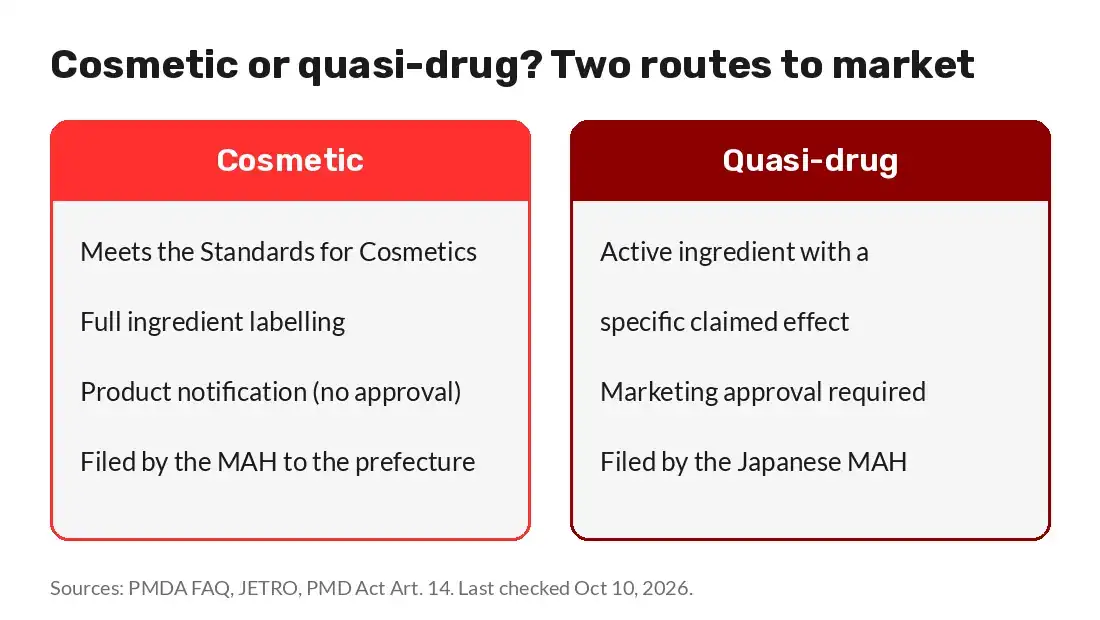
Classify the product first, because the route to market depends on it. A cosmetic that meets the Standards for Cosmetics does not need a marketing approval. A product with an active ingredient that claims a specific effect is generally a quasi-drug (医薬部外品) and needs marketing approval, according to PMDA.
The classification depends on the ingredients and the claims. PMDA’s FAQ says the procedure varies by product and points buyers to MHLW and the MAH for questions about classification.
| Product type | Route under the PMD Act | Who files | Official source |
|---|---|---|---|
| Cosmetic that meets the Standards for Cosmetics, with full ingredient labelling | Product notification (届出), no approval | Japanese MAH, to the prefecture | MHLW, JETRO |
| Cosmetic with an ingredient MHLW says needs approval | Product-by-product approval | Japanese MAH | PMD Act Art. 14, JETRO |
| Quasi-drug (active ingredient, specific claim) | Marketing approval | Japanese MAH | PMDA FAQ |
What is a Marketing Authorization Holder (MAH), and do you need one?
Yes. To import and sell cosmetics in Japan, the company placing them on the market needs a cosmetics marketing licence (化粧品製造販売業許可). JETRO explains that the application goes to the pharmaceutical affairs division of the prefecture where the office of the General Marketing Compliance Officer (総括製造販売責任者) is located (PMD Act Article 12).
In practice, this means one of two options for an overseas brand:
- Your Japanese buyer or distributor already holds the licence and acts as your MAH.
- You appoint a third-party MAH service, or set up your own Japanese entity and apply for the licence.
The licence application needs, among other things, company registration documents, an organisation chart and proof that the compliance officer has the required qualifications, such as a pharmacist licence (JETRO).
A second licence is needed for some activities. If imported cosmetics are packed, labelled or stored in Japan, the site doing that work needs a cosmetics manufacturing licence (化粧品製造業許可), issued per site by the prefecture (PMD Act Article 13, JETRO). This matters if you plan to put Japanese labels on products after they arrive.
Is an Importer of Record (IOR) the same as an MAH?
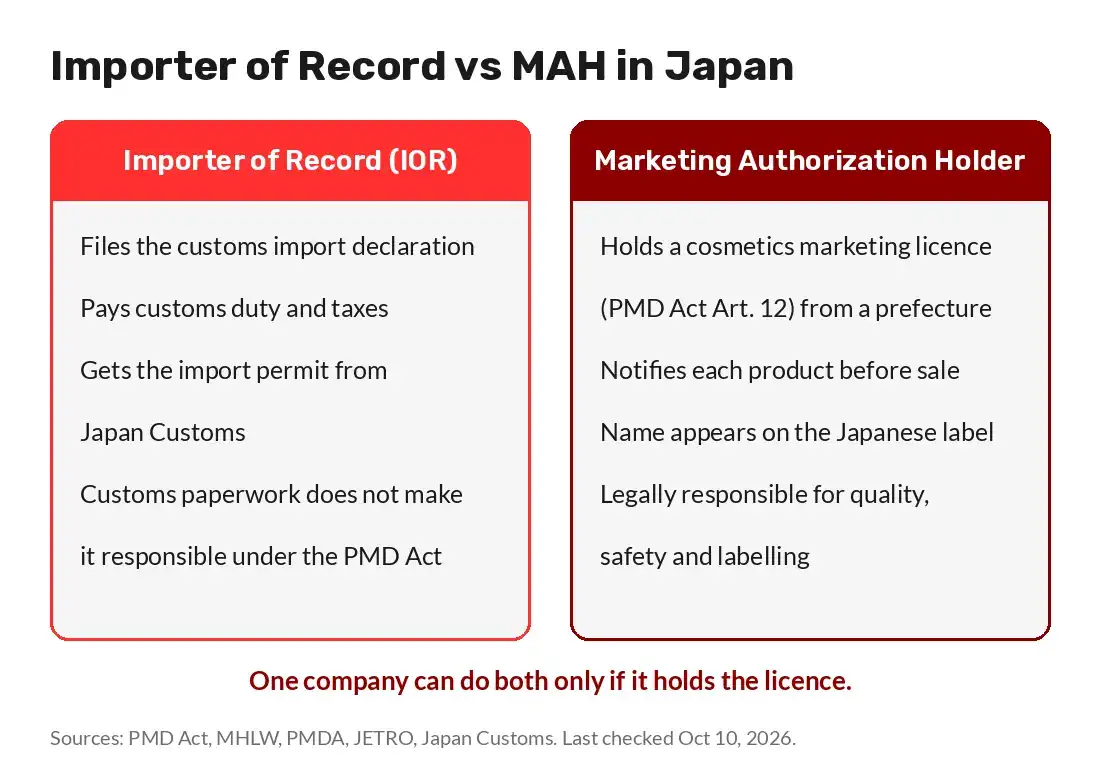
No. An importer of record is the party responsible for the customs declaration, duties and taxes. An MAH is the party legally responsible under the PMD Act for the quality, safety and labelling of the cosmetic on the Japanese market. One company can do both jobs only if it actually holds the cosmetics marketing licence. Ask any partner to show you the licence before you rely on it. You can read more about the IOR role in our guide to what an importer of record is and why it matters.
Does your formula meet Japan’s Standards for Cosmetics?
Every cosmetic sold in Japan must comply with the Standards for Cosmetics (化粧品基準, MHW Notification No. 331 of 2000). MHLW publishes an English version.
The standards work in two ways:
- Negative list: ingredients that are banned (Appendix 1) and ingredients that are allowed only up to a set limit (Appendix 2).
- Positive list: preservatives (Appendix 3) and UV absorbers (Appendix 4) may only be used if they are on the list, and only up to the maximum amount per 100 g.
Tar colours are controlled by a separate ministerial ordinance. Any other ingredient may be used if it is not on the negative list, but the company is responsible for confirming its safety. This is why your MAH will ask for a full formula with percentages, not just the ingredient list on your label.
Practical tip: A formula that is legal in the USA or the EU is not automatically legal in Japan. Check every preservative and UV filter against Appendices 3 and 4 before you print packaging.
What filings are needed before the first shipment?
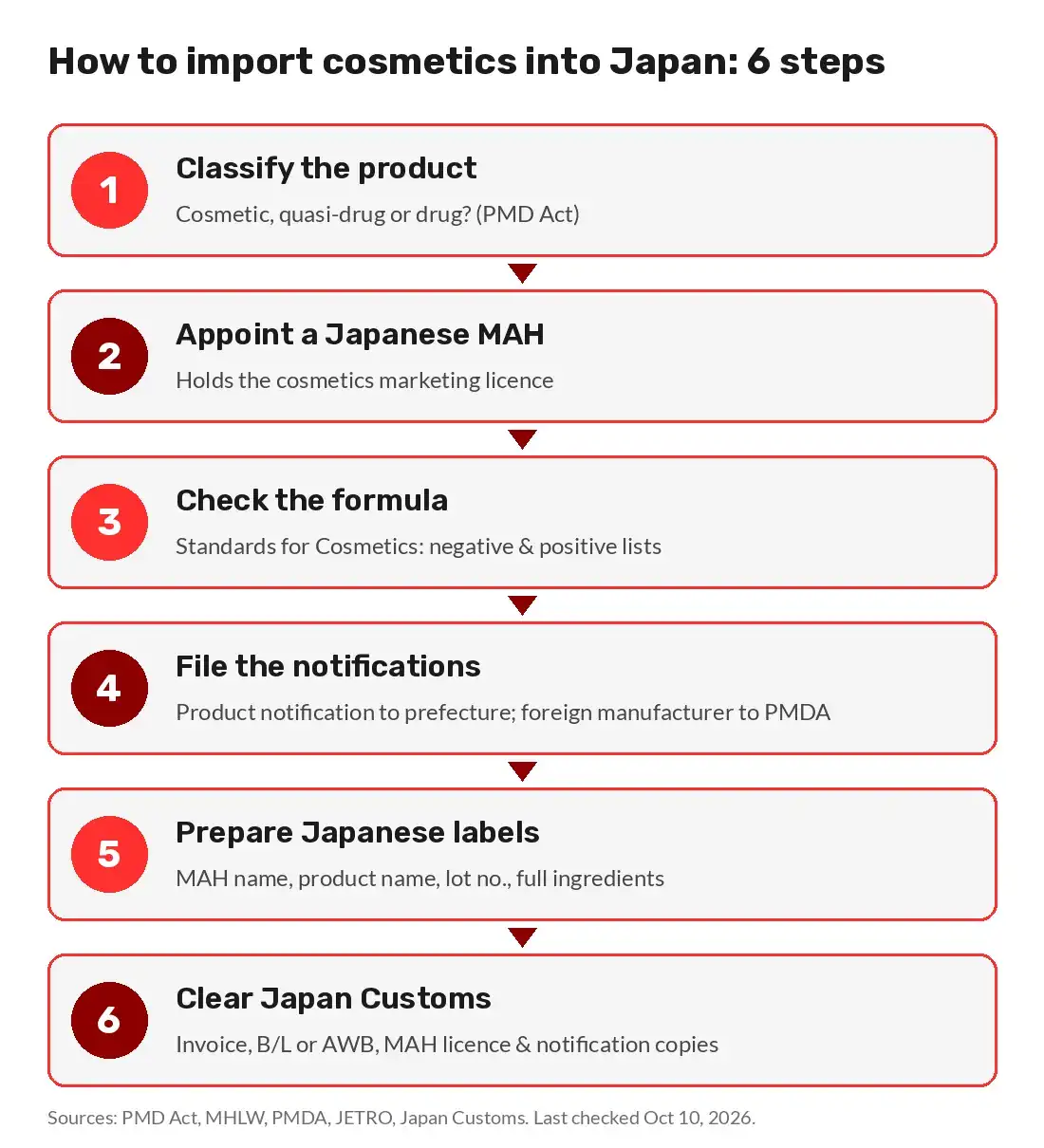
For a standard cosmetic, there is no product approval, but the MAH must file notifications before selling.
Step 1: Cosmetic product notification to the prefecture
The MAH notifies each product (販売名, manufacturing site and other details) to the governor of the prefecture where its main office is, before marketing it (PMD Act Article 14-9). In Tokyo, this goes to the Tokyo Metropolitan Institute of Public Health, usually through the FD electronic application software.
Step 2: Foreign manufacturer notification through PMDA
When the cosmetic is made outside Japan, the MAH also notifies the name and address of the foreign manufacturer to the Minister of Health, Labour and Welfare through PMDA (PMD Act Article 80, as described by the Tokyo Metropolitan Institute of Public Health and JETRO).
Step 3: No separate import notification any more
Since January 1, 2016, a separate cosmetics import notification (輸入届) is no longer required. Instead, at customs clearance the importer presents copies of the cosmetics marketing licence and the product notification, according to the Tokyo Metropolitan Institute of Public Health. Confirm the exact documents with the customs office handling your shipment.
What must a Japanese cosmetics label show?
The direct container or packaging must show, in Japanese, the MAH’s name, the product name, the lot or manufacturing number and, in principle, all ingredients (全成分表示), according to JETRO’s summary of the PMD Act. False or misleading statements are prohibited.
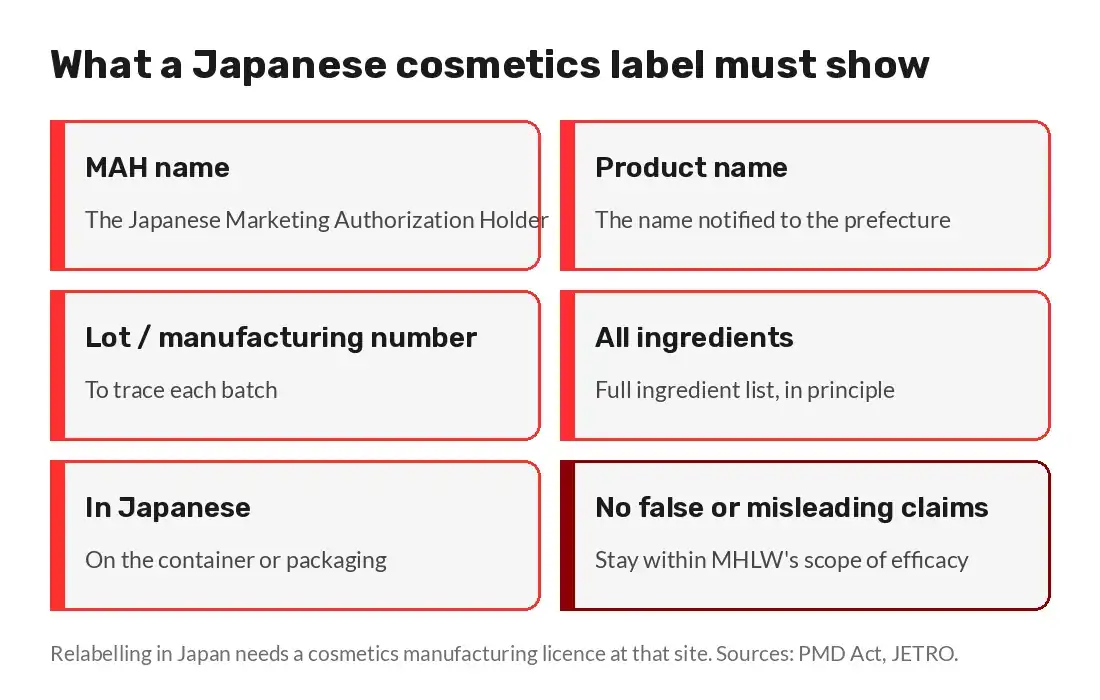
Claims are also limited. MHLW publishes the permitted “scope of efficacy” (効能の範囲) for cosmetics. Claims beyond that scope, such as treating a skin condition, can turn a cosmetic into a quasi-drug or drug in the eyes of the regulator. The industry body’s Fair Competition Code on cosmetics labelling also applies to labels and advertising (JETRO).
If you add Japanese labels after arrival, remember that labelling is a manufacturing activity that needs a cosmetics manufacturing licence at that site.
How does Japan Customs clear a cosmetics shipment?
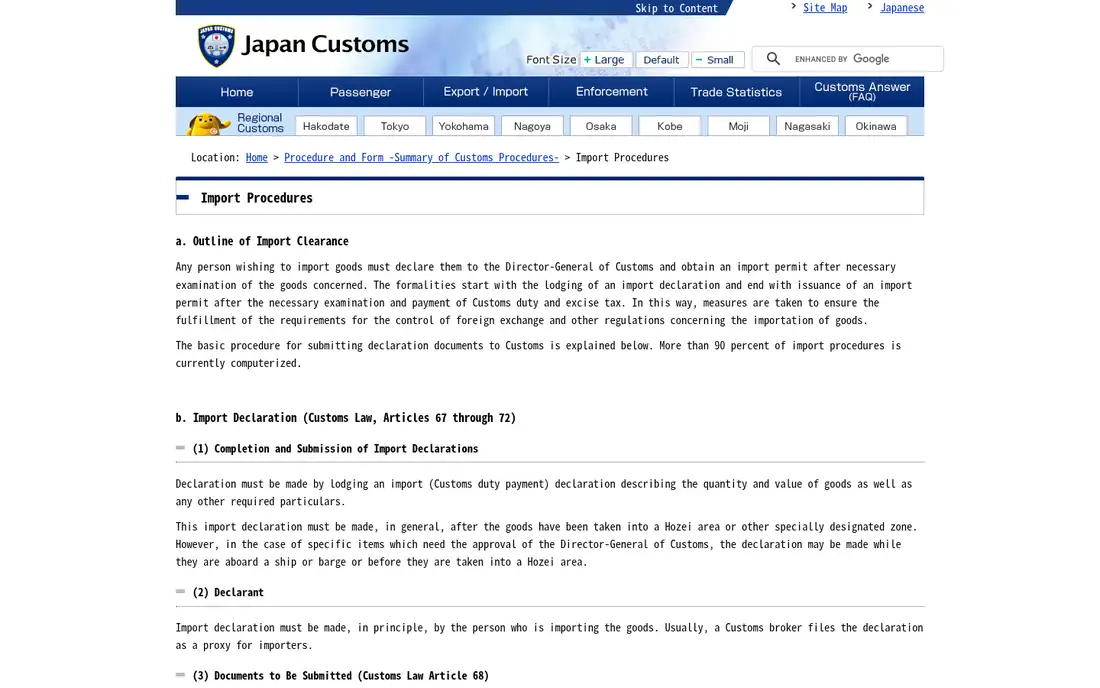
The importer files an import declaration with Japan Customs and receives an import permit after examination and payment of customs duty and taxes. Usually a licensed customs broker files the declaration for the importer, according to Japan Customs.
Documents usually include:
- commercial invoice;
- bill of lading or air waybill;
- packing list and freight or insurance documents where needed;
- a certificate of origin if you claim a preferential or WTO rate;
- licences and certificates required by other laws, which for cosmetics means copies of the MAH’s marketing licence and product notification.
HS codes for beauty products vary: for example, beauty and make-up preparations and sunscreen (HS 3304), hair preparations (HS 3305), shaving preparations (HS 3307) and soap (HS 3401), per JETRO. JETRO recommends asking Japan Customs for an advance ruling (事前教示) on the exact code. We do not quote duty rates here because they change, so confirm them with your customs broker. Our customs clearance in Japan guide explains the general clearance process.
Aerosols need extra care. Spray products fall under the High Pressure Gas Safety Act. JETRO explains that they can be exempted if the importer’s test results show the product meets the published requirements (contents of 1 litre or less and internal pressure of 0.8 MPa or less).
Counterfeits are seized. Goods that infringe trademarks or other IP rights are prohibited imports, even if the importer did not know they were fake (Japan Customs, JETRO).
Not sure which route your product needs? Send us your product list and the destination market, and we will tell you what information to prepare before you talk to an MAH. Request a quote.
Which requirements apply, at a glance?
| Requirement | What it means | Who is responsible | Source |
|---|---|---|---|
| Cosmetics marketing licence | Licence to place cosmetics on the Japanese market | Japanese MAH | PMD Act Art. 12, JETRO |
| Cosmetics manufacturing licence | Needed for packing, labelling or storing imported cosmetics in Japan | The Japanese site doing the work | PMD Act Art. 13, JETRO |
| Standards for Cosmetics | Negative list (Appendices 1–2), positive list (Appendices 3–4) | Brand and MAH | MHLW Notification No. 331 |
| Product notification | Filed per product before marketing | MAH, to the prefecture | PMD Act Art. 14-9 |
| Foreign manufacturer notification | Name and address of the overseas maker | MAH, via PMDA | Tokyo Metropolitan Institute of Public Health |
| Japanese label | MAH name, product name, lot number, full ingredients | MAH | JETRO |
| Import declaration | Invoice, B/L or AWB, licence and notification copies | Importer or customs broker | Japan Customs |
| Personal-use exemption | Up to 24 standard-size units per item for personal use is outside PMD Act control | Individual buyer, not business | JETRO |
The personal-use rule does not apply to stock you plan to sell. Commercial samples above certain quantities need a confirmation certificate (輸入確認証) from the Regional Bureau of Health and Welfare (JETRO).
What are the most common mistakes overseas beauty brands make?
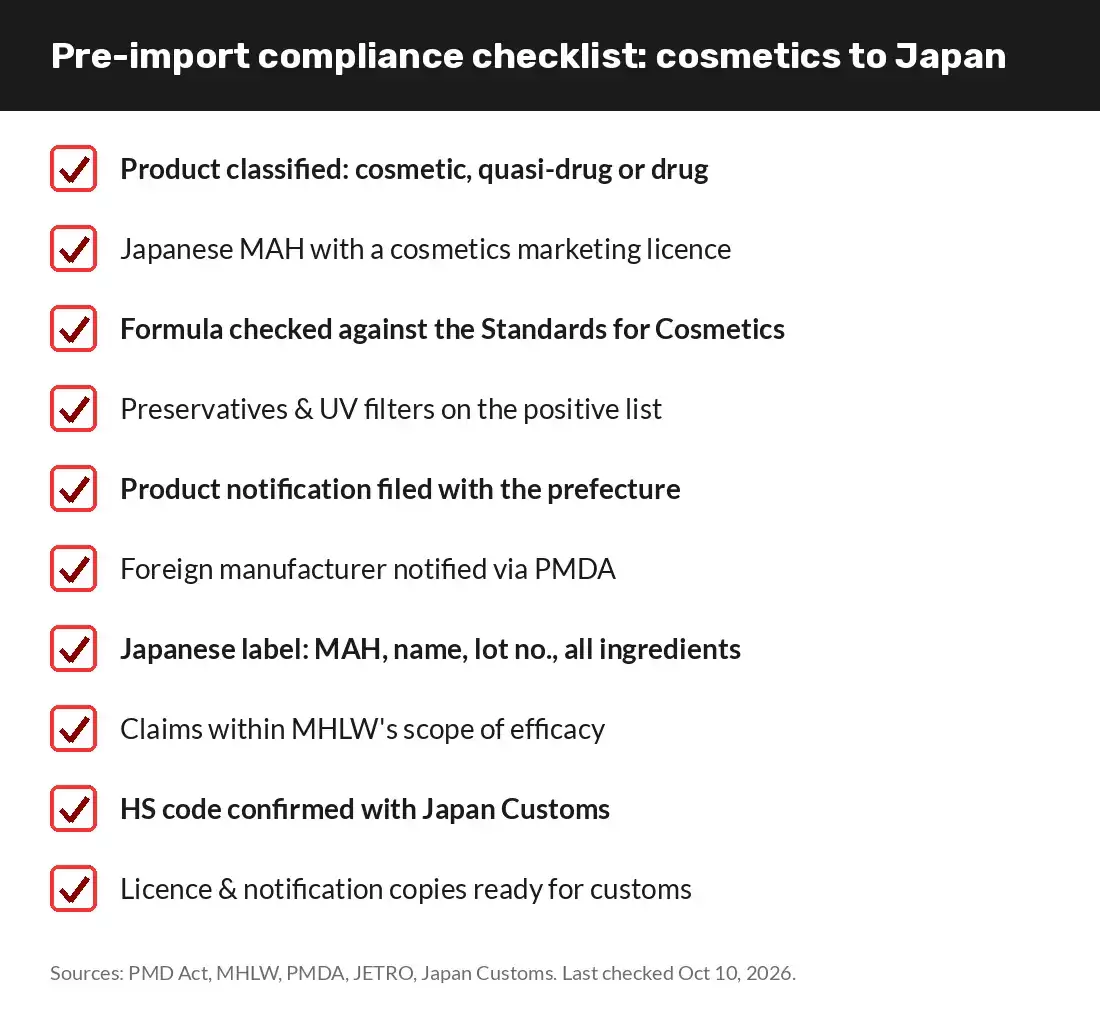
- Treating the IOR or freight forwarder as the MAH. Customs paperwork does not make anyone legally responsible for the product under the PMD Act.
- Printing packaging before the formula check. A preservative or UV filter outside the positive list can force a reformulation and new packaging.
- Using Western marketing claims. Claims outside MHLW’s permitted scope of efficacy can reclassify a product as a quasi-drug.
- Labelling in a warehouse without a manufacturing licence. Relabelling in Japan is a regulated manufacturing step.
- Assuming the personal-use exemption covers test sales. Selling even small quantities is commercial and needs the full route.
Frequently asked questions
Can a foreign company be the MAH for cosmetics in Japan?
Not from abroad. The cosmetics marketing licence is granted by the prefecture where the General Marketing Compliance Officer’s office is located, so the MAH needs an office and a qualified officer in Japan. Overseas brands usually use their distributor, a third-party MAH service, or their own Japanese subsidiary.
Do cosmetics need PMDA approval before sale in Japan?
Usually not. PMDA says a cosmetic does not need marketing approval if it complies with the Standards for Cosmetics. The MAH files a product notification with the prefecture instead. Products with active ingredients are generally quasi-drugs, and those do need marketing approval.
Is an import notification still required for cosmetics?
No. The separate import notification for cosmetics was abolished on January 1, 2016. At customs clearance, the importer now shows copies of the cosmetics marketing licence and the product notification. Check the exact list with the customs office that will handle your shipment.
Do labels have to be in Japanese?
Yes. The required information, including the MAH’s name, the product name, the lot number and the full ingredient list, must appear on the container or packaging in Japanese. If the Japanese label is added after import, the site doing it needs a cosmetics manufacturing licence.
Can I send samples to Japanese buyers without an MAH?
Small quantities of samples may be allowed with the right documents, but larger quantities need a confirmation certificate from the Regional Bureau of Health and Welfare, according to JETRO. There is no fixed size rule for “standard size”, so confirm with Japan Customs and the regional bureau before you ship.
Sources
Last checked: October 10, 2026.
- e-Gov Law Search: PMD Act (Act No. 145 of 1960), Japanese: https://laws.e-gov.go.jp/law/335AC0000000145
- Japanese Law Translation (Ministry of Justice): PMD Act, English: https://www.japaneselawtranslation.go.jp/en/laws/view/3213
- MHLW: Cosmetics and quasi-drugs homepage (Japanese): https://www.mhlw.go.jp/stf/seisakunitsuite/bunya/kenkou_iryou/iyakuhin/keshouhin/index.html
- MHLW: Standards for Cosmetics (English PDF): https://www.mhlw.go.jp/file/06-Seisakujouhou-11120000-Iyakushokuhinkyoku/0000032704.pdf
- PMDA: Frequently Asked Questions: https://www.pmda.go.jp/english/about-pmda/0004.html
- Tokyo Metropolitan Institute of Public Health: notifications for cosmetics marketing (Japanese): https://www.tmiph.metro.tokyo.lg.jp/k_yakuji/i-sinsa/cosmetics/todokede/
- JETRO: Import procedures for cosmetics, Japan (Japanese, updated August 2025): https://www.jetro.go.jp/world/qa/04M-010768.html
- Japan Customs: Import procedures: https://www.customs.go.jp/english/summary/import.htm
- Japan Customs: Prohibited and restricted imports: https://www.customs.go.jp/english/summary/prohibit.htm
Rules change. This article is general information, not legal or regulatory advice. Confirm your product classification, formula and labels with a licensed Marketing Authorization Holder or a Japanese regulatory consultant before importing.
Ready to bring your beauty brand to Japan?
Tell us what you sell, where it is made and how you plan to sell it in Japan. Our Tokyo team will help you plan the import, customs clearance and logistics, and point out what you need from a licensed MAH. Request a quote or explore our import and export services.