
Every trade deal changes the math on import costs, and few markets offer importers as many advantages as Japan right now. Japan trade agreements like the EU-Japan Economic Partnership Agreement, the CPTPP, and the U.S.–Japan pacts have rewritten tariff schedules across sectors from automotive to agricultural products. If you import Japanese goods, Japan trade agreements decide how much duty you actually pay.
This guide explains what each trade agreement does, how rules of origin unlock preferential tariff treatment, and how Japan customs applies the customs tariff schedule at the border. Terra Global Sales Partners builds every import declaration around the best available tariff treatment, so the reduction you are entitled to is the reduction you receive.
How Japan Trade Agreements Lower Your Import Tariffs
At its core, a trade agreement is a promise: cut your tariff rates on my goods, and I will cut mine on yours. Japan trade agreements deliver that promise through staged tariff reductions, duties that fall to zero immediately for many lines and phase out over years for sensitive ones. The WTO sets the baseline, free trade agreements go further, and Japan has negotiated some of the world’s most generous ones.
For an importer, the practical win is tariff treatment below MFN rates. Japan trade agreements matter most where duties were highest: beef and pork, dairy products, wine, leather goods, and automotive parts. Check the tariff rate for your HS code under each EPA, the savings often decide whether a product line is viable. The economics of the tariff itself are worth understanding before you negotiate prices.
Related: Most Profitable Japanese Products to Import in 2026 Anber Miso Soup Ingredients 105g
EU-Japan EPA, The Deal That Reshaped Japan Customs for European Importers
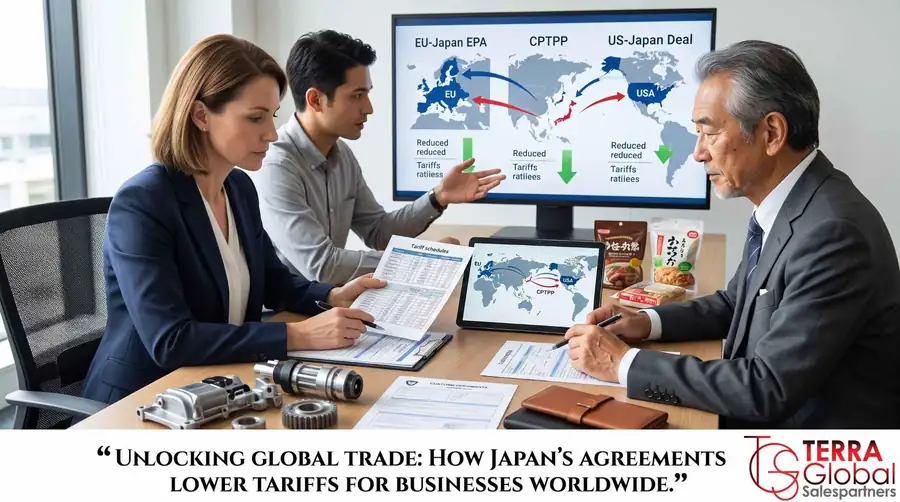
The EU-Japan Economic Partnership Agreement, the EPA that entered into force in 2019, is the largest bilateral trade deal the European Union has ever concluded. For Japan trade, it was a landmark: the EU scrapped duties on Japanese cars and electronics over a transition period, while Japan opened staged access for European cheese, wine, and pork.
Japan trade agreements do not get bigger than this one for European importers. Japan customs applies the EPA’s preferential tariff rates once you prove origin, more on rules of origin below. The Ministry of Foreign Affairs publishes the full legal texts, and Japanese authorities update guidance as staging completes. European buyers of Japanese goods, from machine tools to pharmaceuticals and medical devices saw some of the steepest tariff reductions of the recent trade era.
Related: Japan vs China vs Korea: Which Is Better for Product Sourcing? Aohata Spoon-Free Orange Jam 170g
CPTPP, One Pact, Eleven Markets, Zero Tariffs on Most Goods

The CPTPP, the Comprehensive and Progressive Agreement for Trans-Pacific Partnership, is Japan’s flagship free trade pact across the Pacific Rim. Japan ratified it among the first members, and it entered into force in late 2018; the UK’s accession took effect in 2024, making it a twelve-member bloc.
Japan trade agreements like the CPTPP give exporters cumulation: inputs from any member count toward origin, which simplifies sourcing across major trade partners. Japan trade agreements reward importers who think beyond one country, a component from Vietnam, assembled in Japan, can still qualify for preferential treatment in Canada or Mexico. For global trade strategy, few instruments beat it.
Related: Wholesale Buying: Importing from Japan Guide Ariake Gourmet Royal Beef Curry 210g
US–Japan Deals, What American Importers Actually Get
The U.S.–Japan trade deal, the phase-one agreement that entered into force in 2020, focused on agricultural products: American beef and pork, wheat, and wine gained staged access to Japan, while the U.S. cut duties on certain Japanese industrial goods. A separate digital trade agreement sets cross-border data rules.
Japan trade agreements with the U.S. keep evolving, watch Washington’s reciprocal tariffs debate and Tokyo’s responses. Japanese companies exported from Japan to America should model scenarios with their broker, since trade policy can shift faster than staging schedules, a constant in international trade. The Foreign Agricultural Service publishes useful importation data for agri-food lines.
Related: Japan vs China Manufacturing Asahi Ippon Manzoku Bar Giga Protein 65g
Rules of Origin, Proving Your Goods Qualify for Preferential Tariffs
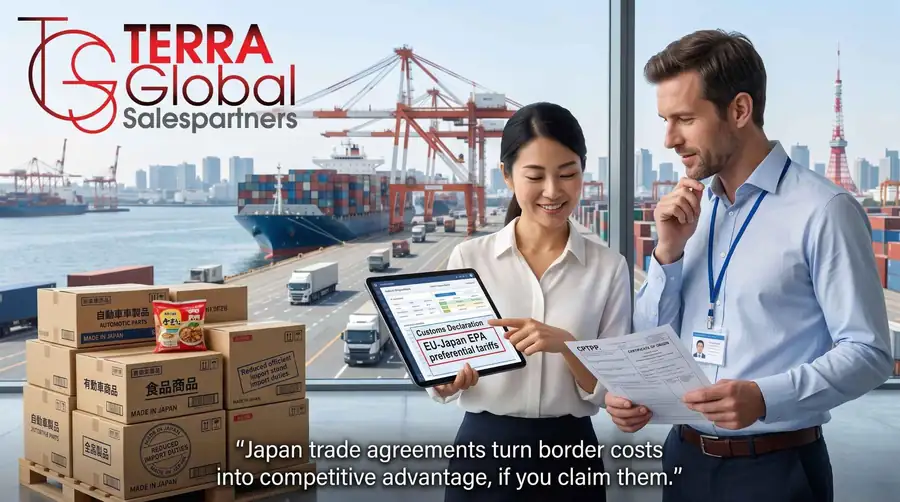
Tariff reductions mean nothing without proof. Rules of origin decide whether your Japanese goods truly qualify: wholly obtained, or substantially transformed under the pact’s formula. Japan trade agreements each define their own thresholds, and getting them wrong means paying full MFN duty plus penalties.
The importer, not the exporter, typically claims the preferential tariff at the customs office via the import declaration, backed by a supplier’s origin statement. Japan trade agreements increasingly accept self-certification, which cuts paperwork but raises your audit risk. Keep origin records for the years your trade agreement requires; Japanese exporters familiar with EPA shipments supply compliant statements as routine.
Related: Import Export Process from Japan: Documents, Costs, Timeline Explained Ajinomoto Umami Seasoning Aji Panda Bottle 70g
Japan Customs in Practice, Declarations, Tariff Schedules, and NACCS
Japan customs runs one of the world’s most digitized borders. The Nippon Automated Cargo and Port Consolidated System, NACCS, processes import declarations electronically, and the customs tariff schedule is published down to nine-digit detail under Japan’s tariff law. Japan trade agreements plug straight into this machinery: claim the EPA or FTA rate in NACCS, attach origin evidence, and the customs office clears accordingly.
METI and MOF, the Ministry of Finance, jointly administer the system, and MOF and METI guidance notes explain how each trade deal with Japan maps to tariff lines. When Japanese authorities audit, they check valuation, classification, and origin together, so consistency across documents is everything.
Related: Customs Clearance in Japan: Your Complete Importer Guide Takara Hon Mirin 1L
Agricultural Products, Automotive, and Other Key Sectors
Sector outcomes differ sharply. Agricultural products won big: beef and pork, dairy products, and wine saw the deepest tariff reductions, with MAFF, the Ministry of Agriculture, Forestry and Fisheries, overseeing quotas and safeguards. The automotive sector, Japan’s export engine, gained phased car-tariff elimination into Europe and parts liberalization across the Pacific.
Japan trade agreements also opened fishery products and processed foods, while semiconductor supply chains benefited as trade facilitation agreement commitments cut border friction. Note that food sanitation rules still apply, the Food Sanitation Act governs imports regardless of duty rates, so compliance work does not disappear when tariffs do.
Related: Why Japanese FMCG Products Lead in Global Markets Meiji Tokachi Smart Cheese Aged Cheddar 8pcs
Export Controls and Economic Security, What the Deals Don’t Cover?
Trade agreements cut tariffs; they do not erase export control. Japan’s FEFTA, the Foreign Exchange and Foreign Trade Act, plus the Export Trade Control Order govern dual-use goods and controlled technology, including semiconductor manufacturing equipment. The Economic Security Promotion Act added further screening, and unfair trade practices can trigger remedies outside any trade deal, and non-tariff trade barriers persist in sensitive sectors. Japan trade agreements assume compliant trade, know the control lists before you ship.
Related: Common Import-Export Mistakes When Sourcing from Japan Amarikoshin Best Japanese Pepper 150g
2026 Outlook, Recent Trade Moves and What’s Next
2026 finds Japan’s trade architecture mature but not static: new trade talks continue, recent trade data shows the trade deficit narrowing in some quarters while the trade surplus in autos persists, and the Japanese government keeps refining implementation. Japan’s policymakers watch U.S. tariff politics closely.
For importers, the lesson is evergreen: confirm the tariff rate in force today, not last year’s, before pricing. Japan trade agreements only save money when someone actually claims them.
Related: Step-by-Step Guide to Importing Goods from Japan Aohata Verde Curry Bread Toast Spread 100g
How Terra Global Sales Partners Puts These Trade Deals to Work?
Knowing the EPA exists and capturing its savings are different skills. Terra Global Sales Partners runs importation end to end: supplier verification, origin documentation, Japan customs brokerage coordination, and customs clearance at destination, every trade agreement with Japan your cargo qualifies for, claimed correctly.
From Japanese goods as familiar as everyday ramen to regulated equipment, one partner handles the import declaration, the preferential tariff claim, and the delivery. That is how a trade deal becomes real money.
Related: Why Terra Global Sales Partners Is a Trusted Trading Partner in Japan Acecook Super Cup 1.5x Soy Sauce Ramen 109g
Conclusion
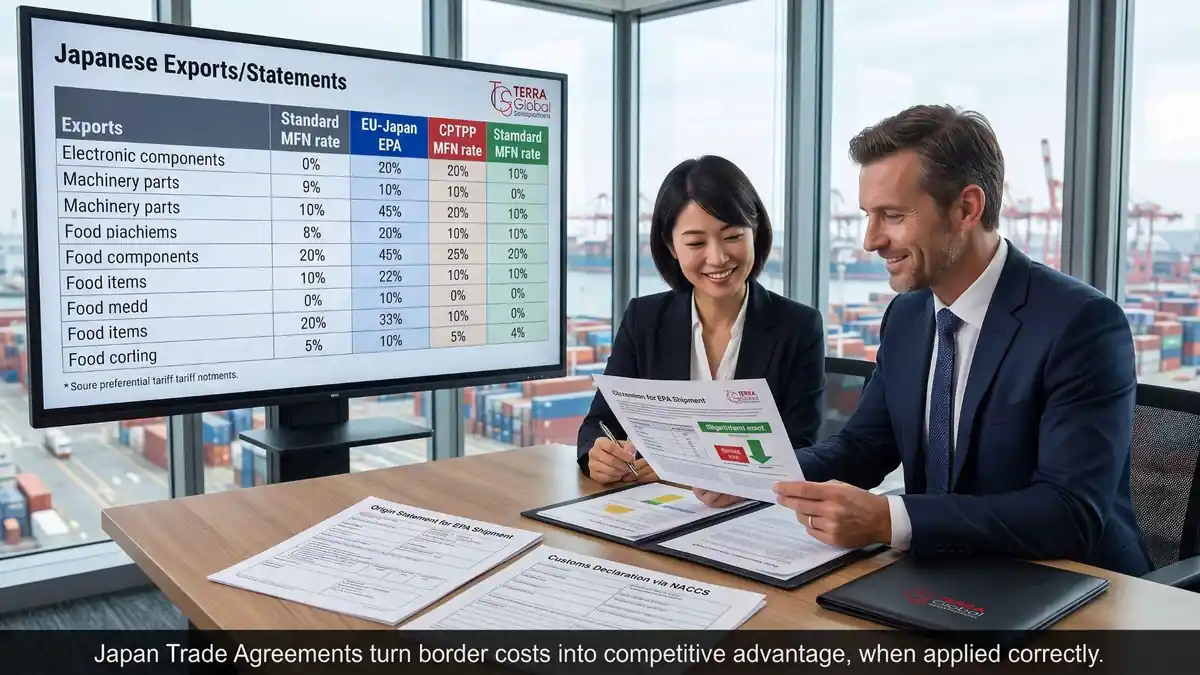
Japan trade agreements turn border costs into competitive advantage, if you claim them. Learn the rules of origin, file clean import declarations, and let Japan customs data work for you instead of against you. Terra Global Sales Partners makes every trade deal deliver: correct tariff treatment, full preferential savings, and reliable logistics from source to shelf.
Want to know which trade deal lowers the duty on your next order? See our customs clearance in Japan service or request a landed-cost quote from Terra Global Salespartners.
FAQs
Which Japan trade deal helps EU importers most?
The EU-Japan EPA, it phases out duties on cars, machinery, and many goods; food lines like cheese and wine get staged cuts too.
Do I need a certificate of origin for CPTPP rates?
Yes, or an origin declaration under self-certification. Your supplier must confirm the goods meet the pact’s rules of origin.
How do rules of origin work?
They define how much regional content a product needs to qualify for preferential tariffs. Check your agreement’s product-specific rule.
Are US–Japan tariff cuts automatic?
No. You must claim the preferential rate on your import declaration with valid origin documentation from your supplier.
Where can I check Japan’s current tariff rates?
Japan Customs publishes the tariff schedule online, and your customs broker can confirm the rate for your HS code.