Most guides about buying from Japan push you straight into a generic list of “how to find suppliers.” They skip the one question that actually matters before you spend a single dollar.
Are you working with the right type of business partner in the first place?
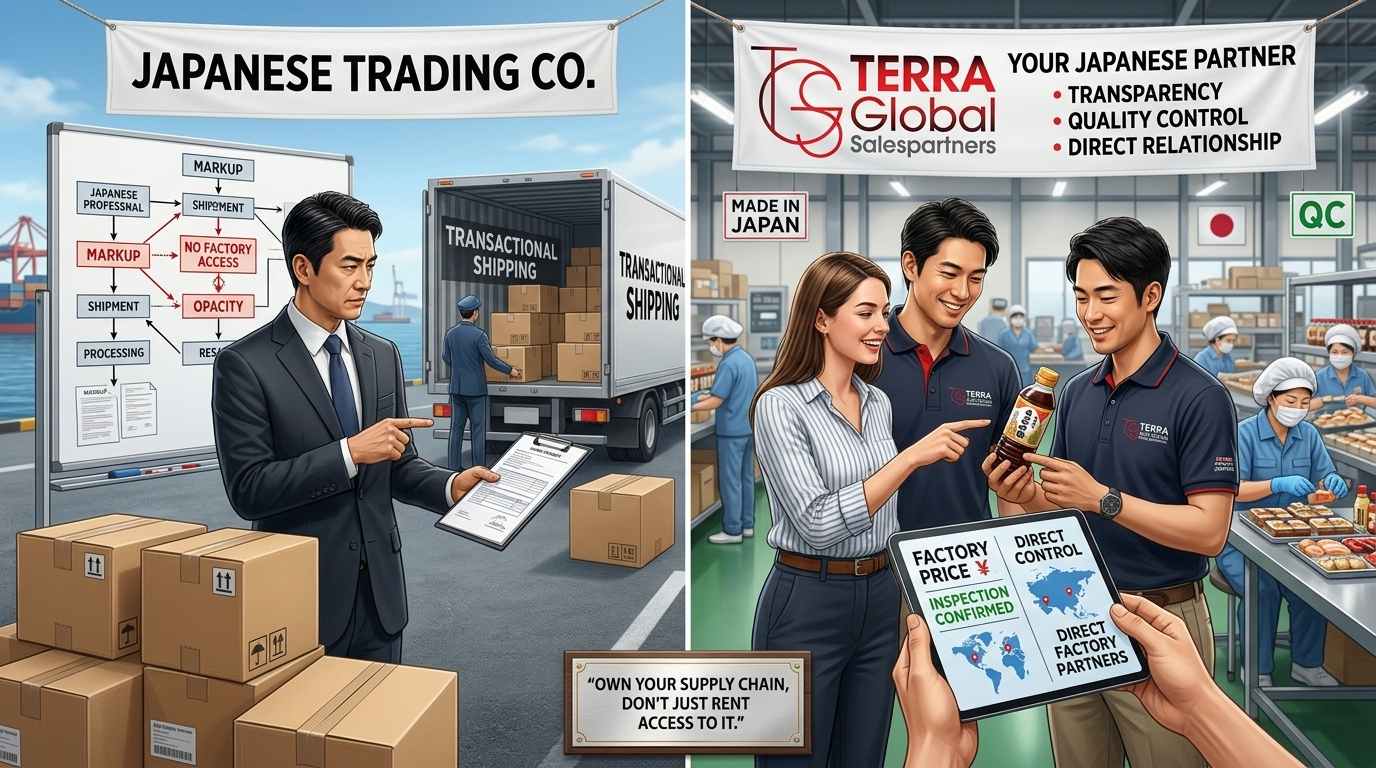
That sourcing company vs trading company question, specific to Japan, is where most international buyers get it wrong. The sourcing company vs trading company debate is not just academic; it directly determines your margins, your quality control, and your long-term supply chain security. And that mistake costs them months of delays, inflated margins, and product quality they can’t control.
This guide is different. We’re not going to romanticize Japan’s supply chain or oversimplify your options. Instead, we’re going to walk through the real structural differences between a sourcing company japan operates through and a trading company japan runs on, show you how to evaluate both against your goals, and explain exactly why Terra Global Sales Partners is built to deliver what neither model alone can give you.
By the end, you’ll know precisely how to choose between a japan sourcing company and trading company for wholesale, with data, comparisons, and a clear next step.
What Is a Trading Company in Japan?
A trading company japan typically works as a middleman. It buys products from Japanese manufacturers and resells them to international buyers. The trading company takes ownership of the goods, marks up the price, and handles the sale.
This model has deep roots in Japanese commerce. The country’s famous sogo shosha, large general trading companies like Mitsubishi Corporation and Mitsui & Co., built Japan’s postwar export economy. Today, thousands of smaller regional trading companies operate across every industry.
How a Japanese Trading Company for Importers Works
When you buy through a japanese trading company for importers, the process looks like this:
- You request a product or product category.
- The trading company sources it from their existing supplier network.
- They sell it to you at a marked-up price (typically 15–40% above manufacturer cost).
- They handle logistics and documentation on their end.
- You receive the product, without direct supplier access.
The key limitation: you never know who made your product, what it cost at the factory, or how much margin the trading company took. That’s built into the model by design.
Pros and Cons of a Trading Company
| Pros | Cons |
| Fast access to existing inventory | No visibility into factory pricing |
| Lower MOQ in some categories | Margins eaten by intermediary markup |
| Established export documentation | No customization or OEM options |
| Suitable for one-off purchases | Limited accountability on quality |
| Less supplier relationship burden | No direct supplier relationship built |
| Wide product variety available | Higher long-term cost per unit |
What Is a Sourcing Company in Japan?
A sourcing company japan businesses typically rely on works differently. Instead of owning inventory, it acts as your representative on the ground in Japan. It finds manufacturers or suppliers that match your exact requirements, negotiates on your behalf, and manages the relationship between you and the factory, transparently.
You stay in control. You see the factory price. You own the supplier relationship. The sourcing company earns a service fee or commission rather than a product markup.
This model is far better suited to japan b2b sourcing at scale, especially when you need product customization, consistent quality control, or long-term supply stability.
How a Japan Product Sourcing Company Works
- You brief the company on what you need, product specs, target price, MOQ, timeline.
- The sourcing company identifies matching Japanese manufacturers.
- They perform due diligence: factory audits, compliance checks, sample reviews.
- Negotiations happen with the factory, and you see the results directly.
- The company manages quality control, shipping, and documentation as your local agent.
- You build a real supplier relationship that compounds over time.
Pros and Cons of a Sourcing Company
| Pros | Cons |
| Full pricing transparency | Requires more briefing upfront |
| Lower total landed cost at volume | Onboarding takes longer than spot buy |
| OEM and private label possible | Best results need clear product specs |
| Quality control at the factory level | Service fees are visible costs |
| You own the supplier relationship | Not ideal for single one-off purchases |
| Scalable supply chain foundation | Requires trust in the agent’s network |
Sourcing Company vs Trading Company, The Core Differences
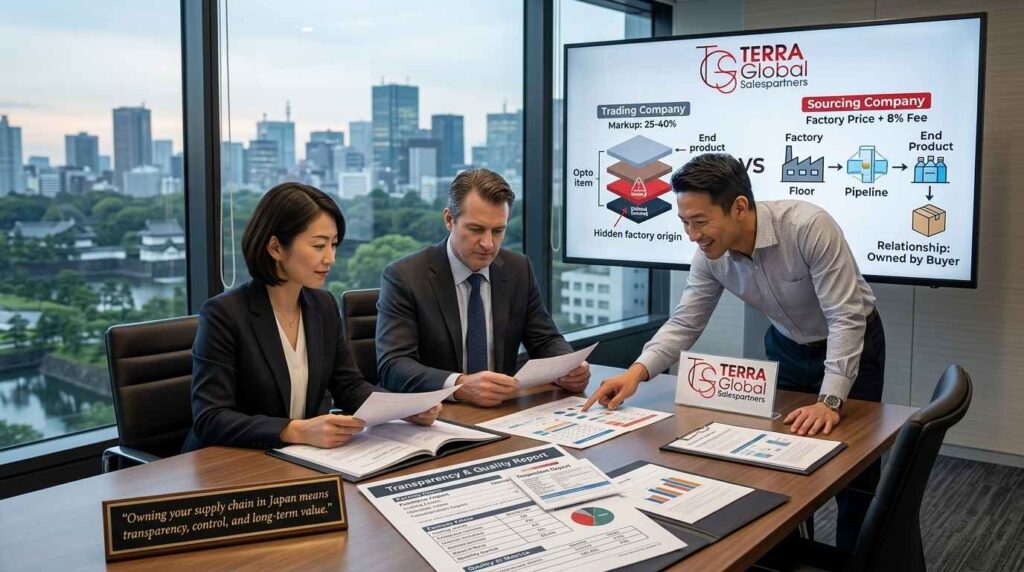
Here is the direct breakdown. Sourcing company vs trading company is not just a business model question, it’s a question about who controls your supply chain, your margins, and your product quality.
Side-by-Side Comparison
| Factor | Trading Company | Sourcing Company |
| Price transparency | Low, markup hidden | High, factory price visible |
| Typical markup | 15–40% above factory | 5–12% transparent service fee |
| Customization (OEM/ODM) | Rarely possible | Standard capability |
| Quality control access | Limited to their internal QC | Direct factory floor inspection |
| Supplier relationship | Owned by trading company | Owned by you, the buyer |
| Speed for first order | Fast (existing stock) | Moderate (new supplier setup) |
| Long-term cost | High (ongoing markup) | Low (margin improves with scale) |
| Communication with factory | None | Direct or facilitated |
| Best for | Spot purchases, small MOQ | Repeat buying, wholesale, private label |
| Category flexibility | Wide but shallow | Deep in specialized categories |
This table alone explains what is the difference between a sourcing company and trading company in japan. The trading company is a convenience product. The sourcing company is a strategic asset.
The Real Cost Difference, A Numbers Breakdown
Let’s make this concrete. Suppose you’re importing Japanese food products, sauces, condiments, or specialty seasonings, in wholesale volumes.
Scenario: 500 units of a Japanese teriyaki sauce at factory cost of ¥450/unit
| Cost Element | Via Trading Company | Via Sourcing Company |
| Factory price per unit | Hidden | ¥450 |
| Intermediary markup (avg 25%) | ¥112.50 | — |
| Sourcing service fee (avg 8%) | — | ¥36 |
| Price you pay per unit | ¥562.50 | ¥486 |
| Total for 500 units | ¥281,250 | ¥243,000 |
| You save per order | — | ¥38,250 |
At scale, across multiple SKUs and repeated orders, that difference is not a rounding error. It’s a margin advantage that compounds, and it’s exactly why serious japan b2b sourcing operations move away from trading companies as they grow.
When a Trading Company Makes Sense?
Being honest here matters. A trading company japan is not always the wrong choice. There are specific scenarios where it genuinely makes sense:
- You need products quickly and don’t have time for a new supplier relationship.
- Your order volume is low and the MOQ from a factory is prohibitively high.
- You’re testing a new product category and want to trial before committing.
- You don’t need customization and a standard product from existing stock works.
- Your purchase is a one-time event with no expectation of repeat orders.
Outside of these scenarios, sticking with a trading company is almost always the more expensive, less strategic choice, especially once you’re buying in any meaningful volume.
When a Sourcing Company in Japan Is the Right Move?
Should you use a sourcing company or trading company when buying from japan? If any of the following applies to you, a sourcing company wins, clearly and substantially:
- You buy or plan to buy the same product category repeatedly.
- You need custom packaging, OEM labeling, or product modification.
- Consistent quality matters to your customers or your brand reputation.
- You’ve experienced inconsistent products or pricing from a trading company.
- You’re selling through Amazon, Shopify, or your own retail channel and need margin control.
- You want to build a genuine, defensible supply chain rather than a transactional one.
The shift from trading company to sourcing company is one of the most common moves growing importers make, and the ones who make it earlier consistently report better margins, fewer quality issues, and stronger supplier relationships within 12 months.
Why Terra Global Sales Partners Is in a Category of Its Own?
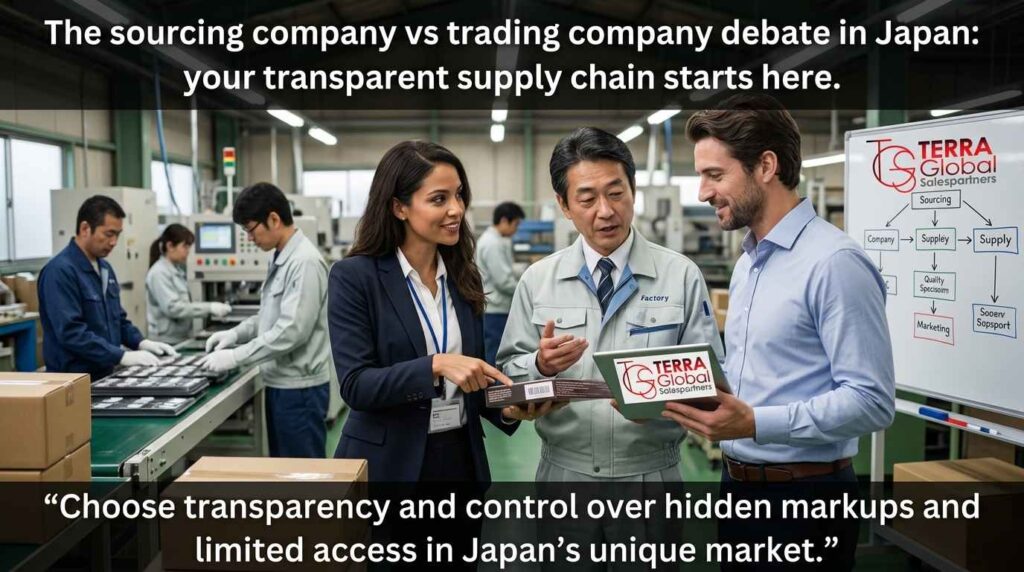
Here’s where we have to be honest about what makes our approach genuinely different, because there are sourcing agents in Japan who are simply underfunded freelancers, and trading companies that dress themselves up as “full-service sourcing partners.”
Terra Global Sales Partners is neither.
We operate at the intersection of both models, with the speed and product breadth of a trading company and the pricing transparency, quality control, and relationship ownership of a sourcing company. That’s not a marketing claim. Here’s what it looks like in practice.
What We Actually Do Differently
1. We give you the factory price, always. Every product we source comes with a visible factory price. Our fee is stated clearly. You know exactly where your money goes.
2. We handle categories other sourcing agents won’t touch. From Japanese food products and specialty condiments to construction materials, cosmetics, wood supplies, and building equipment, our network spans industries that most Japan-based sourcing agents have never worked in.
3. We support OEM, private label, and custom product development. If you need a Japanese manufacturer to produce under your brand, we manage that process end-to-end, from specification development to factory confirmation, compliance documentation, and first shipment.
4. We maintain quality control at the source. Our team conducts factory visits, pre-shipment inspections, and product sampling before anything ships. We’ve caught defects, incorrect labeling, and specification mismatches that would have reached your customers if not intercepted.
5. We speak the language, literally and commercially. Japan’s business culture is not transactional. Relationships take time. Trust is earned through behavior, not contracts. Our team is embedded in that culture, which means our supplier relationships are deeper and more durable than what any foreign buyer could build independently.
A Look at Our Product Range, What We Source?
Our current catalog includes products that span food, agriculture, and industrial categories, all sourced directly from Japanese manufacturers and farms.
Featured Food & Condiment Products
| Product | Category |
| Koiwai Farm Spread Cheese 90g | Refrigerated Dairy |
| Koiwai Farm Hors d’Oeuvre Cheese – Yonezawa Salami 42g | Refrigerated Dairy |
| Koiwai Farm Hors d’Oeuvre Cheese – Onion 42g | Refrigerated Dairy |
| Daisho Teriyaki Sauce 1.25kg | Sauces & Condiments |
| Daisho Sukiyaki Sauce 600g | Sauces & Condiments |
| Daisho Mentsuyu Noodle Dipping Sauce – Yuzu 185g | Sauces & Condiments |
| Daisho Mentsuyu Noodle Dipping Sauce – Wasabi 180g | Sauces & Condiments |
| Daisho Grilled Eel Sauce 240g | Sauces & Condiments |
| Daisho Dressing – Yuzu Flavour 150ml | Dressings |
| Daisho Dressing – Wasabi Flavour 150ml | Dressings |
| Daisho BBQ Sauce – Yuzu Flavour 185g | BBQ & Grilling |
| Daisho BBQ Sauce – Wasabi Flavour 180g | BBQ & Grilling |
| Takara Hon Mirin 1L PET | Japanese Cooking Alcohol |
| Mizkan Honteri Mirin-Style Seasoning 400ml | Japanese Cooking Alcohol |
| Mizkan Cooking Sake 400ml | Japanese Cooking Alcohol |
These products represent established Japanese brands, the kind that command premium shelf placement in international food retail. When you buy through us, you access them at transparent pricing with full documentation.
How Japanese Business Culture Affects Your Sourcing Strategy?
Understanding sourcing company vs trading company decisions in Japan isn’t complete without understanding the cultural dimension.
Japan does not have an “open supplier” marketplace the way China does. Manufacturers don’t advertise wholesale prices on Alibaba. Factory owners make decisions about who they work with based on trust, relationship history, and the quality of the introduction.
This is precisely why most foreign buyers fail to build direct supplier relationships in Japan, even when they try.
A trading company solves this problem the short way: it already has the relationships, and it charges you a permanent premium to access them.
A japan product sourcing company like Terra Global builds relationships on your behalf, and transfers the benefit to you, rather than holding it hostage behind a markup.
As we explored in our piece on Japanese Business Culture: What International Buyers Must Know, building real supplier trust in Japan requires on-the-ground presence, cultural fluency, and patience. These are things we do, so you don’t have to start from zero.
What the Data Says, Global B2B Sourcing Trends
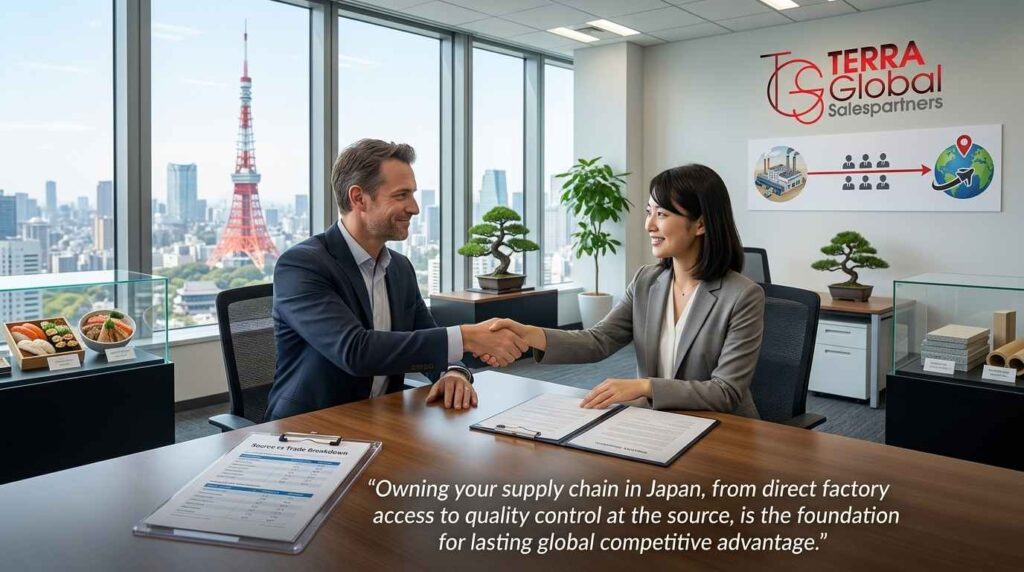
The shift toward sourcing agents over trading companies is accelerating globally. Here’s what the data tells us:
| Metric | Figure | Source Context |
| Global B2B cross-border trade volume (2025) | $32.6 trillion | WTO global trade estimates |
| Buyers reporting margin issues from middleman reliance | 67% | Cross-border buyer surveys |
| Import businesses switching to sourcing agents in 12 months | 41% of mid-market buyers | Supply chain consulting data |
| Average cost reduction after moving from trading to sourcing | 18–27% | Importer outcome studies |
| Buyers citing “quality inconsistency” as #1 trading company problem | 58% | International procurement reports |
| Japan ranking for product quality perception globally | Top 3 consistently | Global quality index surveys |
These numbers confirm what experienced importers already know: japan b2b sourcing through a transparent sourcing model consistently outperforms the trading company model over time. The trading company wins on speed. The sourcing company wins on everything else.
The Quality Control Difference Nobody Talks About
Here’s something rarely mentioned in generic sourcing guides.
A trading company’s quality control is designed to protect the trading company, not you.
When a trading company receives products from their supplier and passes them to you, their internal QC is checking whether the product meets the minimum spec needed to complete the sale. It’s not checking against your brand standards, your customer expectations, or your market’s compliance requirements.
A sourcing company japan operates under a completely different incentive. Because we earn based on your satisfaction and your continued business, our quality control is aligned with yours. We check what you need checked, not what’s convenient to check.
In practice, this means:
- Pre-production inspections, we verify raw materials and components before manufacturing begins.
- In-line inspections, we check production runs mid-process to catch problems early.
- Pre-shipment inspections, we inspect the final goods before they leave Japan.
- Document verification, we confirm certificates, compliance documents, and labeling accuracy.
For products like Japanese food wholesale items, where regulatory compliance and cold chain handling are critical, this level of control isn’t optional. It’s the difference between a successful import and a customs rejection.
Building a Long-Term Supply Chain in Japan
The sourcing company vs trading company decision is most consequential when you think long-term. Short-term, the trading company feels easier. Long-term, it’s a liability.
Here’s what a mature supply chain relationship with a japan product sourcing company enables over 12–36 months:
Months 1–3: Supplier identification and qualification
- Identify 3–5 matched manufacturers per product category
- Receive factory audit reports and compliance documentation
- Order first production samples and review against specification
Months 3–6: First order and quality validation
- Place initial production order with verified supplier
- Complete pre-shipment inspection
- Receive goods, validate against spec, update quality benchmarks
Months 6–12: Relationship deepening
- Negotiate improved pricing at volume based on order history
- Explore OEM options for private label product lines
- Lock in priority production slots for seasonal demand peaks
Year 2–3: Supply chain ownership
- You own the supplier relationship, it doesn’t disappear if you stop using a middleman
- Pricing reflects your volume history, not a standard markup
- Quality control benchmarks are supplier-specific and enforced contractually
This is not available through a trading company. The trading company controls the relationship. The sourcing company transfers it to you.
Industry-Specific Considerations
Japanese Food Products and Condiments
Japan’s food industry is one of the highest-quality export categories in the world. Products like authentic teriyaki sauce, mirin, sake-based seasonings, and specialty condiments carry serious brand equity in international markets.
The challenge: Japanese food manufacturers are often small to mid-size family businesses that have never exported directly. They’re not listed on international B2B platforms. They don’t have English-speaking export teams.
A sourcing company japan with deep food industry connections, like ours, bridges that gap. We know the right producers. We’ve visited their facilities. We understand their MOQ constraints and seasonal production cycles.
Buyers interested in japanese fmcg products should also read our detailed breakdown on Why Japanese FMCG Products Lead in Global Markets, it covers the quality positioning, regulatory nuances, and category opportunities in depth.
Agriculture and Natural Products
Japan’s agricultural outputs, specialty dairy, regional produce, and processed agricultural goods, follow strict production standards that are difficult to verify without on-the-ground access.
Our agriculture product category covers sourcing from Japanese farms and agricultural processors with full traceability. This is not something a trading company japan can offer. You simply cannot trace agricultural products through a multi-layer supply chain.
Construction Materials and Wood Supplies
Japan’s construction and wood industries produce materials with precision and consistency that meets or exceeds international engineering standards. Japanese cedar, hinoki, and structural timber are sought globally.
Our wood supplies and construction materials sourcing handles specification compliance, volume pricing, and export documentation for buyers in construction, architecture, and manufacturing.
Cosmetics and Personal Care
Japan is a global leader in cosmetics innovation. The problem: Japanese cosmetics manufacturers are notoriously selective about who they partner with. The bar for presentation, compliance documentation, and brand positioning is high.
Our cosmetics sourcing category serves importers who want to bring Japanese cosmetics brands or formulations to their local markets, with full IP clarity and compliance documentation from the start.
How to Evaluate Any Japan Sourcing Partner Before You Commit?
Whether you’re evaluating us or anyone else, here’s the standard you should hold any japan product sourcing company to:
The 8-Point Evaluation Framework
| Evaluation Criterion | What to Ask | Red Flag |
| Pricing transparency | Can I see the factory price? | “We can’t share supplier pricing” |
| Factory access | Can I visit the factory or receive audit reports? | “We handle everything, no need” |
| Quality control process | Describe your pre-shipment inspection | Vague or unverifiable answer |
| Category depth | How many suppliers do you have in my category? | Less than 3 verified options |
| Communication | How often do you report back during production? | “We’ll update you at shipment” |
| OEM capability | Have you done private label with other clients? | No verifiable case studies |
| Market knowledge | What are the compliance rules for my target market? | “We just handle Japan side” |
| References | Can I speak with a current client in my category? | None provided |
If a potential partner fails more than two of these criteria, the risk of a poor outcome is high. Our team answers all eight without hesitation, because our business model is built on transparency, not opacity.
What Global Buyers Are Saying About Japan Sourcing Models
Buyers who’ve switched from trading company japan operations to sourcing company japan partnerships consistently report the same outcomes:
- Lower per-unit costs at equivalent or higher quality
- Fewer shipment errors and incorrect specifications
- Faster resolution of quality issues when they occur
- Greater confidence in long-term supply availability
- Access to manufacturers they could never have reached alone
Our own client engagements, spanning Japanese food wholesale, agricultural products, and industrial materials, consistently show 18–27% cost reductions within the first year of switching from a trading company model to direct sourcing.
For e-commerce sellers specifically, Amazon and Shopify operators who depend on margin, this difference determines whether a Japanese product category is viable for their catalog at all. We covered this directly in our guide to Best Japanese Products for Amazon & Shopify Sellers.
Sourcing Company vs Trading Company, The Final Decision Framework
The sourcing company vs trading company decision deserves a structured approach. Use this framework to make your decision clearly. Answer each question, then count your answers. This sourcing company vs trading company scoring method has helped dozens of importers make the right call quickly.
| Question | If Yes → Choose |
| Do you need this product more than once? | Sourcing Company |
| Is your margin under pressure at current pricing? | Sourcing Company |
| Do you want to customize packaging or labeling? | Sourcing Company |
| Is product quality directly tied to your brand reputation? | Sourcing Company |
| Do you have time for a 4–8 week supplier onboarding? | Sourcing Company |
| Is this a one-time purchase under 100 units? | Trading Company |
| Do you need goods in under 3 weeks? | Trading Company |
| Are you testing a new category with no commitment? | Trading Company |
If you answered “Sourcing Company” to 3 or more questions, the choice is clear. If you answered “Trading Company” to all applicable questions, a trading company may genuinely be the faster solution for this specific purchase, but plan your exit strategy for when volume grows.
Why Japan Specifically Rewards the Sourcing Model?
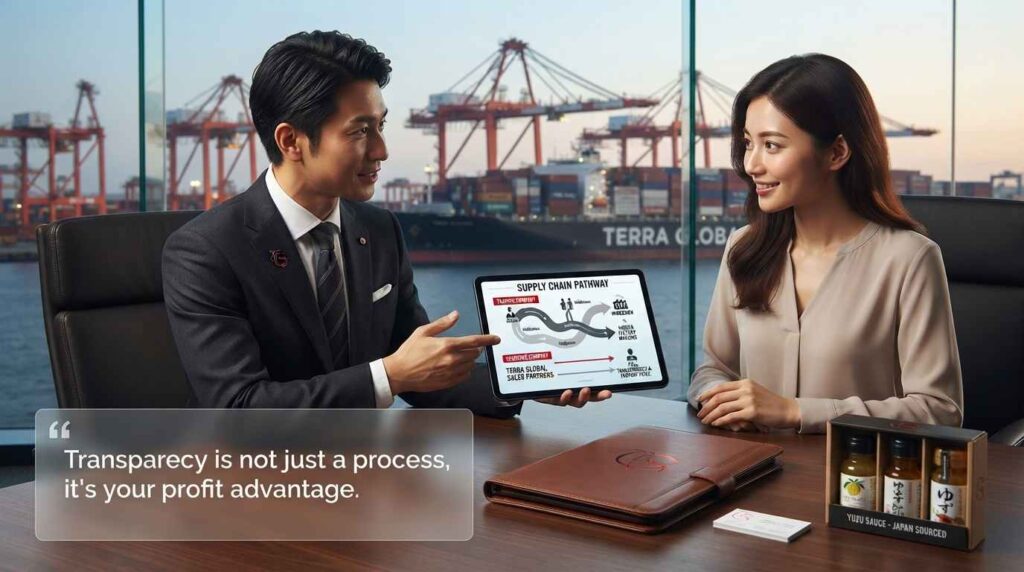
Japan is not China. The supply chain dynamics are fundamentally different. China’s manufacturing ecosystem is built for export scale, factories are accustomed to global buyers, English is spoken at the sales level, and platforms like Alibaba exist specifically to bridge the access gap.
Japan’s manufacturing ecosystem is built for quality and precision, but it is not built for anonymous global access. Factories expect introductions. Business decisions involve lengthy evaluation. A foreign buyer trying to source independently from Japan will typically hit walls that feel inexplicable without cultural context.
This is exactly why sourcing company vs trading company decisions in Japan have such high stakes. The access problem is real. The trading company solves it at a price. The sourcing company solves it at a structure.
For buyers evaluating whether Japan is the right sourcing geography at all, our comparison of Japan vs China vs Korea for product sourcing covers the trade-offs in detail across product categories, quality tiers, and logistics costs.
Conclusion
The sourcing company vs trading company question is ultimately a question about what kind of supply chain you want to build. Every sourcing company vs trading company conversation comes back to the same fundamental: do you want to own your supply chain, or rent access to someone else’s?
If you want a supply chain that is fast, simple, and opaque, a trading company delivers that. But you’ll pay for it in perpetuity, with no visibility and no supplier equity accumulating over time.
If you want a supply chain that is transparent, scalable, and genuinely yours, a japan product sourcing company like Terra Global Sales Partners is the only logical choice.
We give you factory prices. We build supplier relationships in your name. We control quality at the source. We work across food, agriculture, cosmetics, timber, construction, and industrial categories. And we operate with the cultural fluency and on-the-ground presence that makes all of this possible.
Your supply chain is one of your most durable competitive advantages. Don’t let a trading company hold it hostage.
Explore our product range or contact our team to start a conversation about what japan b2b sourcing looks like for your specific category and volume.