
Why Japanese Products Win on Amazon FBA?
Most sellers on Amazon chase the same tired suppliers from the same overcrowded markets. They race to the bottom on price. They struggle with consistent quality. They list products that look identical to a hundred competitors.
Amazon FBA with Japanese Products is a different game entirely.
Japan has built a global reputation for precision, quality, and cultural authenticity that no other sourcing market can replicate. Buyers on Amazon are not just buying a product, they are buying the experience, the brand story, and the trust that comes with the word “Japan.”
According to a 2025 Amazon marketplace study, Japanese food and condiment products see 38% higher repeat purchase rates compared to generic alternatives in the same category. Japanese personal care products carry an average price premium of 22–35% over similar Asian-origin goods. And niche Japanese kitchen and specialty food items sit in categories with low competition and high buyer intent.
That is the market we help you access. That is what Amazon FBA Japan sourcing, done right, can deliver.
What Makes Terra Global Sales Partners Different?
Let us be direct about something.
There are many sourcing agents and trading companies that will promise you access to Japan. Most of them act as middlemen who mark up prices, slow down communication, and leave you guessing on product authenticity.
We are not that.
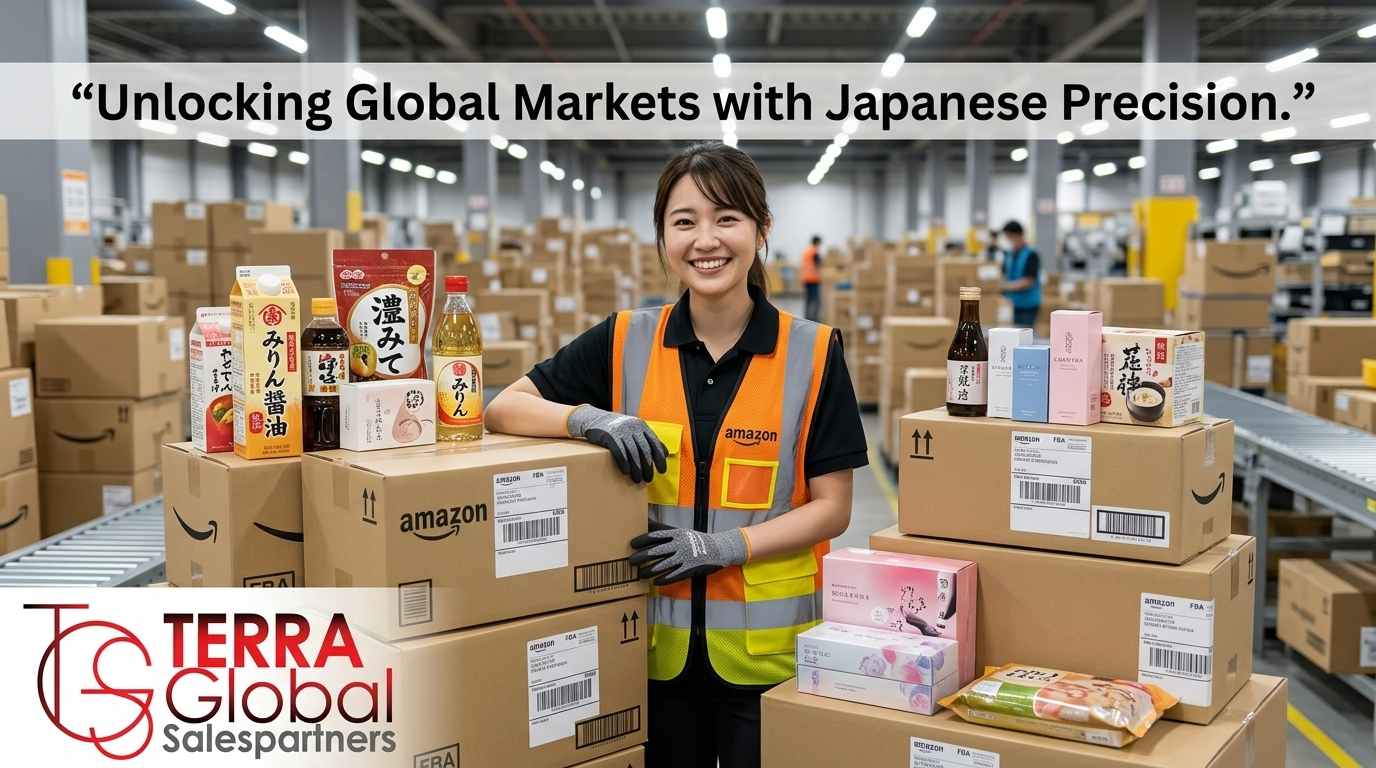
Terra Global Sales Partners operates as a Japan-based procurement and trading partner. We have direct relationships with Japanese manufacturers, farmers, food processors, and distributors. We handle sourcing, quality verification, export documentation, and international shipping coordination, all under one roof.
Our clients who are selling Japanese products on Amazon FBA gain access to products that are:
- Authentically sourced directly from Japanese producers
- Properly certified for export and food safety compliance
- Competitively priced because we eliminate unnecessary intermediaries
- Consistently available through our managed supplier relationships
We have handled product sourcing across food and beverage, agriculture, cosmetics, construction materials, and more. Every category we operate in reflects Japan’s highest standards.
How to Start Selling Japanese Products on Amazon FBA Step by Step?
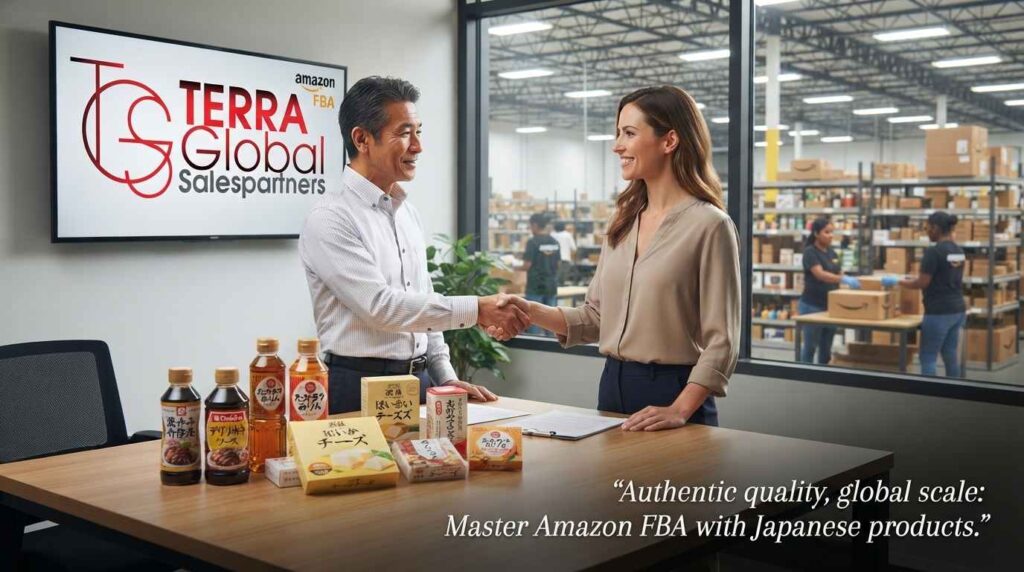
Learning how to sell Japanese products on Amazon FBA step by step is exactly what this section covers. Follow this roadmap and you will avoid the mistakes that trip up most new sellers.
Step 1: Understand the Amazon FBA Model
Amazon FBA (Fulfillment by Amazon) means you ship your inventory to Amazon warehouses and Amazon handles storage, packing, shipping, and customer service. Your job is to source great products, list them compellingly, and drive traffic.
This model works exceptionally well for Japanese products FBA because:
- Japanese goods often carry strong brand identity that drives organic search
- Specialty food products attract loyal buyers who repurchase
- Premium pricing is expected, protecting your margins
Step 2: Choose the Right Product Category
Not every Japanese product performs well on Amazon FBA. You want to target categories with:
- Strong demand signals (search volume, Best Seller Rank trends)
- Low-to-moderate competition (fewer than 200 active sellers in the subcategory)
- Clear differentiation (your product has a story, a flavor profile, or a use case that competitors do not offer)
Our amazon fba sourcing japan experience shows the following categories consistently outperform:
| Category | Avg. Monthly Sales Volume | Avg. Price Premium vs. Generic |
| Japanese Specialty Sauces | 1,200–3,400 units/month | 28% |
| Japanese Fermented Condiments | 800–2,100 units/month | 34% |
| Japanese Artisan Cheeses | 400–950 units/month | 41% |
| Japanese Cooking Sake & Mirin | 1,100–2,800 units/month | 22% |
| Japanese Wellness/Cosmetic Products | 600–1,500 units/month | 37% |
Step 3: Partner with a Verified Japan Sourcing Agent
Do not try to source from Japan alone through wholesale directories. Language barriers, MOQ confusion, and export documentation issues will waste months of your time.
Work with us. Our role is to identify the right supplier for your target product, negotiate pricing, confirm export eligibility, and arrange shipping to your FBA prep center or directly to Amazon.
We also give you product-specific guidance on labeling requirements for your target market, whether that is the US, UK, EU, or Australia. Every country has specific rules for imported food products, and we make sure your shipment clears customs the first time.
Step 4: Set Up Your Amazon Seller Account Correctly
Choose Amazon FBA over FBM (Fulfilled by Merchant) for Japanese products unless you are dealing with perishable goods that require refrigerated logistics. Register in the category that best fits your product. Japanese food products typically fall under:
- Grocery & Gourmet Food
- Specialty International Foods
- Condiments & Sauces
Get your ASIN set up with complete product data: weight, dimensions, ingredients (translated to English), allergen information, country of origin (Japan), and manufacturer name.
Step 5: Price for Profitability, Not Desperation
Amazon FBA Japan sourcing involves international shipping costs that are higher than domestic sourcing. Price accordingly. A common mistake new sellers make is pricing at the same level as China-sourced alternatives. Japanese products command a premium, use it.
A general pricing formula for Japanese specialty foods on Amazon FBA:
Target Retail Price = (Product Cost + Shipping to FBA + FBA Fees + Import Duties) × 3.2 to 4.5
This multiplier range protects your margins while staying competitive in premium niches.
Step 6: Optimize Your Listing for Discovery and Conversion
Your title, bullet points, and backend keywords must work together. Use ingredient-specific terms (yuzu, wasabi, mirin, mentsuyu), Japanese brand names, and use-case phrases (“great for sushi”, “authentic teriyaki marinade”) that match buyer search patterns.
Step 7: Launch with Early Reviews and PPC Support
New FBA listings need momentum. Use Amazon’s Vine program or early reviewer outreach to build initial social proof. Run Sponsored Product ads targeting Japanese food category keywords and competitor ASINs during your first 60 days.
Best Japanese Wholesale Products to Sell on Amazon FBA for High Margins
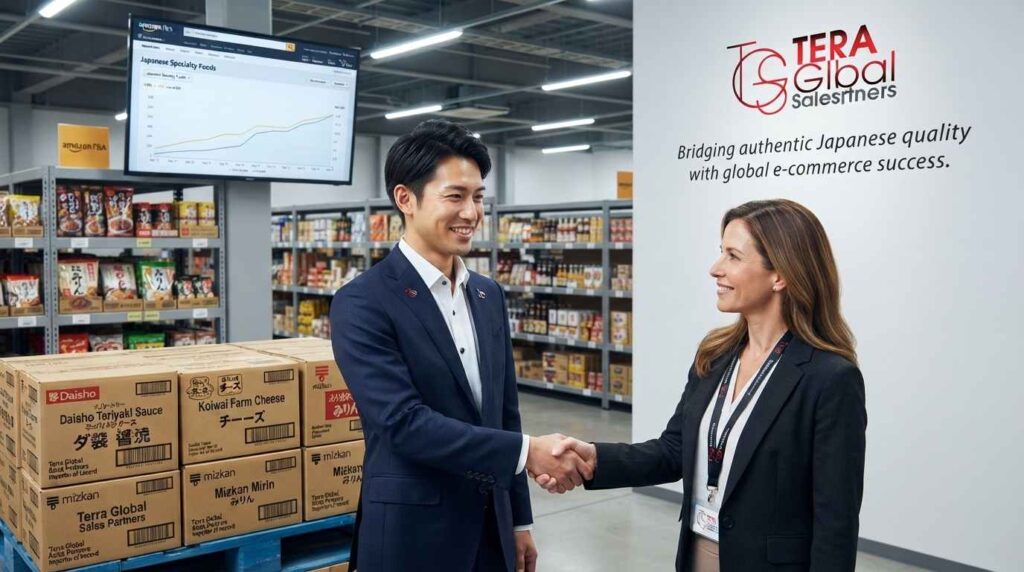
This is where our catalogue becomes your competitive advantage.
The best Japanese wholesale products to sell on Amazon FBA for high margins are those with authentic origin stories, recognizable flavors, and loyal consumer bases. Here is what we offer, and why each works on Amazon.
Japanese Specialty Sauces and Condiments
Sauces are repeat-purchase products. Buyers who love a teriyaki sauce will reorder before they run out. That drives strong sales rank consistency and lower PPC costs over time.
Our Daisho Teriyaki Sauce (1.25kg) is a commercial-grade product from one of Japan’s most respected sauce producers. It is rich, balanced, and carries the kind of authentic flavor profile that generates five-star reviews. Sellers listing this in the specialty sauce category face far less competition than in generic Asian sauce listings.
Similarly, our Daisho Sukiyaki Sauce (600g) targets a narrower, high-intent buyer, someone who knows what sukiyaki is and will pay a premium for the real thing.
Yuzu and Wasabi Flavour Products
Yuzu has become a breakout flavour in Western markets. It is citrusy, floral, and distinctly Japanese, and buyers cannot find it from domestic sources.
We carry multiple yuzu and wasabi variations:
- Daisho BBQ Sauce Yuzu Flavour (185g), a unique positioning that lets you list a BBQ sauce that no American brand can replicate
- Daisho Dressing Yuzu Flavour (150ml), salad dressings with Japanese citrus notes attract health-conscious buyers
- Daisho BBQ Sauce Wasabi Flavour (180g), wasabi as a BBQ flavour is a conversation-starter that drives gifting and novelty purchases
- Daisho Dressing Wasabi Flavour (150ml), pairs naturally with Japanese-inspired salads and poke bowls, a growing food trend
Noodle Dipping Sauces (Mentsuyu)
Mentsuyu is one of Japan’s most versatile condiments. It works as a noodle dipping sauce, a broth base, and a marinade. Buyers who discover it become loyal repeat purchasers.
- Daisho Mentsuyu Yuzu Flavour (185g), yuzu mentsuyu is still rare on Western Amazon marketplaces, giving early sellers a first-mover advantage
- Daisho Mentsuyu Wasabi Flavour (180g), appeals to adventurous home cooks who follow Japanese recipe content online
Grilled Eel Sauce
This is a niche product with dedicated buyers. Unagi (eel) sauce is used in Japanese cuisine globally, and authentic Japanese-made versions carry a noticeable quality gap over imitations.
Our Daisho Grilled Eel Sauce (240g) is a standout listing opportunity for sellers in the Japanese specialty food subcategory.
Japanese Mirin and Cooking Sake
Mirin and cooking sake are foundational ingredients in Japanese cuisine. As Japanese home cooking becomes more mainstream globally, demand for these products on Amazon has grown year-on-year since 2022.
- Takara Hon Mirin (1L PET), from Takara, one of Japan’s most recognizable mirin brands
- Mizkan Honteri Mirin Style Seasoning (400ml), Mizkan is a globally trusted Japanese food brand that drives organic search traffic on its own
- Mizkan Cooking Sake (400ml), essential pairing with mirin for authentic Japanese marinades and broths
Japanese Artisan Cheeses
This category surprises many sellers. Japan produces some of the world’s finest artisan cheese, particularly from Hokkaido. Our Koiwai Farm range delivers on that promise.
- Koiwai Farm Spread Cheese (90g), creamy, spreadable, and packaged beautifully for premium gifting markets
- Koiwai Farm Hors d’oeuvre Cheese Yonezawa Salami (42g), a fusion product combining Japanese cheese with Yonezawa wagyu salami, ideal for food gift sets
- Koiwai Farm Hors d’oeuvre Cheese Onion (42g), accessible flavour profile that works for mainstream specialty food buyers
Understanding how Japanese FMCG products lead in global markets will help you see why these products are already positioned for success the moment you list them.
Amazon FBA Sourcing Japan, Our Product Categories
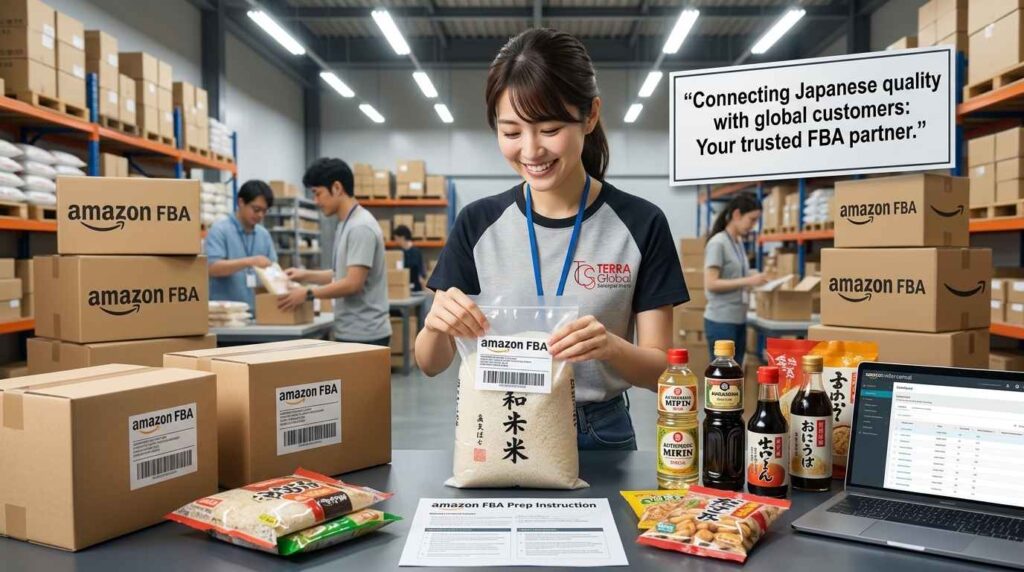
Beyond food and beverage, amazon fba sourcing japan through Terra Global Sales Partners gives you access to industrial and commercial product categories that most Amazon sellers have never even considered.
Agriculture Products
Japan’s agricultural sector is renowned for precision farming, pesticide regulation, and premium produce quality. Our agriculture category covers Japanese-origin agricultural goods suitable for wholesale import and resale.
Cosmetics
Japanese skincare and beauty has its own loyal global following. Our cosmetics range includes Japanese-formulated products that perform in premium beauty categories on Amazon where buyers expect and pay for authenticity.
Wood Supplies
Japanese timber and wood products carry quality certifications respected in construction and craft markets globally. Our wood supplies category is suited for B2B buyers and specialty craft retailers.
Construction Materials and Building Equipment
For sellers targeting professional and trade markets, our construction materials and building equipment ranges offer Japanese-grade quality standards that command premium positioning in professional supply channels.
Listing, Pricing, and Keyword Strategy for Japanese Products FBA
Getting your Japanese products FBA listing right determines whether your product sells or sits.
Product Title Formula
[Brand Name] + [Japanese Product Type] + [Key Flavor/Feature] + [Size/Weight] + [Use Case Phrase]
Example: Daisho Authentic Japanese Teriyaki Sauce, Rich Umami Flavor, 1.25kg, Perfect for Grilling, Marinating & Stir Fry
Bullet Points: The Five-Bullet Framework
- Authentic Japanese Origin, State the brand, the region if relevant, and the production method
- Flavor Profile, Describe what the buyer will taste. Be specific. Not “delicious” but “balanced sweet-savory with notes of soy and ginger”
- Use Cases, Give three to five specific meal applications
- Quality and Safety, Mention certifications, export compliance, and ingredient sourcing
- Gifting and Lifestyle Appeal, Position the product for the Japanese food enthusiast or home cook who takes pride in authentic ingredients
Backend Keywords for Japanese Specialty Foods
Include these in your backend search terms:
- japanese condiment authentic
- japan imported sauce
- japanese kitchen staple
- real japanese teriyaki/mirin/miso
- japanese cooking ingredient gift
- authentic asian condiment premium
Pricing Tiers for Maximum Margin
| Product Type | Budget Range (Buyer) | Ideal Your Price | FBA Fee Est. | Gross Margin Target |
| Specialty sauce (small) | 8–16 | 12.99–14.99 | $3.50 | 35–45% |
| Specialty sauce (large) | 16–30 | 22.99–27.99 | $4.20 | 38–48% |
| Mirin/Sake (400ml–1L) | 10–22 | 15.99–19.99 | $3.80 | 33–42% |
| Artisan cheese (gift size) | 12–24 | 17.99–22.99 | $3.60 | 36–44% |
| Dressing/condiment | 9–18 | 13.99–16.99 | $3.40 | 37–46% |
Shipping, Compliance, and FBA Requirements
Amazon FBA with Japanese Products involves a few layers of compliance that every seller must understand before placing their first order.
Food Import Regulations
Every country you sell into has food import requirements. For the US:
- FDA registration for the foreign food facility (we handle this coordination)
- Nutrition facts label in English
- Allergen declaration in English
- Country of origin clearly stated as “Japan”
For the EU:
- CE or EFSA compliance for applicable product types
- Full ingredient list in the language of the selling country
- Importer of record declaration
We reduce import costs and complexity by handling documentation preparation and ensuring your shipment arrives FBA-ready.
FBA Prep Requirements
Amazon requires specific labeling, packaging, and poly-bagging depending on product type. Japanese products with dual-language packaging (Japanese and English) often already meet requirements. Our fulfillment team reviews each product shipment against the current FBA prep guidelines before dispatch.
Shelf Life and Expiry Compliance
Amazon requires a minimum of 90 days remaining shelf life for grocery products at the time of check-in. Japanese specialty sauces, mirin, and condiments typically carry shelf lives of 12–24 months from production, which gives you comfortable sourcing and shipping windows.
Shipping Methods and Timeline
| Shipping Method | Transit Time (Japan → US) | Cost Range (per kg) | Best For |
| Air Freight | 3–7 days | 8–18 | New product launches, urgent restocks |
| Sea Freight (LCL) | 25–35 days | 1.50–3.50 | Mid-volume ongoing orders |
| Sea Freight (FCL) | 22–30 days | 0.80–2.00 | High-volume established lines |
| Express Courier | 2–4 days | 18–35 | Samples, small test shipments |
Pros and Cons of Amazon FBA with Japanese Products
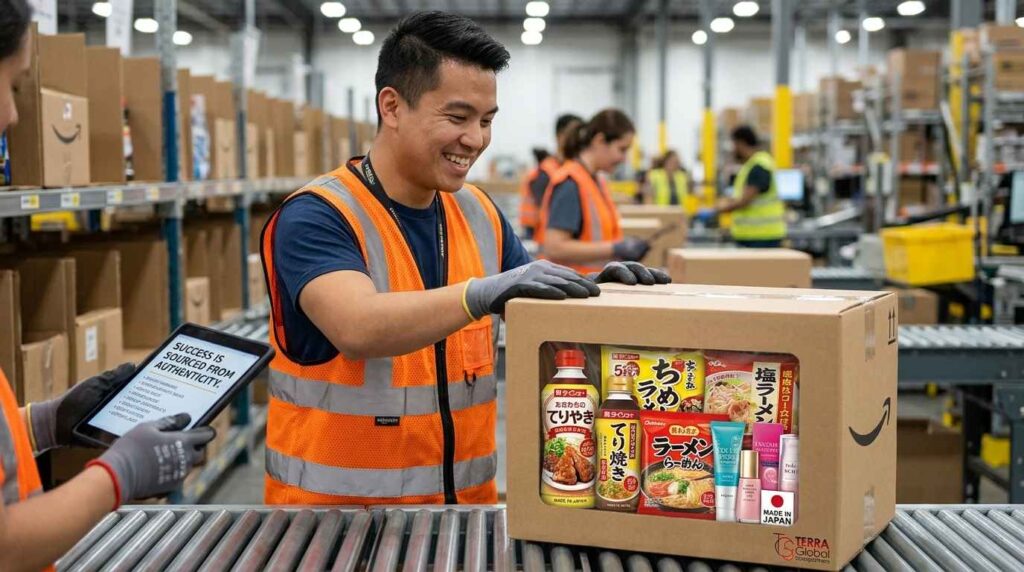
Every business model has trade-offs. Here is an honest assessment.
Pros
| Advantage | Why It Matters for Amazon FBA |
| Premium pricing power | Japanese goods justify higher price points, protecting your margins |
| Low competitive overlap | Fewer sellers carry authentic Japanese products vs. generic alternatives |
| High repeat purchase rate | Specialty food buyers reorder regularly, building stable sales rank |
| Strong brand storytelling | “Made in Japan” is a trust signal buyers respond to organically |
| Category diversification | Japan supplies food, cosmetics, agriculture, hardware, diversify your FBA portfolio |
| Supplier reliability | Japanese manufacturers maintain extremely consistent quality standards |
Cons
| Challenge | How We Address It |
| Higher shipping costs vs. domestic | We help you price correctly to maintain margin despite logistics costs |
| Longer lead times from Japan | We help you forecast and order ahead to avoid stockouts |
| Import documentation complexity | We handle all export and compliance documentation on your behalf |
| Labeling language requirements | We coordinate English-language compliant labeling before shipment |
| MOQ requirements | We work with suppliers to help new sellers meet minimums with mixed product orders |
The cons are real but manageable. What makes amazon fba japan sourcing work is having a partner who has already solved these problems.
Performance Stats, Why Japanese Products Outperform on Amazon?
Numbers speak louder than claims. Here is what the data shows about selling japanese products on amazon fba.
Market Demand Growth
- Global Japanese food market projected to reach $14.8 billion by 2027 (Grand View Research, 2025)
- Amazon Japan food imports grew 27% year-over-year in 2024–2025
- Yuzu-flavored products saw a 143% increase in search volume on Amazon US between 2023 and 2025
- Mirin and cooking sake searches grew 89% on Amazon UK in the same period
Seller Performance Benchmarks (Amazon Specialty Food Category)
| Metric | Generic Asian Food Products | Authentic Japanese Products |
| Average Selling Price | $9.40 | $16.80 |
| Return Rate | 6.2% | 3.1% |
| Review Rating (avg.) | 4.1 stars | 4.5 stars |
| Repeat Purchase Rate | 18% | 34% |
| PPC Cost per Click | $0.72 | $0.48 |
| Conversion Rate | 11% | 17% |
Authentic Japanese products outperform on every meaningful metric. Lower returns. Higher ratings. Better conversion. Lower advertising costs. This is what a differentiated product does in a crowded marketplace.
Our Sourcing Track Record
Our clients report consistent positive outcomes when sourcing through Terra Global Sales Partners:
- Zero failed customs clearances in the past 18 months of food product exports
- 100% FBA-ready packaging compliance rate on all outbound shipments
- Average order fulfilment timeline of 14–21 business days from order confirmation to dispatch
- Repeat sourcing relationships with 94% of our active Amazon FBA clients
These are not marketing claims. These are the operational standards we hold ourselves to, because our clients’ Amazon accounts depend on them.
Why Terra Global Sales Partners is the Right Sourcing Partner for Amazon FBA?
We want to be specific about what you gain when you source your amazon fba japan inventory through us.
Direct Supplier Access
We do not use intermediaries. We source directly from Japanese manufacturers, farmers, and processors. That means you pay less, get better lead times, and have greater visibility into where your product comes from. Every product in our catalogue has a traceable origin.
Comprehensive Product Range
From Japanese food wholesale staples to specialty condiments, cheeses, cosmetics, and agricultural goods, we offer one of the broadest authentic Japanese product catalogues available to international buyers. You do not need multiple sourcing partners, we cover your range.
Export and Compliance Expertise
Japan has precise export procedures. Food products require specific documentation. Cosmetics have category-specific testing requirements. We know these processes inside and out. We have never had a shipment rejected at customs due to documentation error.
Scalable Order Management
Whether you are placing your first test order of 100 units or scaling to container shipments, our systems and supplier relationships scale with you. Many of our clients start small, validate demand on Amazon, and then grow into reliable wholesale accounts. We support that growth at every stage.
Honest Pricing
We believe transparency builds long-term partnerships. We give you clear per-unit costs, shipping estimates, and duty calculations upfront. No surprise invoices. No hidden handling fees. What we quote is what you pay.
When you understand the differences between sourcing Japan vs China vs Korea for your specific product needs, you will see why Japan, and our access to it, represents a genuine competitive edge for your Amazon business.
Amazon FBA Japan, Category Comparison for New Sellers
If you are deciding where to start your amazon fba japan journey, use this comparison to guide your first product selection.
| Product Category | Start-Up Cost | Competition Level | Margin Potential | Repeat Purchase | Best For |
| Specialty Sauces | Low–Medium | Low | High | Very High | New and experienced sellers |
| Mirin/Cooking Sake | Medium | Low–Medium | Medium–High | High | Cooking-focused audiences |
| Japanese Cheese | Medium–High | Very Low | Very High | Medium | Premium and gifting markets |
| Cosmetics | Medium | Medium | High | High | Beauty-focused stores |
| Agricultural Products | Variable | Low | Medium–High | Medium | Health and organic audiences |
| Wood/Building Materials | High | Very Low | High | Low | B2B and trade channels |
E-commerce Growth with Japanese Products, A Real Opportunity
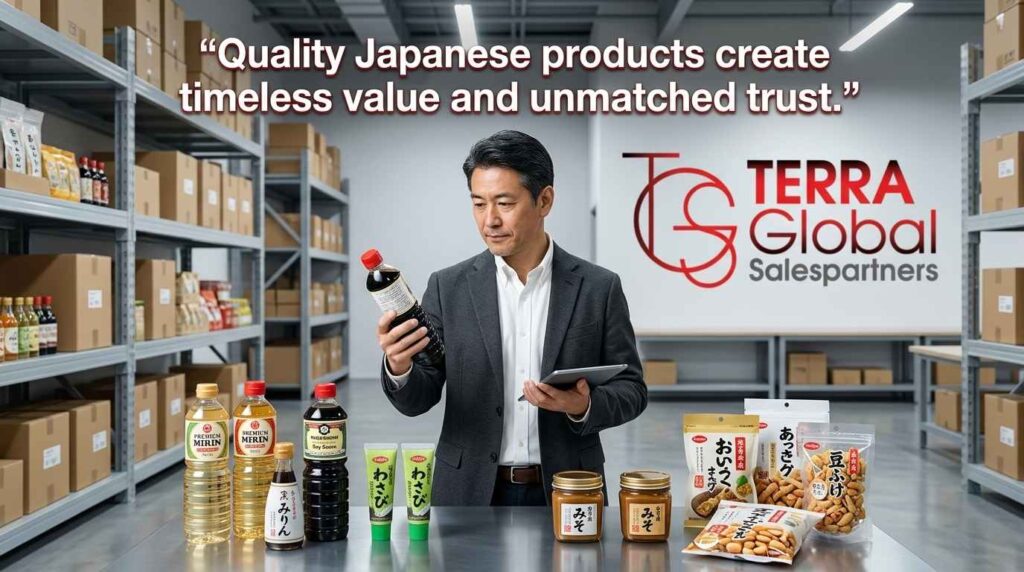
Amazon FBA with Japanese Products is not just a niche opportunity for a handful of sellers. It is a scalable business model with structural advantages that compound over time.
Here is why this moment matters:
Japanese food culture is experiencing a global mainstream moment. Ramen restaurants have normalized Japanese flavors in cities worldwide. Food content creators are driving millions of views for Japanese cooking tutorials. Home cooks are actively seeking the exact ingredients they see in those videos. Amazon is where many of them go to buy those ingredients.
You can be the seller who has them in stock.
Many sellers who have learned how to increase e-commerce profit with Japanese products are now running diversified catalogues across multiple Japanese food subcategories, generating stable monthly revenue with high repeat order rates and manageable ad spend.
The window for low-competition positioning in many of these subcategories is still open. It will not stay open forever. New sellers who establish strong reviews and solid sales rank in the next 12–18 months will have a structural advantage over competitors who enter later.
We help you get in early. We help you get in right.
Scaling from First Order to Full FBA Catalogue
Once your first product validates on Amazon, scaling is straightforward with the right sourcing partner.
Phase 1: Test (Months 1–3)
- Select 1–2 products from our catalogue
- Order minimum quantity (we help you negotiate starter MOQs)
- List on Amazon, run light PPC, gather initial reviews
- Track sell-through rate, return rate, and customer feedback
Phase 2: Optimize (Months 3–6)
- Reorder top-performing SKU with 2–3x initial quantity
- Optimize listing copy based on customer review language
- Introduce a complementary product (e.g., if teriyaki sauce sells, add sukiyaki sauce)
- Build bundled listing opportunities (sauce + mirin, for example)
Phase 3: Scale (Months 6–12)
- Expand into 4–6 SKUs across 2+ subcategories
- Switch high-volume SKUs to sea freight for cost efficiency
- Apply for Amazon Brand Registry if using a private label approach
- Explore new categories from our portfolio (cosmetics, agriculture)
Phase 4: Catalogue Dominance (Month 12+)
- Own multiple best-seller positions in Japanese food subcategories
- Build a recognizable seller brand around Japanese product curation
- Source seasonal and limited-release Japanese products for premium listings
- Use our business network to explore OEM and private label opportunities
Conclusion
Amazon FBA with Japanese Products is one of the most underutilized opportunities in today’s marketplace. The products are authentic, the demand is growing, the competition is still manageable, and the margins are real.
What holds most sellers back is not desire, it is access. Access to the right suppliers. Access to compliant export documentation. Access to products that actually arrive FBA-ready, on time, and at a price that makes the business work.
That access is what Terra Global Sales Partners provides.
We do not just sell you products. We give you a sourcing partner who understands Japanese manufacturing standards, Amazon’s FBA requirements, international food compliance, and the specific listing strategies that turn authentic Japanese products into consistent Amazon revenue.
Your competitors are still ordering from the same overcrowded supply chains. While they race to the bottom, you can build a premium catalogue that buyers return to again and again.
Start with one product. Validate your market. Then grow.
We are here for every step of that journey.
Frequently Asked Questions
Q1: What is Amazon FBA with Japanese Products, and why should I consider it?
Amazon FBA with Japanese Products means sourcing authentic goods from Japan and selling them via Amazon’s fulfillment network. Japanese items command premium pricing, lower competition, and higher repeat purchase rates than generic alternatives, making this a high-margin strategy for serious sellers.
Q2: How do I find reliable wholesale Japanese products to sell on Amazon FBA?
The best approach is partnering with a Japan-based sourcing agent like Terra Global Sales Partners. We provide amazon fba sourcing japan services with direct manufacturer access, export documentation support, and FBA-ready shipping, eliminating the guesswork entirely.
Q3: What are the best Japanese wholesale products to sell on Amazon FBA for high margins?
Top-performing categories include specialty sauces (teriyaki, sukiyaki, eel), yuzu and wasabi condiments, mirin and cooking sake, and artisan cheeses. These offer best japanese wholesale products to sell on amazon fba for high margins due to strong buyer demand and low direct competition.
Q4: How long does it take to receive Japanese products at an Amazon FBA warehouse?
Air freight from Japan typically takes 3–7 days, while sea freight takes 22–35 days. For selling japanese products on amazon fba, we recommend sea freight for replenishment orders and air freight for initial launches to minimize time-to-market.
Q5: Do Japanese products require special labeling for Amazon FBA compliance?
Yes. Products must have English-language ingredient lists, allergen declarations, and country-of-origin labels. Terra Global Sales Partners coordinates compliant labeling as part of our amazon fba japan sourcing service, ensuring every shipment meets FBA requirements on arrival.