

Terra Global Freight Desk – Tokyo
Japan to USA Shipping Sea Freight, Air Freight and US Customs Basics from Tokyo
Japan to USA shipping usually means sea freight (a full container or shared LCL space) to a US port, air freight to a US cargo airport, or an express courier for small parcels. Whichever mode you choose, the US importer must meet CBP rules before the goods are released. Terra Global Salespartners, a Tokyo trading company, helps overseas buyers plan and coordinate these shipments. Below: modes, ports, transit, US import rules, documents, costs and mistakes.
Full containers or shared space from major Japanese ports.
For urgent, light or high-value cargo and samples.
ISF data, HTS codes and documents ready before loading.
Japanese with suppliers, English with you.
Key Takeaways
Japan to USA shipping in brief- Sea for volume, air for speedFCL or LCL suits most commercial cargo; air and courier suit urgent, light or valuable goods.
- ISF before loadingOcean cargo needs an Importer Security Filing at least 24 hours before it is loaded in Japan.
- No more $800 de minimisCBP has suspended the exemption for all modes, so even small shipments need an entry.
- A US importer is requiredThe importer of record files the entry, pays duties and usually needs a customs bond.
- Check duties at shipment timeUS tariff measures changed often in 2025-2026. Check the HTSUS before you quote a landed cost.
Choose a Mode
Sea vs Air vs Courier: Which Japan to USA Shipping Method Fits?
The right mode depends on volume, value, urgency and how your US buyer receives goods.
Short answer: Use sea freight (FCL or LCL) for most commercial volumes, because it costs far less per unit. Use air freight when speed matters more than cost, and an express courier for samples and small parcels.
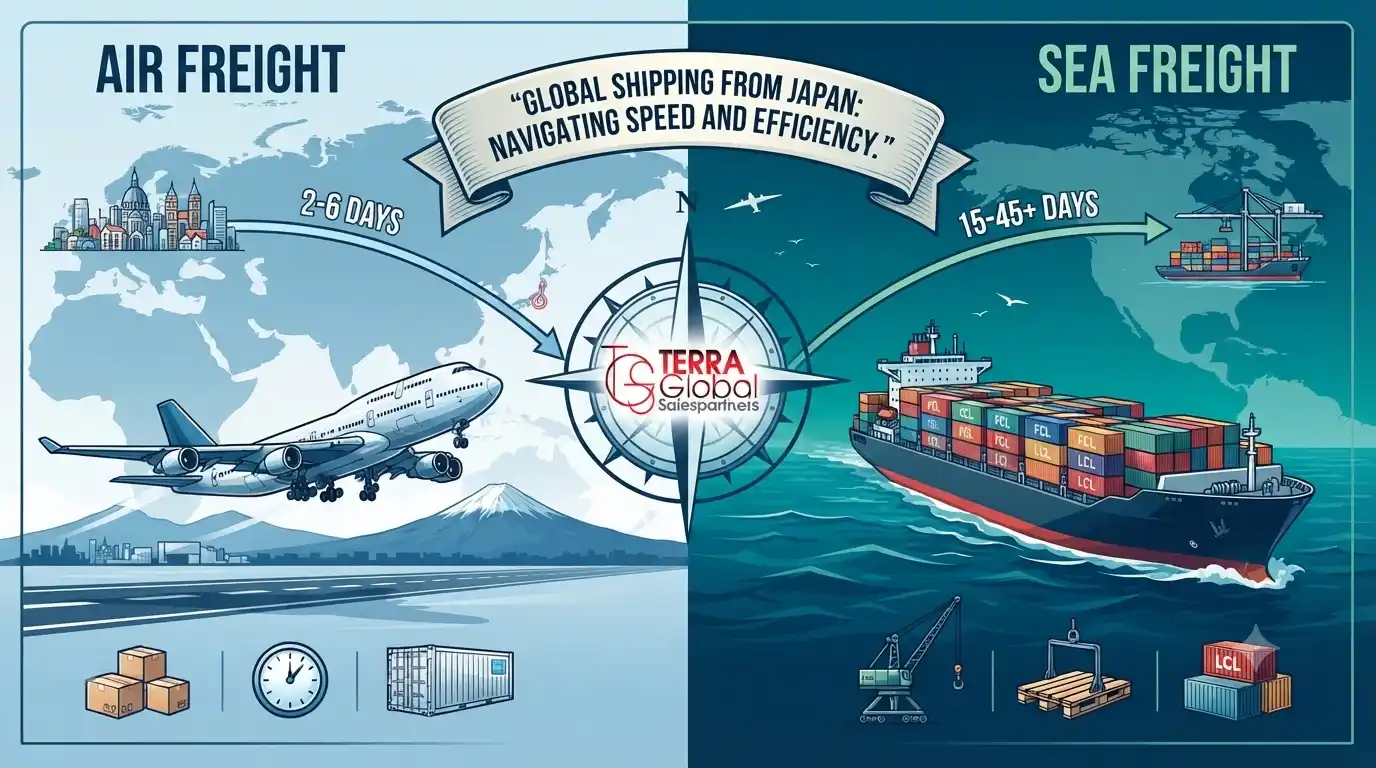
Transit figures are indicative planning ranges from our air freight vs sea freight guide. Estimates only, excluding US customs clearance.
Sea and Air
Sea Freight Japan to USA: FCL or LCL?
Most commercial cargo from Japan to the United States travels by sea.
Short answer: Choose FCL (full container load) when your cargo fills most of a container or needs to stay sealed. Choose LCL (less than container load) for smaller volumes, accepting a few extra days for consolidation.
Full container load
One shipper, one containerLess than container load
Shared container, consolidatedAir freight Japan to USA: when is it worth the cost?
Air freight from Narita, Haneda, Kansai or Chubu suits launches, urgent restocks, perishables and high-value electronics or cosmetics. Airlines charge the greater of actual and volumetric weight, so bulky light cargo costs more.
Batteries, aerosols and other dangerous goods follow airline rules and may be refused. More detail: air freight vs sea freight from Japan.
Routes
Which US Ports and Airports Receive Cargo from Japan?
Pick the gateway closest to your final delivery point, not just the cheapest ocean rate.
Short answer: Most sea freight from Japan to the USA arrives at West Coast ports: Los Angeles/Long Beach, Oakland or Seattle/Tacoma. East Coast cargo goes via the Panama Canal or by rail from the West Coast. Air cargo lands at gateways such as LAX, Chicago or JFK.
Neighbouring ports; a common choice for Southern California and inland rail.
Serves Northern California and the Bay Area.
Run jointly as the Northwest Seaport Alliance; suits the Pacific Northwest.
New York/New Jersey or Savannah, all-water via the Panama Canal or by rail.
LAX, Chicago O’Hare (ORD), New York JFK and others, by airline routing.
Seaports: Tokyo, Yokohama, Nagoya, Osaka and Kobe. Airports: Narita, Haneda, Kansai and Chubu.

A cheaper ocean rate can cost more overall after inland delivery. Compare door-to-door.
Timing
How Long Does Shipping from Japan to the USA Take?
Plan with ranges, then confirm the actual schedule when you book.
Short answer: As an indicative guide, air freight from Japan to the USA takes about 3-6 days, sea freight to the West Coast about 15-25 days and to the East Coast about 25-38 days, before US customs clearance. Actual times depend on the sailing, routing and clearance.
What adds time to a Japan to USA shipment?
Space, cut-offs and LCL schedules.
Missing data or permits hold cargo.
Extra port calls, storms, congestion.
CBP exams or agency holds.
Rail, trucking and appointments.
Source of ranges: our transit time guide for shipping from Japan.
US Customs
Japan to US Customs Basics: ISF, Bond, Entry and De Minimis
The US side decides when your goods are released. Prepare it before cargo leaves Japan.
Short answer: To import from Japan into the USA you need a US importer of record, an ISF filed 24 hours before loading for ocean cargo, usually a customs bond, a CBP entry with the correct HTS classification, and payment of duties and fees. The $800 de minimis exemption is currently suspended.
Why the de minimis change matters
Low-value parcels from Japan once entered duty-free under the $800 rule. CBP’s June 2026 rules now require an entry, and a 2025 law ends the exemption from 1 July 2027. Budget duties even for small orders.
HTS codes and tariffs
Duty depends on the HTSUS classification, value and origin. Tariff measures changed often in 2025-2026; CBP is refunding former IEEPA duties after court rulings. We do not publish duty rates; check the official HTSUS or ask a licensed US customs broker.
General information, not legal or customs advice. Rules can change; confirm with CBP or a licensed US customs broker before shipping.
Other Agencies
Do FDA, USDA, FCC or CPSC Rules Apply to Your Goods?
CBP enforces other agencies’ rules at the border.
Short answer: Yes, if your goods fall into a regulated category. Typical examples are food, cosmetics, wooden packaging, radio devices and children’s products.

Not a complete list: alcohol, medicines, plants, vehicles and chemicals have their own rules. See also our import-export process guide.
Paperwork
What Documents Do You Need to Ship from Japan to the USA?
Most delays start with documents that do not match the cargo.
Short answer: You need a commercial invoice, packing list, Japan export declaration and a bill of lading or air waybill on the Japan side. On the US side you need ISF data for ocean cargo, an importer of record number, a bond, HTS codes and any agency documents.
Japan side (export)
Before cargo leaves JapanParties, clear description, quantity, value, Incoterm and origin.
Cartons, weights and sizes matching the cargo.
Filed before loading; see customs clearance in Japan.
The house bill number links to the ISF.
For controlled or dual-use items.
US side (import)
Before cargo arrives in the USASent to the ISF filer well before loading.
IRS/EIN or CBP-assigned number, plus a bond.
Ten-digit HTSUS codes agreed with your broker.
FDA, FCC, CPSC or other records if needed.
Lets your US broker file for you.
Need help understanding who is the exporter in Japan? See exporter of record in Japan.
Budgeting
What Affects the Cost of Shipping from Japan to the USA?
We do not publish standard rates; quotes depend on cargo, route and timing.
Short answer: The cost depends on the mode, volume and weight, origin charges in Japan, the freight rate and surcharges, US destination charges, duties and CBP fees, broker and bond costs, and inland delivery. Compare total landed cost, not just the freight line.
Per container, per CBM or per chargeable kg.
Pickup, export clearance and terminal fees.
Base rate plus fuel and other surcharges.
Terminal, CFS and delivery order fees.
Duty by HTS code, plus CBP fees such as the merchandise processing fee.
Customs broker fees, ISF filing and bond premiums.
Drayage, rail or trucking.
Exam fees, demurrage and insurance.
Your Incoterm (for example EXW, FOB or DDP) decides which of these costs you pay. See how to reduce import costs when buying from Japan.
Step by Step
How Does Japan to USA Shipping Work, Step by Step?
A clear sequence keeps the supplier, carrier and US broker aligned.
In short: brief, importer and compliance check, mode and route, pickup, Japan export clearance, ISF and tracking, then US entry and delivery.
Share your shipment brief
Goods, cartons, weight, CBM, pickup point and US address.
Confirm the US importer and rules
Importer of record, bond and any FDA, FCC or CPSC rules.
Choose mode, route and Incoterm
FCL, LCL, air or courier, and the best US gateway.
Book space and collect cargo
Supplier pickup, with packing and pallets checked.
Clear export in Japan
Export declaration filed before the cut-off.
File ISF and track the shipment
ISF filed 24 hours before loading; updates in English.
US entry, release and delivery
Your US broker files entry; cargo moves to your door.

Avoid Delays
Common Mistakes When Shipping from Japan to the USA
Most problems are visible before loading.
Pattern to watch: buyers often book freight before the US importer, bond and product rules are settled. Confirm those first.
De minimis is suspended, so small shipments now need an entry and may owe duty.
Can lead to holds and liquidated damages.
Cargo cannot be entered; storage costs build.
“Parts” is not enough for HTS classification.
Wood packaging without an ISPM 15 mark can be refused or re-exported.
Food or RF devices can be held at the border.
A cheap ocean rate can cost more after inland delivery to the final address.
Check current HTSUS duties before you set prices.
Our Role
What Terra Global Does for Japan to USA Shipping
We work on the Japan side and coordinate with carriers and your US customs broker.
Short answer: Terra Global Salespartners LLC is a Tokyo trading company (Ginza, established 10 October 2022). Our corporate profile lists import-export, customs brokerage and shipping agency among our main business lines. We help buyers plan and coordinate shipments from Japan to the USA.
We contact Japanese suppliers, confirm ready dates and arrange collection.
Sea FCL, LCL, air or courier options compared on time and total cost.
Invoice and packing list checks, plus export clearance through customs clearance Japan.
ISF details, HTS codes and documents shared early with your US broker.
Logistics Japan for freight, and warehousing Japan for storage.
Proxy agent Japan for buying, and used cars from Japan for vehicles.
US entries are filed by the US importer of record or its licensed US customs broker, not by us. Our importer of record page covers imports into Japan; see also what an importer of record is and how to choose a freight forwarder in Japan.
Shipping to Europe instead? EU rules differ; see our Japan to Europe shipping page, or global shipping for other destinations.
No carrier contracts, licences, transit guarantees or prices are claimed here; we confirm carriers and filers in writing. About us: corporate information.
Clarity and Answers
Frequently Asked Questions About Japan to USA Shipping
Straight answers on transit, de minimis, ISF, bonds, duties and product rules.
How long does Japan to USA shipping take?
As an indicative guide, air freight takes about 3-6 days, sea freight to the West Coast about 15-25 days and to the East Coast about 25-38 days, before US customs clearance.
What is the cheapest way to ship from Japan to the USA?
For commercial volumes, sea freight is usually cheapest per unit: LCL for smaller loads, FCL once you fill most of a container. For small parcels, a courier is often simpler.
Is the $800 de minimis exemption still available for shipments from Japan?
No. CBP has indefinitely suspended it for all countries and modes, so shipments need a formal or informal entry.
What is ISF 10+2, and who files it?
It is CBP’s Importer Security Filing for ocean cargo. The ISF importer, usually the US importer or its customs broker, must file it no later than 24 hours before the cargo is loaded in Japan.
Do I need a customs bond to import goods from Japan?
Formal entries need one: a single transaction bond per shipment, or a continuous bond (minimum $50,000 or 10% of the prior year’s duties, taxes and fees).
What import duty applies to goods shipped from Japan to the USA?
It depends on the HTSUS classification, value and tariff measures in force at entry. Rates changed often in 2025-2026, so check the HTSUS or ask a US customs broker.
Who should be the importer of record for a Japan to USA shipment?
Usually the US buyer or owner of the goods. A licensed customs broker can file for them, but CBP holds the importer of record responsible for duties and accuracy.
Do wooden pallets from Japan need an ISPM 15 mark?
Yes. USDA APHIS requires regulated wood packaging entering the USA to be treated and marked to ISPM 15.
Can I ship Japanese food or cosmetics to the USA?
Yes, if you meet FDA rules. Food needs prior notice, and the producing facility generally must be registered with FDA. Cosmetics fall under MoCRA registration and listing rules.
What does Terra Global do for Japan to USA shipping?
We help on the Japan side: supplier coordination, mode and route comparison, export paperwork and early data for your US broker.
General information only, not legal, customs or tax advice. Official references: CBP de minimis rule (Federal Register), CBP ISF 10+2 FAQ, CBP bond guide and USDA APHIS wood packaging.
USA Shipping Inquiry
Get a Japan to USA Shipping Quote
Tell us what you are shipping, where it is in Japan and where it needs to go in the USA. We will suggest a mode and route and list what to prepare.
Ginza Ohtake Residence 2F, 1-22-11 Ginza, Chuo-ku, Tokyo 104-0061, Japan
What to Include in Your Request
Send these through our contact page for a faster quote.
- 01Goods description and HTS code if known
- 02Cartons or pallets, total weight and CBM
- 03Pickup location in Japan and ready date
- 04US delivery address, Incoterm and importer of record
- 05Company name and business email