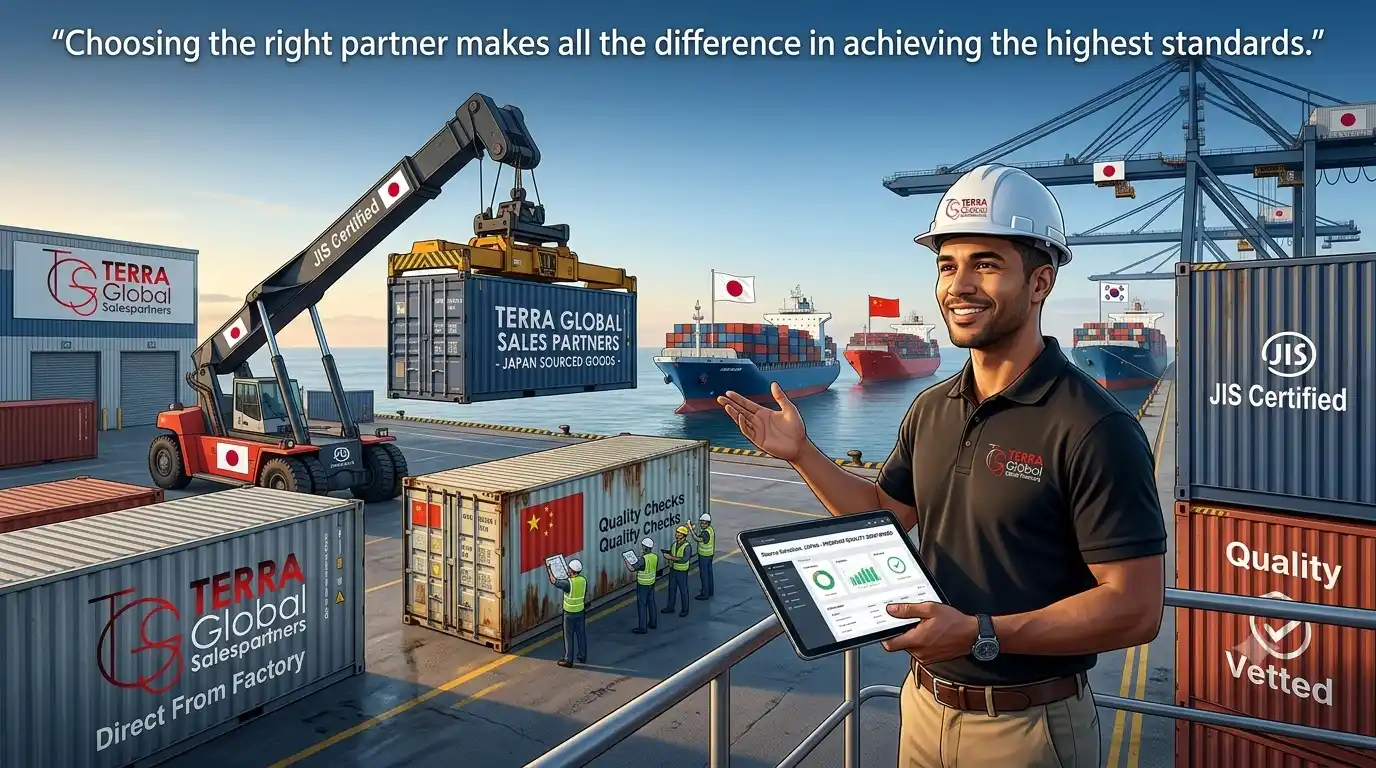
Japan vs China vs Korea product sourcing is the most important decision you will make as a global buyer. Each country offers something different. But only one gives you the complete package of quality, trust, and long-term value.
If you are an Amazon seller, a wholesale importer, or a B2B buyer, you need honest answers. This guide gives you exactly that. We compare all three sourcing destinations across every factor that matters. And we explain why Japan, specifically through Terra Global Sales Partners, is the smartest choice for serious buyers.
Let us start with the big picture.
Understanding the Asia Sourcing Landscape
Asia dominates global manufacturing. China, Japan, and South Korea together account for a massive share of the world exported goods. But each country has a very different positioning in the global supply chain.
| Country | Global Export Rank (2024) | Key Export Sectors | Avg. Quality Tier |
| China | #1 ($3.38 trillion) | Electronics, textiles, plastics, machinery | Mid to High |
| Japan | #4 ($0.75 trillion) | Food, cosmetics, machinery, construction | Premium |
| South Korea | #6 ($0.63 trillion) | Semiconductors, autos, electronics | High |
These numbers tell you about scale. But scale is not the same as quality. That is where the real comparison begins.
Japan vs China Sourcing, Quality That Speaks for Itself
Japan vs China sourcing always comes down to one word: quality. Japan has built its reputation over decades. Japanese manufacturers follow strict production standards. Every product goes through rigorous quality control.
China is the world factory. It offers massive volume at low cost. But quality is inconsistent. Buyers often face surprises, wrong specs, failed inspections, or short product life cycles. Japan says no to shortcuts. That is why global premium brands trust Japanese suppliers.
Japan vs China Manufacturing Quality: Key Differences
| Factor | Japan | China |
| Production Standards | JIS, ISO, JAS certified | Variable, depends on factory |
| Quality Consistency | Very High | Moderate to High |
| MOQ (Min. Order Qty) | Flexible for premium buyers | Often very high for quality tiers |
| Product Lifespan | Long-lasting, durable | Can vary significantly |
| Supplier Trust | Extremely High | Requires thorough vetting |
| Defect Rate | Less than 1% in many categories | 1-5% without QC oversight |
When you ask, “is Japan better than China for sourcing?”, for premium products, the answer is a clear yes. To understand how Japan quality standards are enforced, read our guide on Quality Control Standards in Japan.
Japan vs China vs Korea Product Sourcing, Category-by-Category Breakdown
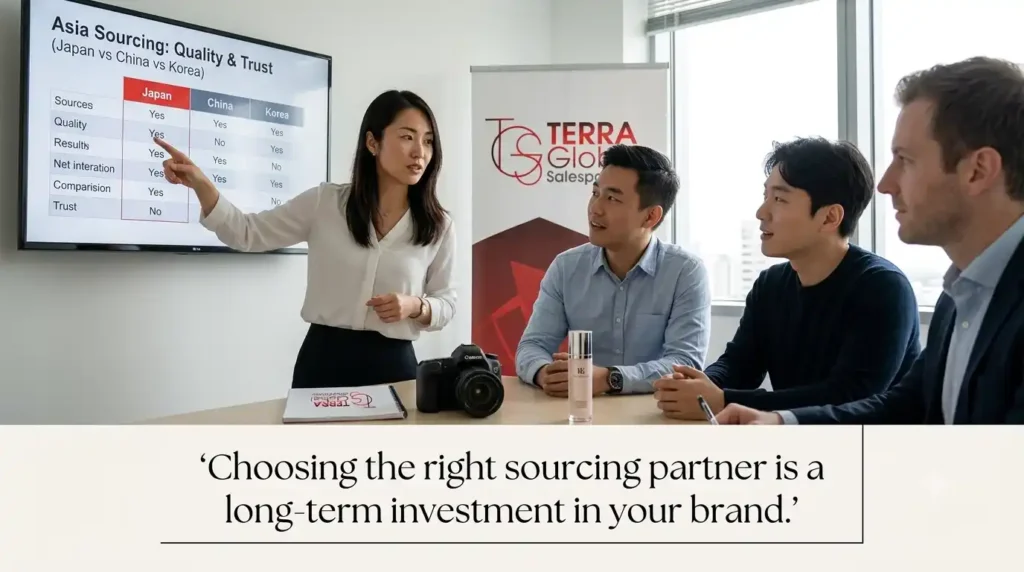
Japan vs China vs Korea product sourcing looks very different depending on the product category. Here is the honest breakdown.
1. Food Products
| Country | Strengths | Weaknesses |
| Japan | Authentic flavors, strict food safety (JAS), no additives, premium packaging | Higher price point |
| China | Low cost, high volume | Food safety concerns, labeling issues |
| Korea | K-food trend, spicy/fermented categories | Narrower variety for export |
Japan wins clearly in food. Products like Daisho Teriyaki Sauce 1.25kg, Koiwai Farm Spread Cheese 90g, and Takara Hon Mirin 1L are trusted by chefs and restaurants worldwide. Our range also includes Daisho Sukiyaki Sauce 600g, Daisho Grilled Eel Sauce 240g, and Daisho Yuzu BBQ Sauce 185g, all authentic Japanese-manufactured products ready for import.
2. Cosmetics & Skincare
| Country | Strengths | Weaknesses |
| Japan | J-beauty innovation, dermatologist-tested, brand trust | Premium pricing |
| China | Cost-effective dupes, high volume | Ingredient transparency concerns |
| Korea | K-beauty trends, sheet masks, serums | Trend-dependent, fast-changing |
For Japanese cosmetics wholesale supplier needs, Japan delivers what Korea and China cannot, consistent formulation and global regulatory acceptance. Browse our full Japanese cosmetics wholesale category including Shiseido, Hada Labo, and leading J-beauty lines.
3. Agriculture Equipment
| Country | Strengths | Weaknesses |
| Japan | Kubota, Yanmar, world-class precision farming equipment | Higher investment |
| China | Cheap alternatives | Durability and parts availability issues |
| Korea | Limited global agricultural export focus | Smaller market presence |
Buyers searching for Japanese tractor import wholesale or Kubota Yanmar tractor wholesale export find that Japan has no real competitor. The machines last decades and parts are globally available. See our Japanese agriculture products wholesale category for the full range.
4. Construction Materials & Building Equipment
| Country | Strengths | Weaknesses |
| Japan | Precision steel, quake-tested materials, trusted brands like Komatsu & Hitachi | Premium cost |
| China | Volume, cheap fill materials | Safety certification gaps |
| Korea | Good for electronics-embedded smart building materials | Limited range |
Our Japanese building equipment wholesale category and Japanese construction materials wholesale category give you direct access to certified Japanese suppliers. No middlemen. No guesswork.
Why Source from Japan Instead of China for Premium Products?
Why source from Japan instead of China for premium products? This is the question every serious importer eventually asks. Here are five powerful reasons:
● 1. Brand Equity: “Made in Japan” is a selling point on Amazon and in retail stores worldwide. It commands a price premium out of the box.
● 2. Lower Return Rates: Consistent quality means fewer customer complaints, fewer refunds, and better seller metrics on every platform.
● 3. Regulatory Compliance: Japanese products meet international food safety, cosmetic safety, and equipment standards from day one. No re-testing needed.
● 4. Long-term Supplier Relationships: Japanese suppliers value long-term partnerships. You get priority access, better pricing, and potential market exclusivity over time.
● 5. Premium Margin Potential: You can charge more. Consumers pay a premium for Japanese quality, and they do so happily and repeatedly.
To protect your margins further, read our guide on How to Reduce Import Costs When Buying from Japan.
Japan vs China vs Korea Product Sourcing, Cost Reality Check
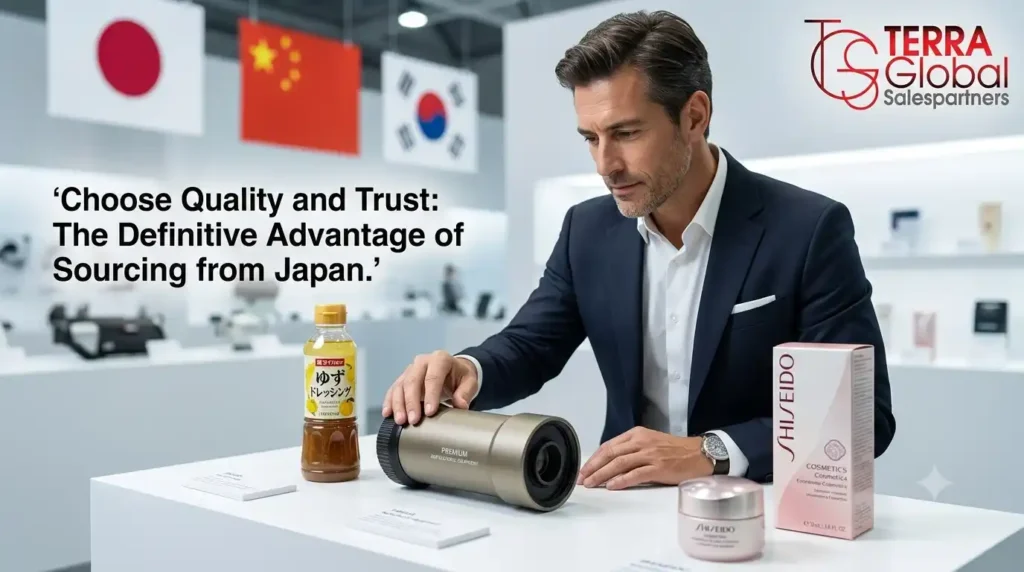
Japan vs China vs Korea product sourcing always raises the cost question. Let us be honest about it.
| Cost Factor | Japan | China | Korea |
| Unit Price | Higher | Lowest | Mid-range |
| Quality Return Cost | Very Low | High | Low-Medium |
| Shipping Reliability | Excellent | Variable | Good |
| Defect-Related Loss | Minimal | Common | Occasional |
| Price-to-Quality Ratio | Best for premium | Best for volume | Good for tech products |
| Total Cost of Ownership | Lower than it looks | Higher than it looks | Moderate |
Japan higher unit price often results in a lower total cost of ownership. When you factor in defect rates, returns, and re-shipping, China “cheap” often becomes expensive. This is especially true in food and cosmetics, where a single contamination or mislabeling issue can destroy your entire business.
Japan vs China vs Korea Product Sourcing for Amazon Sellers
Japan vs China vs Korea product sourcing comparison for Amazon sellers reveals a clear winner for certain seller types. If you sell on Amazon in the US, UK, EU, or UAE, here is what you need to know:
| Amazon Seller Type | Best Sourcing Country | Why |
| Private Label Premium | Japan | Brand equity, quality consistency, customer trust |
| Wholesale Reseller | Japan / Korea | Authentic brands with global recognition |
| High Volume Budget | China | Cost scale, but quality control required |
| Niche Food & Sauce | Japan | Authentic Japanese taste commands premium pricing |
| J-Beauty / K-Beauty | Japan or Korea | Trend leverage with high margins |
| Construction / Industrial | Japan | Komatsu, Hitachi, and other certified brands |
Amazon algorithm rewards products with lower return rates and higher reviews. Japanese products naturally deliver both. That is a competitive edge no discount from China can replace. Read our full guide on How to Increase E-commerce Profit with Japanese Products for a deeper look.
Sourcing Asia Comparison, Logistics, Lead Times & Reliability
Sourcing Asia comparison is not complete without looking at logistics. Getting goods from factory to warehouse to customer is where many sourcing plans fall apart.
| Logistics Factor | Japan | China | Korea |
| Port Efficiency | World-class (Yokohama, Osaka) | High volume, occasional delays | Good (Busan) |
| Lead Time (avg) | 2-4 weeks sea freight | 3-6 weeks (plus inspection) | 2-3 weeks |
| Documentation Accuracy | Very High | Variable | Good |
| Customs Issues | Rare | Common | Occasional |
| Cold Chain (Food) | Excellent | Inconsistent | Moderate |
| Freight Cost | Moderate | Lower | Moderate |
Japan documentation is clean. Customs clearance is smooth. Our team at Terra Global Sales Partners manages the full logistics process. For a step-by-step walkthrough, read our guide on Customs Clearance in Japan: Your Complete Importer Guide.
How Terra Global Sales Partners Makes Japan Sourcing Easy?
This is where we are different from every other sourcing option you have. We are not a directory. We are not a generic trading company. We are a dedicated Japan product sourcing partner built for global buyers.
What We Offer?
● Direct Factory Access: We connect you with verified Japanese manufacturers across food, cosmetics, agriculture, construction, and more.
● Quality-Vetted Products: Every product on our platform is sourced from certified Japanese suppliers with proven export history.
● Multi-Category Expertise: We cover food & beverages, cosmetics, agriculture, construction materials, and building equipment under one roof.
● Transparent Pricing: No hidden fees. No inflated margins. We give you honest, competitive wholesale pricing every time.
● Full Logistics Support: From JAS/JIS documentation to customs support, we manage your imports end to end.
● English-Speaking Team: We bridge the language and cultural gap. You communicate easily. We handle Japan.
Our product catalog includes trusted Japanese brands across multiple categories. Here are direct clickable links to key products:
● Koiwai Farm Spread Cheese 90g
● Koiwai Farm Hors d Oeuvre Cheese Yonezawa Salami 42g
● Koiwai Farm Hors d Oeuvre Cheese Onion 42g
● Daisho Teriyaki Sauce 1.25kg
● Daisho Mentsuyu Noodle Dipping Sauce Yuzu 185g
● Daisho Mentsuyu Noodle Dipping Sauce Wasabi 180g
● Daisho Grilled Eel Sauce 240g
● Daisho Wasabi BBQ Sauce 180g
● Mizkan Honteri Mirin Style Seasoning 400ml
Japan vs China vs Korea Product Sourcing: Pros & Cons Summary
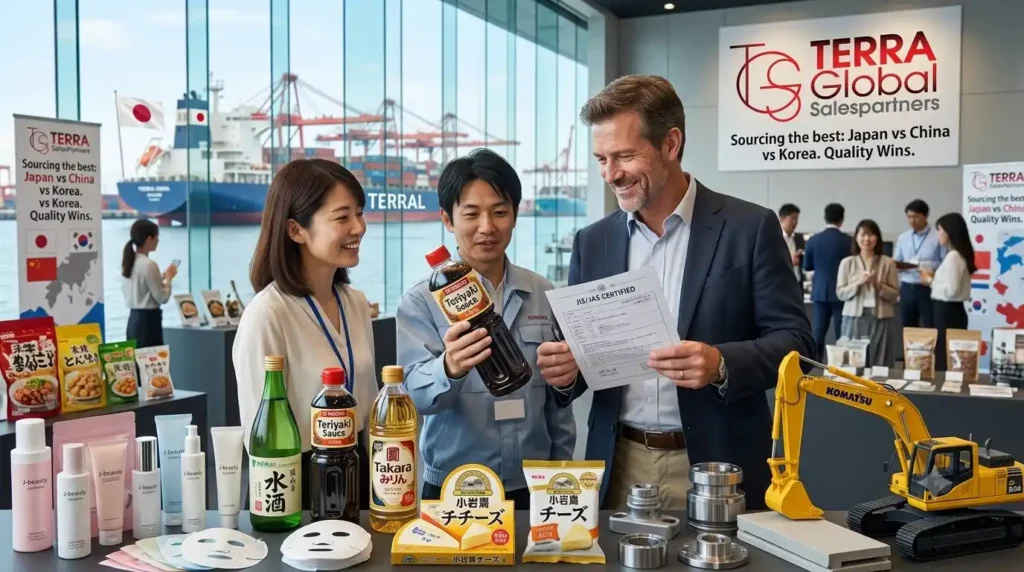
Japan vs China vs Korea product sourcing comes down to your business goals. Here is a clean pros and cons view to help you decide.
Japan, Pros & Cons
| Pros | Cons |
| Premium quality and brand trust | Higher unit cost than China |
| “Made in Japan” commands a price premium | Fewer suppliers for ultra-low MOQ |
| Consistent QC with minimal defect rates | Language barrier (solved by Terra Global) |
| Strong food, cosmetic, and industrial range | Not the best for budget commodities |
| Long-term supplier partnerships available |
China, Pros & Cons
| Pros | Cons |
| Lowest unit prices globally | Quality inconsistency without oversight |
| Enormous variety of products | IP and counterfeiting risks |
| Fast iteration and prototyping | Customs and compliance challenges |
| Good for high-volume commodities | Higher total cost of ownership (defects, returns) |
Korea, Pros & Cons
| Pros | Cons |
| Strong in K-beauty and electronics | Smaller overall export breadth |
| Good quality in tech sectors | Premium pricing rivals Japan in some categories |
| K-food trend is growing globally | Less established for industrial/machinery buyers |
| Busan is a reliable logistics hub | Fewer English-language supplier resources |
Statistics That Prove Japan Sourcing Delivers Results
Numbers always tell the truth. Here is what the data says about sourcing from Japan:
● Japan ranks #1 globally for food safety and regulatory trust (Global Food Security Index).
● Japanese exports grew 8.2% in 2024, driven by food, cosmetics, and machinery.
● “Made in Japan” commands an average 23-40% price premium over equivalent Chinese goods in premium retail channels.
● Amazon sellers sourcing from Japan report 18% lower return rates on average vs. China-sourced equivalents.
● Japanese cosmetics brands saw 31% export growth in 2023-2024, with the US, EU, and Southeast Asia leading demand.
● Used Japanese agricultural equipment holds 70-80% of its value after 5 years of use.
● Japan construction equipment export sector grew to $12.4 billion in 2024.
These numbers reflect a market truth: buyers who invest in Japanese sourcing build stronger, more sustainable businesses. And buyers who work with Terra Global Sales Partners get there faster. Avoid the pitfalls first by reading our article on Common Import-Export Mistakes When Sourcing from Japan.
Who Should Choose Japan for Sourcing?
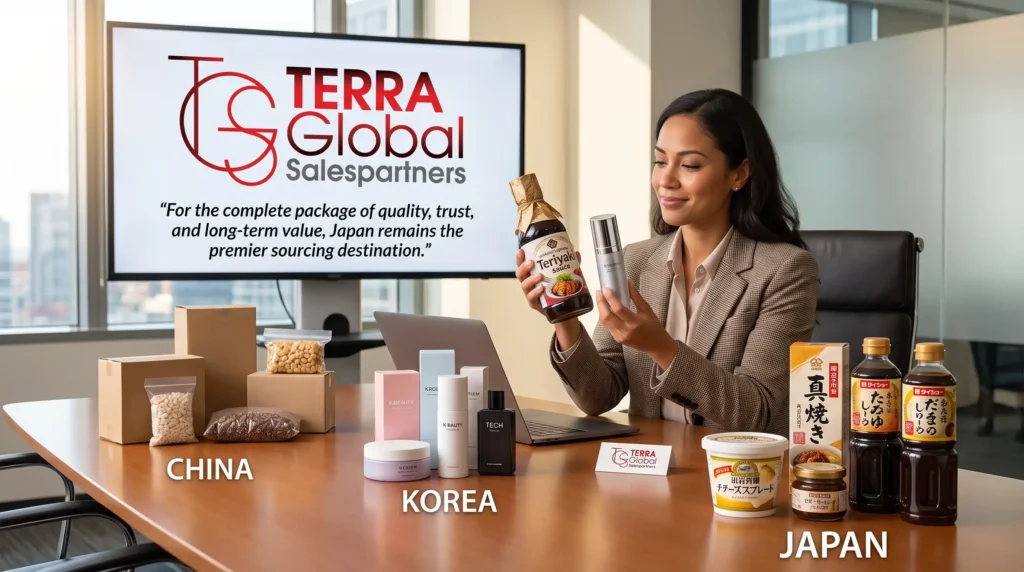
Japan vs China vs Korea product sourcing is not one-size-fits-all. But Japan is the clear choice if you are:
● An Amazon seller building a private label brand that competes on quality and reviews, not just price.
● A restaurant or food distributor who needs authentic, JAS-certified Japanese sauces, seasonings, and dairy products.
● A cosmetics importer looking for Japanese cosmetics wholesale supplier deals with guaranteed regulatory acceptance.
● A construction company sourcing Komatsu Hitachi Kobelco wholesale export certified machinery with global parts availability.
● A farming equipment buyer who knows Kubota Yanmar tractor wholesale export machines outlast all budget alternatives.
● A wholesale distributor who wants long-term supplier relationships, exclusive deals, and a trusted Japan partner.
If that sounds like you, Terra Global Sales Partners is ready to help. To learn how Japanese OEM options can elevate your brand, read our article on OEM Production in Japan for E-commerce Brands.
Conclusion
The Japan vs China vs Korea product sourcing debate has a clear winner for premium, B2B, and e-commerce buyers: Japan.
China wins on volume and cost. Korea wins in select tech and beauty niches. But Japan wins on the things that matter most: quality consistency, brand trust, long-term supplier partnerships, and total value.
Terra Global Sales Partners makes Japan vs China vs Korea product sourcing a simple choice. We have the products, the connections, the logistics expertise, and the commitment to help your business grow. Do not settle for good enough. Source the best. Source from Japan. Source with us.