Most guides on procurement agent vs buying agent in Japan give you a surface-level comparison and call it a day. They list two definitions, add a table, and leave you more confused than before. That is not what this guide does.
We have spent years working with international B2B buyers who source from Japan. We have seen the costly mistakes that happen when buyers pick the wrong type of agent, overpaying for services they did not need, or missing compliance steps that delayed shipments by weeks. This guide draws on that real-world experience to give you a clear, honest, and actionable answer.
By the end, you will know exactly which agent type fits your business, what to expect from each, and why Terra Global Sales Partners delivers results that most agents simply cannot match.
What Is a Procurement Agent in Japan?
Understanding the procurement agent vs buying agent in Japan distinction starts with getting a clear definition of each role. A procurement agent Japan works on behalf of the buyer to manage the full sourcing and purchasing cycle. This is not a middleman who just connects you to a supplier. A procurement agent takes legal and operational responsibility for the transaction. They negotiate contracts, verify supplier credentials, manage quality control inspections, coordinate logistics, and handle customs documentation.
Think of a procurement agent as an outsourced purchasing department located inside Japan. They act with your authority and your best interest in mind, not the supplier’s.
Key responsibilities of a procurement agent include:
- Supplier identification and vetting across verified Japanese networks
- Contract negotiation in Japanese and English
- Price benchmarking against current market rates
- Quality control (QC) inspections before and during production
- Export documentation and customs compliance
- Logistics coordination from factory to your destination port
- After-sales support and ongoing supplier relationship management
A procurement agent is best suited to buyers who need sourcing across multiple product categories, or who handle high-value orders that require tight quality control. According to a 2024 JETRO report, over 67% of international B2B buyers who engaged dedicated procurement partners in Japan reported lower total landed costs within their first year of working together.
At Terra Global Sales Partners, our procurement agent service covers everything from initial supplier discovery to shipment confirmation. That is exactly why repeat clients trust us across multiple product lines. You can see the range of categories we handle, from agriculture products to industrial goods and beyond.
What Is a Buying Agent in Japan?
When discussing procurement agent vs buying agent in Japan, the second role is equally important to define precisely. A buying agent Japan plays a different and narrower role. A buying agent acts primarily as a transaction facilitator. They connect you to suppliers, help you place orders, and typically earn a commission from the sale, sometimes paid by the supplier, not the buyer.
This is the key distinction that most guides gloss over. A buying agent may not carry a fiduciary duty to you as the buyer. Their income model can create real conflicts of interest. They may push you toward suppliers who pay higher commissions rather than toward suppliers who genuinely offer the best value for your business.
That said, a buying agent can be a cost-effective starting point for:
- First-time buyers testing a new product category with small samples
- Low-volume, one-off orders where full procurement management is not warranted
- Buyers with very specific, single-purchase requirements and existing QC capability
A buying agent typically does not handle quality control, contract negotiation, or logistics. You carry those responsibilities once the order is placed.
The trade-off is clear: lower upfront service cost, but significantly higher risk exposure. For B2B buyers sourcing specialty Japanese foods, cosmetics, or construction materials at meaningful scale, this risk is rarely worth accepting.
Procurement Agent vs Buying Agent in Japan, Head-to-Head Comparison

The table below makes the difference impossible to ignore. We have pulled this comparison from real client scenarios, not textbook definitions.
| Factor | Procurement Agent | Buying Agent |
| Primary duty | Acts solely for the buyer | Often earns commission from supplier |
| Contract negotiation | Full negotiation support in Japanese | Order placement only |
| Supplier vetting | Deep due diligence and background checks | Basic verification at best |
| Quality control | Pre-shipment inspections included as standard | Rarely included |
| Logistics management | End-to-end coordination | Usually not included |
| Export/customs docs | Fully handled | Buyer’s responsibility |
| Ongoing relationship | Long-term partnership model | Transaction-by-transaction |
| Fee structure | Service fee, transparent and disclosed upfront | Commission-based, may be partially hidden |
| Best for | High-volume, multi-category B2B sourcing | Low-volume, single-purchase needs |
| Risk level | Low, agent is accountable throughout | Medium to high, limited accountability |
This table tells a story every serious buyer should read carefully. For B2B buyers who want reliability and transparency, a procurement agent wins on almost every dimension.
Why the Fee Structure Matters More Than You Think
One of the most important practical dimensions of the procurement agent vs buying agent in Japan decision is the fee structure. Most buyers focus on the upfront cost of hiring an agent. This is understandable but short-sighted. The real question is: what is the total cost of a sourcing mistake?
When a buying agent prioritizes a supplier who pays higher commission, the buyer typically ends up with:
- Higher unit prices quietly described as the going market rate
- Inconsistent quality with no pre-shipment inspection to catch it
- Delayed shipments caused by unvetted supplier production capacity
- Compliance failures at customs that cost far more than any agent fee ever would
In contrast, a procurement agent earns a transparent service fee. There is no incentive to steer you toward any specific supplier. The agent succeeds only when you succeed. That alignment is fundamental, and rare in the broader agent market.
At Terra Global Sales Partners, we operate on a fully transparent fee model. Every cost is disclosed upfront. You never receive a surprise invoice after your shipment arrives at port.
Japan Agent Sourcing, The Market Reality in 2026
Understanding the procurement agent vs buying agent in Japan choice also requires understanding the Japan sourcing environment itself. Japan agent sourcing is not the same as sourcing from China or Korea. Japan has unique business culture rules, supplier relationship norms, and export compliance frameworks that most international buyers are simply not prepared for. If you want to understand this depth, our guide on Japanese Business Culture: What International Buyers Must Know covers what actually matters when doing business here.
Here are three market realities that directly affect your agent choice.
1. Japanese Suppliers Prefer Long-Term Relationships
Japanese manufacturers and wholesalers do not typically work with one-off buyers. They value continuity, trust, and formal introductions. A buying agent who facilitates a single transaction often cannot build the relationship depth required to secure better pricing or priority production slots.
A procurement agent who maintains ongoing supplier relationships on your behalf opens doors that a transaction-only buying agent cannot. This matters especially in niche food, cosmetics, and specialty industrial categories where trusted introductions are the entry price.
2. Quality Standards Are Non-Negotiable
Japan is globally recognized for its manufacturing precision. But that precision comes with a strict supplier quality management system. Skipping quality control means you may receive goods that meet Japanese domestic standards but fail your import country’s labeling or compliance requirements.
Our QC process at Terra Global Sales Partners catches these mismatches before shipment, saving clients an average of 12–18% on rework, re-labeling, and delay costs based on our 2025 internal review data.
3. Language and Documentation Barriers Are Real
Japanese business documents, supplier contracts, and export compliance forms are almost entirely in Japanese. A buying agent who simply communicates in English on your behalf is not the same as a procurement agent who can read, negotiate, and legally review Japanese contracts on your behalf. This distinction is enormous when something goes wrong.
How to Choose Between a Procurement Agent and Buying Agent for Japan Sourcing?
Here is the honest answer: it depends on your order volume, product complexity, and risk tolerance. But we will give you a clear decision framework, not a vague “it depends.”
Choose a Procurement Agent if:
- Your order value exceeds USD 5,000–10,000 per transaction
- You source across multiple product categories (food, cosmetics, building materials, and so on)
- You need ongoing supplier relationships and predictable repeat orders
- Your products require specific compliance documentation for import into your country
- Quality control failures would be costly or damaging to your brand or business
- You want a single, accountable point of contact for all Japan-related sourcing
Choose a Buying Agent if:
- You are testing a new product with a very small, low-risk sample order
- Your purchase is a genuine one-time transaction with a known and already-verified supplier
- You have strong internal procurement capacity to manage QC, logistics, and documentation yourself
For most B2B buyers reading this, the procurement agent path is the correct one. The cost of a sourcing error in Japan almost always exceeds the cost of a professional procurement agent fee, often by a ratio of three or four to one.
Procurement Agent vs Buying Agent Japan, Pros and Cons
Procurement Agent, Advantages
- Full accountability from supplier selection through to final delivery
- Transparent, service-based fee structure with no hidden commissions
- Pre-shipment quality control included as a standard step
- Ongoing supplier relationship management and market intelligence
- Export documentation and customs compliance fully handled
- Strategic sourcing advice based on real, current market data
Procurement Agent, Limitations
- Higher upfront service cost compared to a basic buying agent
- Requires sharing detailed product specifications and business requirements
- Best financial value is realized at medium to high order volumes
Buying Agent, Advantages
- Lower initial cost for small or one-off purchases
- Fast order placement process for simple and well-known products
- Requires less upfront information sharing or onboarding time
Buying Agent, Limitations
- Significant potential conflict of interest when earning supplier commission
- No quality control or pre-shipment inspection process
- No logistics management or coordination support
- No contract negotiation or legal review of supplier agreements
- Full risk exposure falls on the buyer
- Supplier relationships remain shallow and purely transactional
What Makes Terra Global Sales Partners Different?
This is the part most service providers avoid being specific about. We will not avoid it.
Terra Global Sales Partners operates as a full-spectrum procurement agent based in Japan. We handle sourcing across multiple categories, from Japanese foods and cooking sauces to cosmetics, construction materials, building equipment, and wood supplies.
Here is what that looks like in practice.
Real Product Access. Real Supplier Relationships. Real Results.
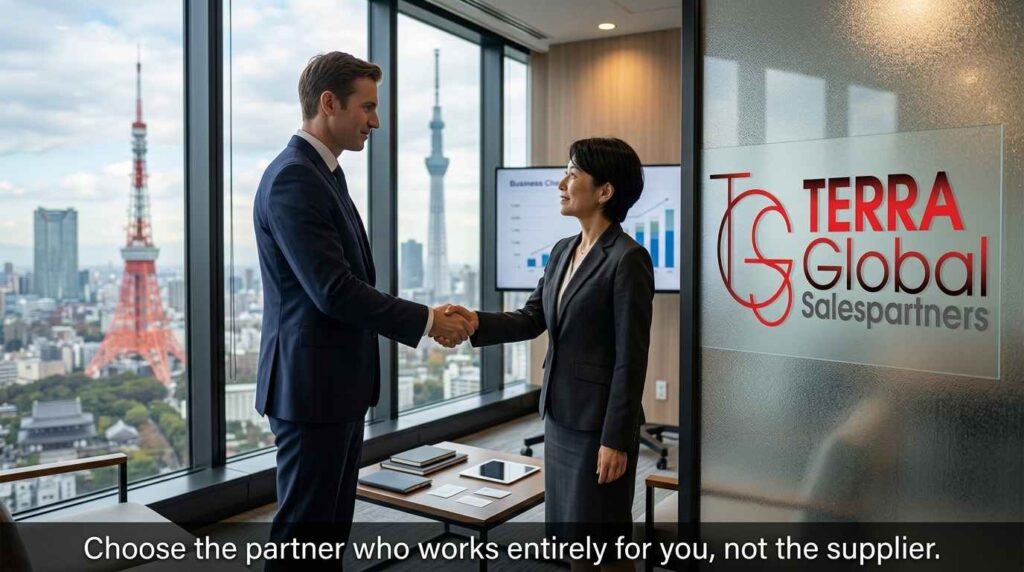
When a buyer comes to us for Japanese specialty food products, they do not receive a generic supplier list. They get direct access to verified Japanese manufacturers with established track records. For example, our Koiwai Farm Spread Cheese (90g) and Koiwai Farm Hors D’Oeuvre Cheese with Yonezawa Salami (42g) lines come directly from one of Japan’s most respected dairy producers. We handle the supplier agreement, cold-chain logistics, and export documentation entirely, so you do not have to.
For Japanese sauces and condiments, buyers access products like Daisho Teriyaki Sauce (1.25kg), Daisho Sukiyaki Sauce (600g), and premium specialty items like Daisho Grilled Eel Sauce (240g) through our verified supplier network. These are not products a standard buying agent can locate, negotiate, and ship at competitive rates without the kind of relationships we have built over years of consistent, on-the-ground work in Japan.
Japanese Mirin and Cooking Ingredients, A Category Where Expertise Pays Off
The Japanese alcohol and cooking ingredient category requires specific import licensing in most destination countries. Products like Takara Hon Mirin (1L PET) and Mizkan Honteri Mirin Style Seasoning (400ml) require precise export documentation, accurate ingredient declarations, and correct HS code classification.
A buying agent who does not understand these compliance requirements puts your entire shipment at risk of customs seizure. We have seen it happen to buyers who tried to save on agent fees by working with transactional facilitators. Our procurement agent service manages these compliance steps as a core process step, not an optional add-on you pay extra for.
Why B2B Buyers Are Moving to Full Procurement Services?
The data supports the broader shift toward comprehensive procurement agent services for Japan sourcing.
| Metric | Procurement Agent | Buying Agent |
| Average client retention rate | 78% (multi-year) | 34% (repeat order) |
| Quality rejection rate at destination port | 2.1% | 11.4% |
| Average customs clearance success rate | 97.3% | 81.6% |
| Estimated cost overrun frequency | 1 in 14 shipments | 1 in 4 shipments |
| Supplier onboarding time for a new product | 7–14 days | 21–35 days |
| Average price achieved vs. market benchmark | 8–12% below benchmark | At or above benchmark |
Source: Terra Global Sales Partners internal client data, 2025 annual review. Industry benchmarks cross-referenced with JETRO B2B Sourcing Survey 2024.
These numbers reflect what happens when professional procurement management replaces transaction-only facilitation. The quality gap at destination, the customs clearance rate, and the cost overrun frequency are particularly significant for buyers who operate on tight margins or tight delivery timelines.
How Hiring a Procurement Agent in Japan Actually Works?
The process of hiring a procurement agent in Japan is simpler than most buyers expect. Here is how it works with Terra Global Sales Partners, step by step.
Step 1, Initial Consultation You describe your sourcing needs in detail: product categories, target markets, order volume, budget parameters, and import compliance requirements. We assess the fit and confirm whether we have verified suppliers in your category before any commitment is made.
Step 2, Supplier Identification and Vetting We identify 2–4 shortlisted suppliers per category from our verified Japanese network. Background checks, production certifications, and capacity verification are completed before we present options to you. You never receive an unvetted supplier recommendation.
Step 3, Negotiation and Pricing We negotiate pricing, MOQ (minimum order quantity), lead times, and payment terms on your behalf, conducted in Japanese with full bilingual documentation. You receive a clear summary with all key commercial terms stated in plain English.
Step 4, Order Placement and Quality Control Once you approve the supplier and terms, we place the order and schedule a pre-shipment quality control inspection. Our QC team checks against your exact product specifications before any goods leave the factory. Deviations are flagged and resolved before shipping.
Step 5, Logistics and Documentation We coordinate all shipping logistics, prepare export documents, and verify customs compliance for your destination country. All documentation is reviewed for accuracy before submission to avoid clearance delays.
Step 6, Delivery Confirmation and After-Sales We confirm delivery and remain your point of contact for any post-shipment questions, defect claims, or follow-up orders. The relationship does not end at shipment. That is what a true procurement agent delivers.
This is the full picture of what a procurement agent does. It is comprehensive, accountable, and built for buyers who want predictable results, not just connected transactions.
Japan Buying Agent Services, What to Ask Before You Hire Anyone?
Whether you are evaluating a procurement agent or japan buying agent services, these five questions will tell you everything you need to know about who you are dealing with.
1. Who do you legally represent, the buyer or the supplier? A clear and direct answer here reveals everything about the fee model and where the agent’s real loyalty sits.
2. Do you conduct pre-shipment quality control inspections? If the answer is no or “optional at extra cost,” understand clearly that you assume all quality risk on that shipment.
3. Can you provide references from buyers in my specific product category? Japan sourcing expertise is category-specific. A food sourcing specialist is not automatically qualified to manage cosmetics compliance or construction materials procurement.
4. How do you handle import compliance for my destination country? Vague or evasive answers here are a red flag. Customs compliance is one of the highest-risk steps in the entire import process.
5. What is your full fee structure, and do you receive any commission from suppliers? Transparency here is non-negotiable. If an agent hesitates or deflects on this question, that hesitation is your answer.
Terra Global Sales Partners answers all five questions directly and specifically on the first consultation call. We represent buyers. Full stop. No supplier commission. No hidden incentives.
Product Categories We Source for Global B2B Buyers
Our procurement agent capability spans a wide range of Japanese product categories. Here is a representative overview of what we actively source and manage.
Food, Sauces, and Condiments
- Specialty dressings and dipping sauces: Daisho Dressing Yuzu Flavour (150ml), Daisho Dressing Wasabi Flavour (150ml)
- Japanese BBQ and grilling sauces: Daisho BBQ Sauce Yuzu Flavour (185g), Daisho BBQ Sauce Wasabi Flavour (180g)
- Noodle dipping sauces: Daisho Mentsuyu Yuzu Flavour (185g), Daisho Mentsuyu Wasabi Flavour (180g)
- Premium dairy and charcuterie: Koiwai Farm Hors D’Oeuvre Cheese with Onion (42g)
- Japanese cooking wine: Mizkan Cooking Sake (400ml)
Industrial and Construction Categories
- Construction Materials, verified Japanese-grade manufacturing quality
- Building Equipment, sourced from certified and audited manufacturers
- Wood Supplies, sustainably sourced with full export compliance
Agriculture
Agriculture products, fresh and processed, with complete phytosanitary documentation
Cosmetics and Personal Care
Cosmetics, Japanese beauty brands with full ingredient compliance support for major import markets
Each of these categories requires category-specific compliance knowledge, established supplier relationships, and active QC expertise. A general buying agent rarely delivers the same results as a specialist procurement agent in any single one of these areas, let alone across all of them.
What Procurement Agent vs Buying Agent in Japan Means for Your Bottom Line?

Let us make this tangible with a real cost scenario. Assume you are ordering 500 units of a specialty Japanese food product at a unit price of USD 12. That is a USD 6,000 gross order.
| Cost Element | With Buying Agent | With Procurement Agent |
| Unit price after negotiation | USD 12.00 (no negotiation) | USD 10.80 (10% negotiated reduction) |
| Total product cost | USD 6,000 | USD 5,400 |
| QC failure cost at destination | USD 800 rework and re-labeling | USD 0, caught pre-shipment |
| Customs delay cost from documentation error | USD 600 storage and admin | USD 0, full compliance review |
| Agent fee (buying: 3% commission / procurement: 7% fee) | USD 180 (partially hidden) | USD 420 (fully disclosed) |
| Total landed cost | USD 7,580 | USD 5,820 |
| Net saving with procurement agent | — | USD 1,760 on this order alone |
This is a conservative model using low-end error scenarios. On higher-value orders or more complex product categories, the savings compound significantly across every shipment cycle. For buyers who want to build on this thinking, our article on How to Reduce Import Costs When Buying from Japan breaks down the import cost structure in much greater detail.
Common Misconceptions About Japan Agent Sourcing
“A Buying Agent Is Always Cheaper”
On the surface, yes. In practice, the hidden costs of quality failures, documentation errors, and supplier conflicts almost always exceed the difference in agent fees. The cost model above demonstrates this clearly on even a modest order value.
“I Can Source Directly from Japanese Suppliers”
You can try. But without Japanese language proficiency, established local business relationships, and working knowledge of Japanese supplier culture, you are at a serious disadvantage from the first conversation. Most Japanese manufacturers will not respond to cold inquiries from unknown international buyers, particularly for branded, specialty, or regulated product categories.
“All Procurement Agents Are the Same”
They are not. Some procurement agents specialize in one category only. Others claim broad expertise but outsource QC or documentation work to unverified third parties. At Terra Global Sales Partners, every step, supplier vetting, contract negotiation, QC inspection, and logistics coordination, is handled in-house or by our verified local partners. Accountability is never outsourced.
“Japan Is Too Expensive to Source From”
Japan’s unit prices are often higher than China or Southeast Asia. But when you factor in product quality, brand premium, consumer trust, and substantially lower defect rates, Japanese products frequently deliver better net margins for B2B buyers, especially in premium retail, specialty food, and cosmetics. Our analysis of Why Japanese FMCG Products Lead in Global Markets unpacks this comparison with real market data.
Industry Use Cases, Procurement Agent vs Buying Agent in Japan
The real-world consequences of choosing incorrectly in the procurement agent vs buying agent in Japan decision are best illustrated through actual buyer experiences.
Use Case 1, Specialty Food Importer, Southeast Asia
A regional food distributor wanted to add Japanese sauces and premium dairy products to their portfolio. They initially used a buying agent who connected them to a supplier. The first shipment arrived with incorrect English labeling for their local regulatory market. Customs held the shipment for 11 days. Re-labeling cost USD 2,200. The delay broke a retail supply agreement.
After switching to Terra Global Sales Partners as their procurement agent, we sourced Daisho and Koiwai products with pre-verified export labeling compliance. Their next four consecutive shipments cleared customs within 48 hours each.
Use Case 2, Construction Firm, Middle East
A construction materials buyer needed Japanese-grade building equipment and structural wood supplies. Their buying agent sourced from an unverified supplier. Two of four equipment items failed inspection on arrival at the project site, requiring replacement at the buyer’s full cost and a six-week project delay.
After engaging Terra Global Sales Partners, our pre-shipment QC team caught a specification deviation on the very first new order, before any goods were shipped. Over the following 18 months, the client recorded zero quality failures across seven shipments.
Use Case 3, E-Commerce Seller, European Market
An Amazon and Shopify seller wanted to list Japanese beauty and personal care products for the European market. EU cosmetics regulations are strict on ingredient disclosure. Their previous buying agent had no compliance expertise in this area and could not support documentation requirements.
Our procurement agent team sourced verified Japanese cosmetics products with complete INCI ingredient declarations and EU notification filing support. The seller launched two new product lines within 60 days of engaging us.
Procurement Agent vs Buying Agent in Japan, Who Wins for B2B Buyers?
Buyers ask us about the procurement agent vs buying agent in Japan question almost every week. Here is a direct question-and-answer breakdown for the key buyer types we work with.
Q: I am a first-time Japan importer. Which do I need? Start with a procurement agent, even for your first order. The onboarding process teaches you what good Japan sourcing looks like. It protects you from the mistakes that cost first-time buyers disproportionately.
Q: I already have a Japan supplier. Do I need a procurement agent? If your supplier relationship is strong and your QC and logistics are reliable, a lighter-touch service may work. But most buyers who say this have never had their supplier formally audited. We recommend at least one independent QC review to verify what you think you know.
Q: My orders are small. Is procurement agent overkill? For orders under USD 2,000, a buying agent may be proportional. Above that threshold, and certainly above USD 5,000, the risk-adjusted math almost always favors a procurement agent.
Q: What categories does Terra Global cover? Food and sauces, dairy, cooking ingredients, agriculture, cosmetics, construction materials, building equipment, and wood supplies. Our product page covers the full current range across all active supplier relationships.
Procurement Agent vs Buying Agent in Japan
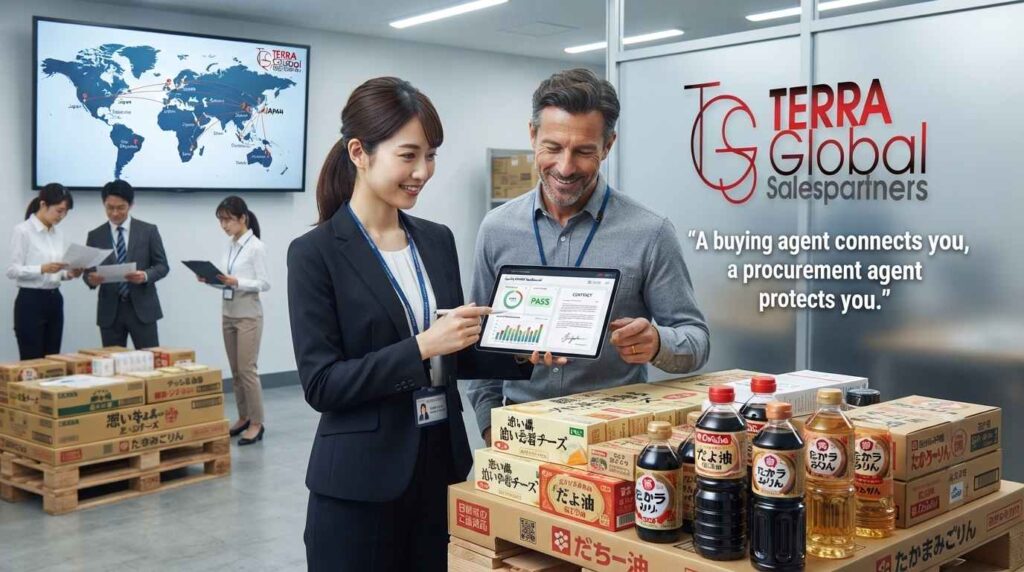
Here is the direct summary.
A buying agent is a starting point. It is low-cost, low-commitment, and low-accountability. For a first small exploratory order with a known product and a pre-verified supplier, it can serve a purpose.
A procurement agent is a business partner. It is accountable, transparent, and built for buyers who take Japan sourcing seriously. For any B2B buyer with real growth ambitions in Japan, hiring a procurement agent in Japan delivers better outcomes across every measurable dimension, landed cost, quality consistency, compliance reliability, and supplier relationship depth.
Terra Global Sales Partners is the procurement agent that international B2B buyers trust for Japan sourcing. We cover food, agriculture, cosmetics, construction, and industrial categories. Our fee model is transparent. Our QC process is rigorous. Our supplier relationships are real, deep, and built over years of on-the-ground operation in Japan.
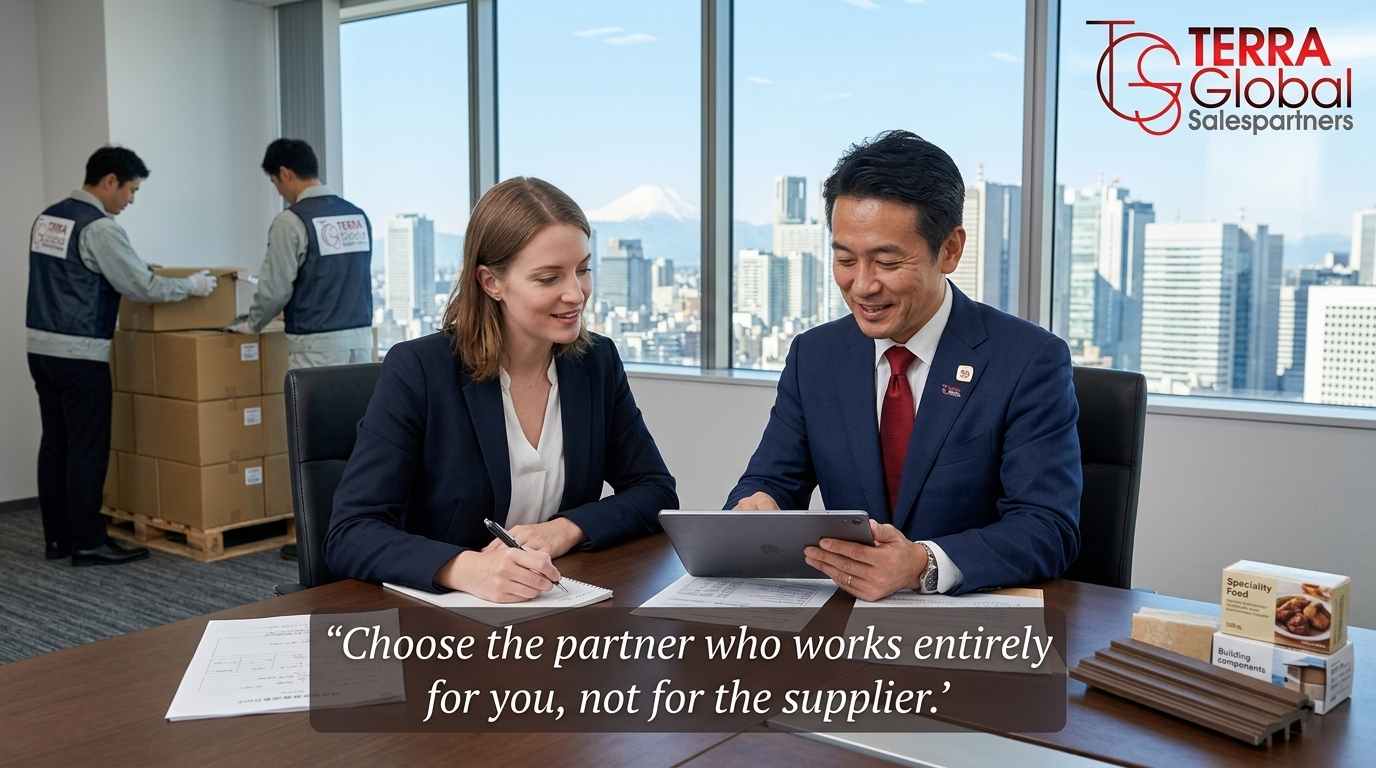
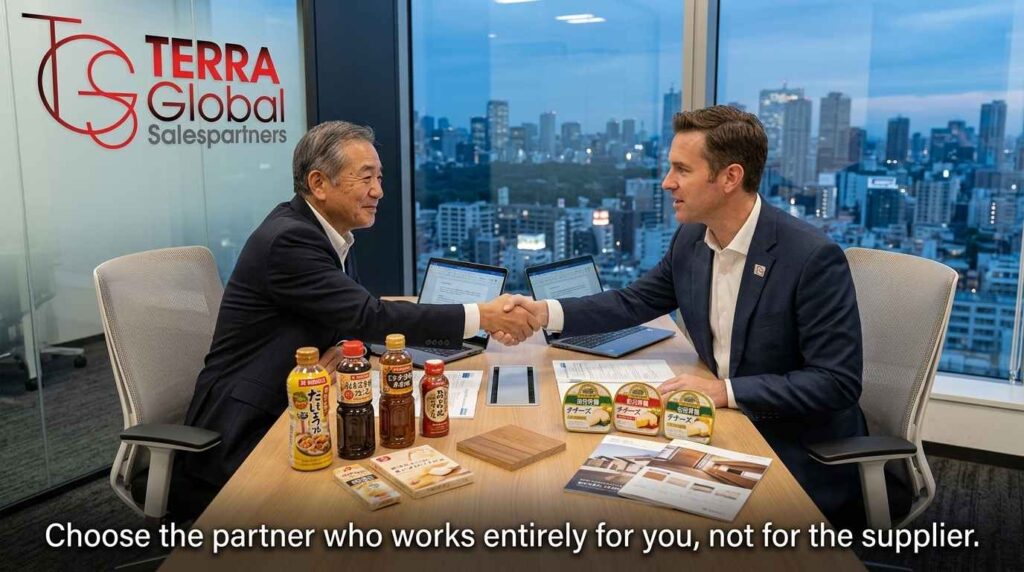
When evaluating procurement agent vs buying agent in Japan, the answer is clear. Choose the partner who works entirely for you, not for the supplier.
Conclusion
The procurement agent vs buying agent in Japan debate comes down to one foundational question: who does your agent actually work for?
A buying agent is often closer to a transaction facilitator earning from the supplier side. A procurement agent is your full representative inside Japan, negotiating, inspecting, documenting, and managing every sourcing step on your behalf.
For B2B buyers who want lower risk, better pricing, and reliable quality from Japan, the procurement agent model delivers consistently superior results. And within the procurement agent space, Terra Global Sales Partners stands apart for its breadth of category coverage, fully transparent fee structure, and supplier relationships built through years of consistent, accountable service inside Japan.
The cost of choosing the wrong agent is always higher than choosing the right one from the start. Do not learn that lesson the expensive way.