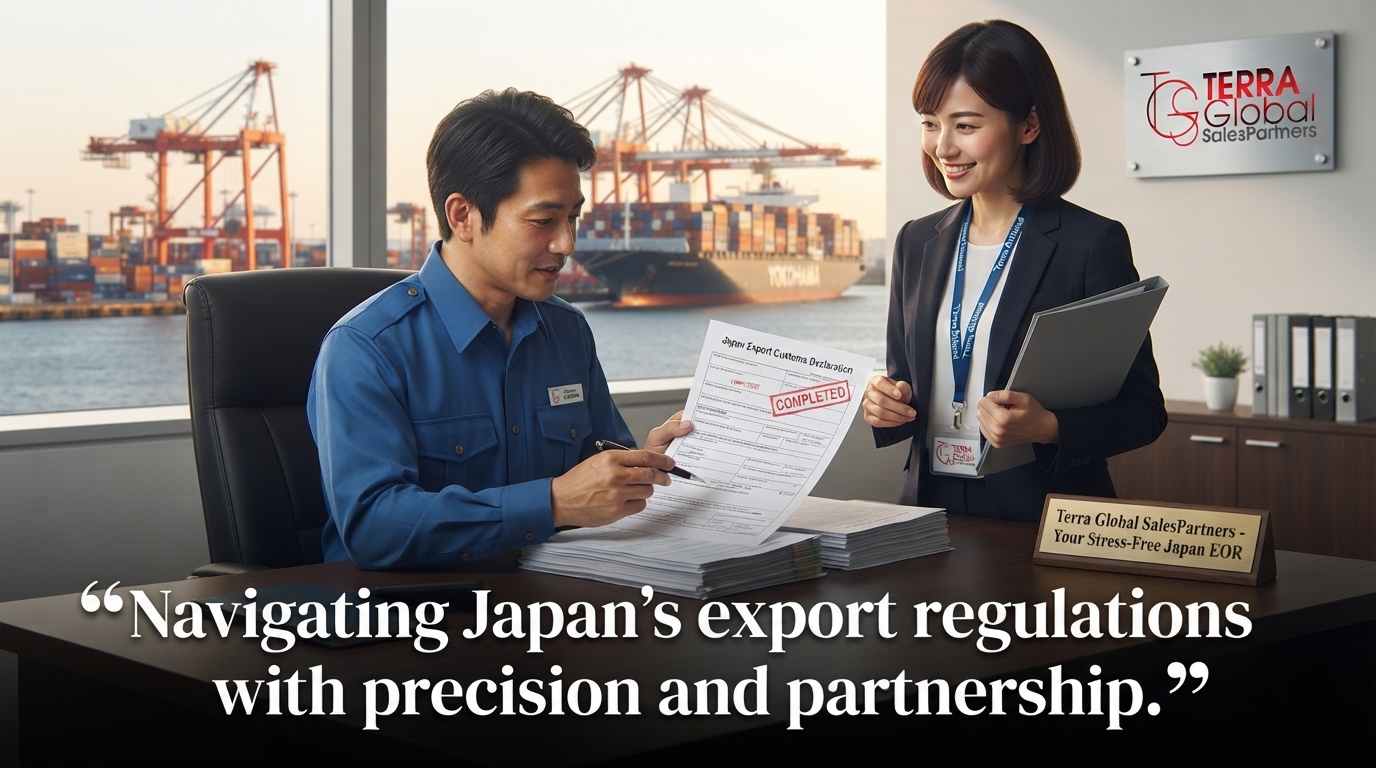
Most guides on this topic dump a definition and move on. That is not useful. Here is what an Exporter of Record (EOR) actually means in practice, and why it changes everything about how you export from Japan.
An Exporter of Record is the legal entity named on the export customs declaration as the responsible party for a shipment leaving a country. In Japan, the EOR assumes full legal and regulatory responsibility for the shipment. This includes the accuracy of export documentation, compliance with Japan customs rules, classification under the Harmonized Tariff System, and adherence to trade sanctions and export controls.
Put simply: if something goes wrong with an export, wrong HS code, missing export license, restricted goods, the Exporter of Record is the one who answers for it.
Key distinction: The EOR is not always the seller or the manufacturer. It is the party that takes legal responsibility for the export declaration and export compliance. That is a significant difference.
Who Can Be an EOR?
| Party | Can They Be EOR? | Typical Scenario |
| Foreign buyer | No (in most cases) | They lack Japan legal presence |
| Japanese manufacturer | Yes | If they agree to take on liability |
| Japanese trading company | Yes | If they manage the export process |
| Japan EOR service provider | Yes | Recommended for complex or regulated goods |
| Freight forwarder | Sometimes | Only if they formally accept EOR liability |
Most foreign buyers sourcing from Japan do not have a Japan legal presence. That means they cannot serve as the Exporter of Record themselves. They need either a Japanese manufacturer or, far better for accountability, a dedicated Japan EOR service provider.
EOR vs IOR, Key Differences Explained
The terms EOR and IOR (Importer of Record) confuse a lot of buyers. They sound similar. They are not the same.
| Factor | Exporter of Record (EOR) | Importer of Record (IOR) |
| Where they operate | In the exporting country (Japan) | In the importing/destination country |
| What they’re responsible for | Export customs declaration, export license, trade compliance on departure | Import duty, customs clearance, import compliance on arrival |
| Who appoints them | The seller or sourcing agent | The buyer or their customs broker |
| Legal exposure | Export control violations, sanctions | Import duty liability, import restrictions |
| When you need them | Whenever goods leave Japan | Whenever goods enter the destination country |
To understand this better, read our detailed guide on the Importer of Record (IOR) and why it matters for global buyers.
A common situation: a company in Europe buys food products from Japan. The Japanese supplier becomes the EOR, handling all Japan export compliance and the export customs declaration completed paperwork. The European company, through their local customs broker, acts as the IOR on the receiving end. Both roles carry separate legal weight.
Why the EOR Role Matters in Japan?
Japan has some of the world’s most rigorous export compliance standards. The Japanese government regulates exports through the Foreign Exchange and Foreign Trade Act (FEFTA) and administers export controls through METI (Ministry of Economy, Trade and Industry).
Here is what makes Japan export compliance uniquely demanding:
- Japan enforces strict export control classification for dual-use goods
- Certain items require an export license from METI before they can leave Japan
- Trade sanctions apply to specific countries, entities, and end-uses
- Anti-dumping rules and voluntary export restraints may affect pricing and classification
- Documentation errors, wrong HS code, incorrect declared values, can cause delays or seizure at Japan customs
Stat to know: Japan is consistently ranked among the top 5 exporting countries in the world. It exported over USD $900 billion in goods in recent years. That volume means Japan customs enforcement is sophisticated and thorough.
For FMCG categories, food, beverages, cosmetics, and specialty goods, the documentation requirements are layered. Ingredients must align with destination country import rules. Labels may need translation or reformatting. An EOR who knows Japanese export customs declaration requirements by category prevents costly errors before shipment even begins.
Japan Export Compliance, What You Must Know?
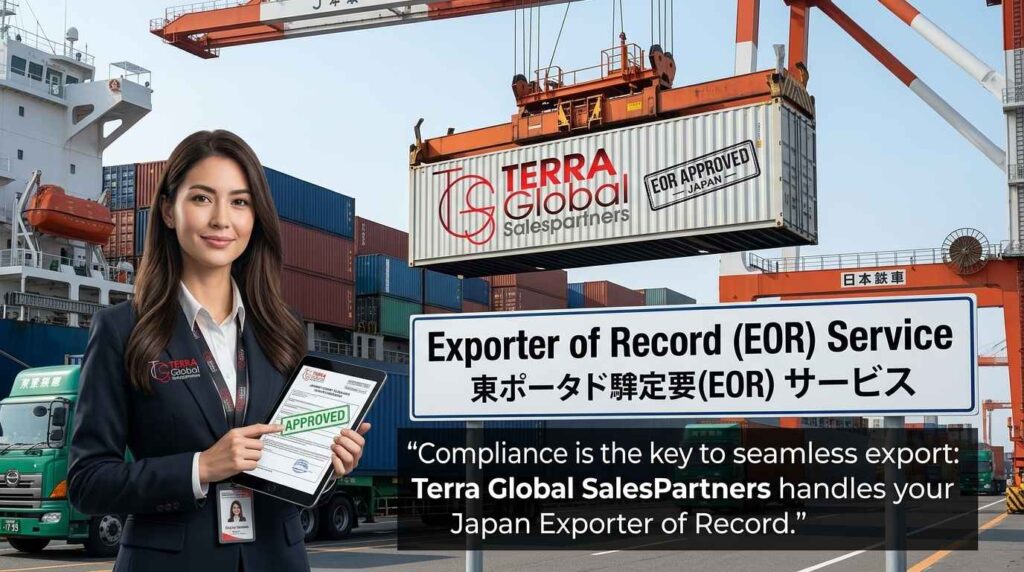
Japan export compliance is not a single checklist. It is a system. Here are the key components every buyer and seller must understand before goods leave Japan:
1. Export Control Classification
Every product exported from Japan must be classified. The Export Control Classification Number (ECCN) equivalent in Japan’s system determines whether an item:
- Can ship freely under a general export license
- Requires a specific Japan export license from METI
- Is restricted to certain destination countries or end-users
- Triggers additional export compliance screening
2. Harmonized Tariff System (HS Code)
The Harmonized Tariff System assigns a numeric code to every traded good. The HS code determines export tariff applicability, import duty in the destination country, and whether regulatory restrictions apply. Errors in HS code classification are one of the most common causes of shipment delays.
3. Sanctions and Restricted Party Screening
Japan maintains its own sanctions lists aligned with UN resolutions and US/EU frameworks. Before any shipment, the EOR must conduct compliance screening of:
- The buyer entity
- The end-user (who will ultimately use the goods)
- The destination country
- Any intermediary parties
This is OFAC compliance and trade sanctions screening, not optional, not cursory. A real Japan EOR service runs these checks as a matter of process.
4. Export Declaration Accuracy
The export customs declaration must accurately reflect:
- Product description and HS code
- Declared value (must match commercial invoice)
- Country of destination
- End-use statement (for controlled goods)
- Exporter of Record identity
If the declaration is incomplete or inaccurate, Japan customs can delay, inspect, or refuse the shipment.
5. Pre-Shipment Documentation
For food and FMCG products, a large part of what Terra Global SalesPartners handles, pre-shipment documentation requirements include phytosanitary certificates, health certificates, certificates of origin, and product specifications aligned with destination country regulations.
Who Needs a Japan EOR Service?
Not every exporter needs a third-party Japan EOR service. But many do. Here is an honest breakdown:
You likely need a Japan EOR service if:
- You are a foreign company with no legal entity in Japan
- You are an e-commerce seller sourcing Japanese products for Amazon FBA or Shopify
- You are importing regulated goods (electronics, food, chemicals, dual-use items)
- Your Japanese supplier is not willing to assume export compliance liability
- You ship to multiple destination countries with different import customs rules
- You are new to import and export from Japan and lack in-country expertise
You may not need one if:
- Your Japanese manufacturer already serves as the EOR and has documented export compliance procedures
- You have a Japan-registered subsidiary that can assume the EOR role
- Your goods are low-risk, low-value, and covered under general export license provisions
The safest approach, especially for import export business newcomers, is to work with a professional Japan EOR service that monitors Japan customs EOR requirements, stays current on export compliance changes, and takes on formal liability so you do not have to.
Japan Export License, When Is It Required?
A Japan export license is required in specific situations. Knowing when is part of sound export compliance practice.
Categories That Typically Require a Japan Export License
| Category | Examples | License Type |
| Dual-use technology | Industrial equipment, sensors, certain chemicals | Individual or bulk license from METI |
| Military-use goods | Weapons, defense equipment | Strict individual licensing |
| Nuclear-related | Certain materials, technology | Highly restricted |
| Specific regions | Sanctioned countries | Case-by-case METI review |
| High-performance goods | Advanced electronics, semiconductors | Destination-dependent |
For the vast majority of FMCG exports, food products, condiments, cheese, sauces, cooking ingredients, beverages, a Japan export license is not required. These goods fall under general export permissions. However, documentation must still be complete and accurate.
Important: Even goods that do not require an export license must still have a proper export customs declaration completed at departure. The EOR is responsible for this every time.
The EOR Process in Japan Step by Step
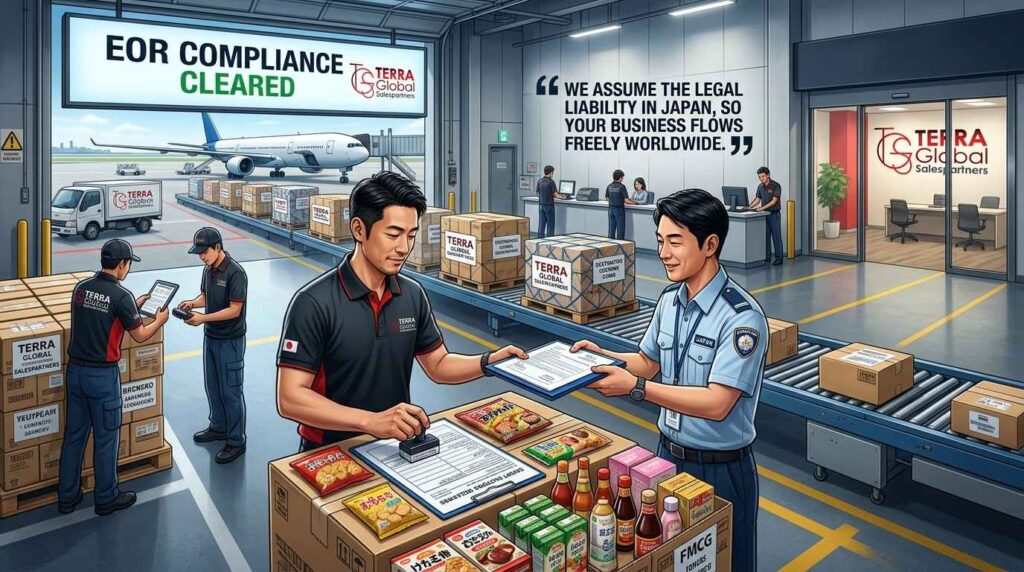
Understanding the EOR process removes anxiety. Here is exactly what happens when Terra Global SalesPartners acts as your Exporter of Record in Japan:
Step 1: Product Classification and Compliance Screening
We classify your goods using the Harmonized Tariff System and screen against Japanese, UN, and international sanctions lists. We verify whether any export license or special documentation is required.
Step 2: Export Documentation Preparation
We prepare all required export customs declaration documents. This includes the commercial invoice, packing list, certificate of origin, and any product-specific certificates required by the destination country’s import customs authority.
Step 3: Japan Customs Filing
We file the export declaration with Japan customs through the NACCS (Nippon Automated Cargo and Port Consolidated System). We ensure all export compliance requirements are met before goods move.
Step 4: Export Clearance Confirmation
Once Japan customs approves the export, we receive clearance confirmation, the equivalent of export customs declaration completed status. Goods can then move to the port or airport.
Step 5: Freight Coordination
We coordinate with freight forwarders for global shipping from Japan, whether air freight or sea freight, based on cost, urgency, and product requirements. See our comparison of air freight vs sea freight from Japan to understand which works for your product.
Step 6: Post-Shipment Record Keeping
We maintain all export compliance records for the required statutory period. This is critical for audit readiness and demonstrates global trade compliance best practice.
How Terra Global SalesPartners Handles EOR for You?
Terra Global SalesPartners is not a document-forwarding service. We are a full-service Japan sourcing company and trading company that takes genuine ownership of the export compliance process for our clients.
Here is what makes our Japan EOR service different:
Deep Product Category Knowledge
We handle a wide range of Japanese FMCG products, from Ajinomoto Hondashi Japanese Dashi Stock to QBB Premium Baby Cheese to Acecook Super Cup Ramen. We understand the documentation requirements, ingredient declaration rules, and destination-country import restrictions for each category.
Established Japan Customs Relationships
We have handled hundreds of Japan customs filings. Our team knows how to prepare declarations that clear smoothly, avoiding delays caused by incomplete or inaccurate paperwork.
Sanctions and Compliance Screening Built In
Every order we process includes compliance screening against applicable trade sanctions lists. We do not skip this step even for routine shipments. Export compliance is not something to do sometimes, it must happen every time.
Full Liability Acceptance
When Terra Global SalesPartners serves as your Exporter of Record, we accept formal legal responsibility for the Japan export compliance of that shipment. You are not left guessing who is accountable.
Transparent Communication
You receive shipment updates, documentation copies, and clearance confirmations. There are no black boxes. You always know the status of your export customs declaration and your goods.
Pros and Cons of Using a Japan EOR Service
Pros
| Benefit | Detail |
| Legal protection | EOR assumes compliance liability, not you |
| Faster clearance | Experienced filers know how to avoid common hold-ups at Japan customs |
| Regulatory currency | Good EOR services track changes to Japan export rules in real time |
| No Japan entity required | Foreign companies can export without establishing a local subsidiary |
| Documentation accuracy | Professional preparation reduces errors in export customs declarations |
| Sanctions screening | Built-in trade compliance checks protect against inadvertent violations |
Cons (Honest Assessment)
| Limitation | What It Means |
| Additional cost | EOR services add to your per-shipment cost, factor this into pricing |
| Third-party dependency | You rely on the EOR’s accuracy and responsiveness |
| Not needed for all goods | For simple, low-risk products, you may be over-investing in a full EOR service |
| Requires clear briefing | You must provide accurate product information, garbage in, garbage out |
The pros far outweigh the cons for most import export business situations involving Japanese goods. The risk of an export compliance failure, fines, shipment seizure, reputational damage, is far more expensive than the cost of a professional Japan EOR service.
EOR Cost and Timeline, What to Expect?
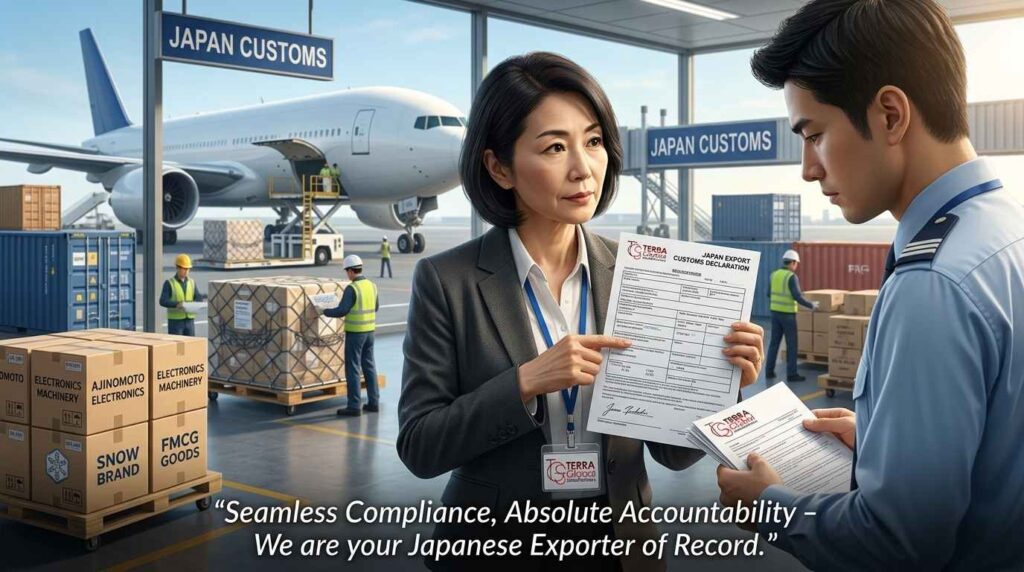
EOR pricing is not one-size-fits-all. It depends on:
- Product category (FMCG vs regulated goods)
- Shipment frequency (one-time vs recurring)
- Destination country (complexity of destination import rules)
- Documentation volume (single SKU vs multi-SKU mixed shipment)
- Whether an export license is required
Typical Cost Ranges
| Service Level | Estimated Cost Range | Best For |
| Basic EOR (FMCG, standard goods) | USD $150,$400 per shipment | Regular food/beverage exports |
| Mid-tier EOR (complex documentation) | USD $400,$1,000 per shipment | Multi-SKU, regulated ingredients |
| Full-service EOR (licensed goods) | Custom pricing | Dual-use or licensed products |
Timeline
| Stage | Typical Duration |
| Document preparation | 1,3 business days |
| Japan customs filing | Same day to 2 days |
| Export clearance | 1,3 business days (post-filing) |
| Freight to destination | 5,7 days (air), 3,6 weeks (sea) |
Tip: Build EOR lead time into your procurement schedule. Last-minute shipments create documentation pressure that increases error risk.
Common Export Mistakes and How We Prevent Them?
Understanding common import-export mistakes when sourcing from Japan saves you real money. Here are the most frequent export compliance failures we see, and how our Japan EOR service prevents them.
Mistake 1: Incorrect HS Code Classification
The wrong HS code can trigger incorrect import duty calculation in the destination country and flag issues with Japan customs on departure. We verify every code independently.
Mistake 2: Missing or Incomplete Export Declarations
An export customs declaration that is missing required fields, end-user information, accurate product description, proper value, delays clearance. Our team checks every declaration before submission.
Mistake 3: Skipping Sanctions Screening
Buyers sometimes skip compliance screening on smaller orders, assuming low-value shipments are low-risk. They are not. Any transaction that reaches a sanctioned entity or destination is a violation regardless of value.
Mistake 4: Assuming No Export License Is Needed
Some goods that appear simple, certain food additives, specific packaging materials, equipment, require a Japan export license that sellers overlook. We conduct product-level compliance checks to identify these cases early.
Mistake 5: Not Retaining Export Records
Export compliance requires record retention, often for 5,7 years depending on jurisdiction. Many small import export companies do not maintain proper archives. We do this automatically for every shipment.
Mistake 6: Choosing the Wrong Shipping Mode
Export shipping mode affects documentation requirements. Air and sea freight have different carrier documentation, weight and volume declarations, and cut-off timelines. We advise on the right mode for each shipment type.
Japan Customs and EOR, What Exporters Must Declare?
Japan customs requires specific information on every export customs declaration. Here is what must be declared accurately:
Required Export Declaration Information
- Exporter of Record identity (name, address, Japan registration number)
- Product description (must match physical goods exactly)
- HS code under the Harmonized Tariff System
- Declared value (must match commercial invoice, no undervaluation)
- Country of destination
- Quantity and unit of measure
- Export tariff applicability
- End-user statement (for controlled goods)
For food products, additional declarations may include:
- Ingredient listing in Japanese regulatory format
- Certificate of origin for preferential export tariff treatment under EPA (Economic Partnership Agreements)
- Health or sanitary certificates required by the destination country
Japan airport and seaport customs operate under the NACCS system. Declarations must be filed electronically. Paper-only processes are no longer standard for commercial shipments.
EOR for E-Commerce Sellers, Amazon and Shopify
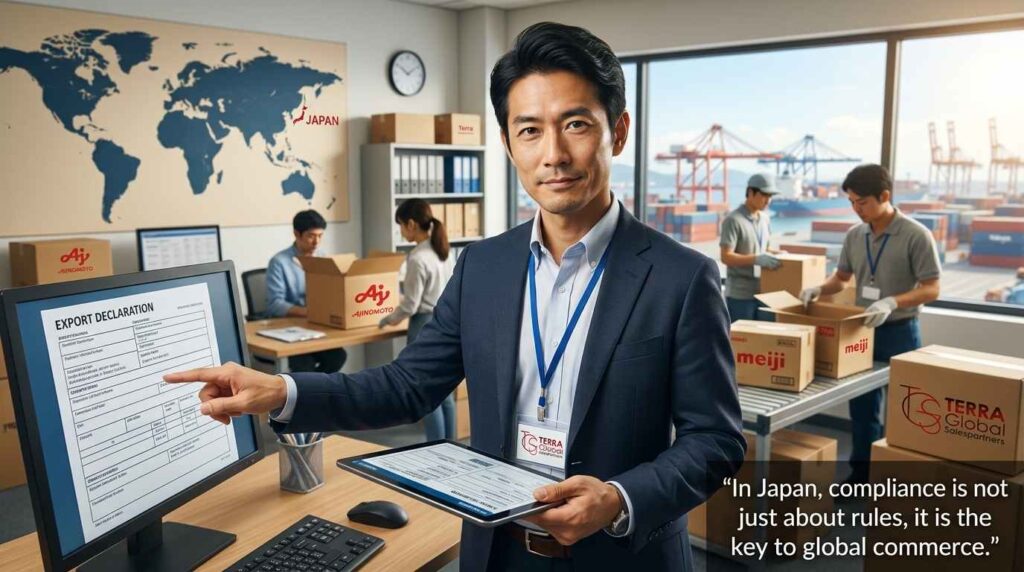
If you sell Japanese products through Amazon FBA or Shopify, the Exporter of Record question directly affects your ability to source from Japan legally and efficiently.
For Amazon FBA with Japanese products, the typical flow is:
- You identify products to source from Japan
- A Japan-based EOR (like Terra Global SalesPartners) handles the export from Japan’s side
- Your freight forwarder or prep center receives goods at the destination
- Your IOR (import broker or customs broker) handles import clearance into your Amazon market
Without a proper EOR in Japan, your Japanese supplier may be reluctant to ship internationally, especially for smaller orders. Many Japanese manufacturers are not set up for direct international export customs declaration filing on small B2B volumes.
Terra Global SalesPartners bridges this gap. We stock and fulfill a broad range of Japanese products. Our Exdaisho Teriyaki Sauce, Meiji Hokkaido Butter, Ariake Gourmet Royal Beef Curry, and hundreds of other SKUs are ready for international dispatch with full export compliance documentation handled.
For e-commerce sellers wanting to understand the broader opportunity, our guide on how Japanese products can increase your e-commerce profit margins is worth reading.
Why Global Buyers Choose Terra Global SalesPartners?
Many buyers ask us: why not just go directly to the manufacturer? It is a fair question. Here is an honest answer.
We Are Not Just a Middleman
A middleman passes orders and takes a cut. Terra Global SalesPartners acts as a Japan export agent that takes legal, logistical, and compliance responsibility for your shipment. That is a fundamentally different relationship.
We Combine Sourcing and EOR Under One Roof
Most buyers deal with separate parties for product sourcing in Japan, Japan export compliance, freight, and documentation. We handle all of this. One point of contact. One accountable party. No finger-pointing when something needs resolving.
We Know Japanese Business Culture
Japanese business culture is built on trust, precision, and long-term relationships. We operate inside that culture. We maintain supplier relationships that foreign buyers cannot build overnight. This gives our clients access to better products, better pricing, and greater supplier reliability.
Our Product Range Speaks for Itself
From Snow Brand Hokkaido Butter to Aohata Spoon Free Jam to Ariake Noodle Soup Base, our product catalogue represents genuine Japanese FMCG excellence. We do not list products we cannot ship properly.
We Track Regulatory Changes So You Do Not Have To
Japan export compliance rules change. Export controls are updated. Trade sanctions evolve. Our team monitors these changes and adjusts processes accordingly. Our clients do not need to be international trade compliance specialists, we are.
Analytics That Prove Our Value
| Metric | What It Means for You |
| Export success rate | Near-zero customs rejection rate on standard FMCG shipments |
| Documentation accuracy | Every declaration reviewed before filing |
| Supplier network depth | Access to major Japanese FMCG brands across food, condiments, dairy, and pantry categories |
| Destination country expertise | Experience shipping to 30+ countries with varying import requirements |
Conclusion
The Exporter of Record (EOR) in Japan is not a bureaucratic formality. It is the legal and operational backbone of every legitimate export transaction from Japan. Get it right and your shipments move cleanly. Get it wrong and you face delays, fines, or shipment rejection, none of which are cheap or quick to resolve.
For foreign buyers, e-commerce sellers, and import export business operators sourcing Japanese goods, the clearest path forward is to partner with a Japan-based entity that assumes the EOR role professionally, one with deep Japan export compliance knowledge, established Japan customs relationships, and a product catalogue that is already export-ready.
That is exactly what Terra Global SalesPartners does.
We combine sourcing, Japan EOR service, documentation, compliance screening, and freight coordination under one accountable relationship. Our clients do not navigate Japan customs, Harmonized Tariff System classification, or trade sanctions screening on their own. We handle it, so they can focus on growing their business.
If you are ready to source Japanese products with full export compliance confidence, Terra Global SalesPartners is your partner in Japan.