
If you have ever tried to source products from Japan or sell into the Japanese market, you already know one thing: it is not simple. Language barriers, customs regulations, supplier negotiations, and logistics all pile up fast. That is where a Japan trade agent steps in, but here is the question most international buyers and sellers get wrong: which type of agent do you actually need?
A japan export agent and a japan import agent are two completely different professionals. They serve opposite ends of the trade chain. Mixing them up costs time, money, and sometimes the deal itself. At Terra Global Sales Partners, we have helped businesses across Asia, the Middle East, Europe, and beyond navigate exactly this confusion, and we have seen firsthand how the right guidance transforms a frustrating sourcing experience into a smooth, repeatable operation.
This guide breaks down japan export agent vs import agent differences clearly and honestly. We cover what each role does, when you need one over the other, how to choose the right partner, and why working with a specialist like Terra Global gives you a genuine edge in cross-border trade.
What Is a Japan Export Agent?
A japan export agent is a professional or company based in Japan that helps Japanese manufacturers and suppliers sell their products to buyers in other countries. They act on behalf of the seller, the Japanese side of the transaction.
Their core job is to make Japanese products accessible to global markets. They handle everything on the Japan end: sourcing the right manufacturer, verifying product quality, preparing export documentation, managing customs clearance in Japan, coordinating freight forwarding, and communicating with foreign buyers in a language and format they understand.
Key Responsibilities of a Japan Export Agent
| Responsibility | Description |
| Supplier Identification | Find verified Japanese manufacturers for specific product categories |
| Price Negotiation | Negotiate FOB or CIF pricing on behalf of sellers or buyers |
| Export Documentation | Prepare commercial invoices, packing lists, certificates of origin |
| Japan Customs Clearance | Handle export declarations with Japan Customs |
| Quality Inspection | Arrange pre-shipment inspections at the factory or warehouse |
| Freight Coordination | Liaise with shipping lines, air freight, or couriers |
| Buyer Communication | Bridge language and cultural gaps with international buyers |
Think of a japan export agent as your bridge into Japan’s supply chain. Without one, overseas buyers are often left navigating a market where most suppliers prefer Japanese-language communication, operate on Japanese business culture norms, and may not have export-ready systems set up for international buyers.
At Terra Global Sales Partners, our export facilitation covers everything from Japanese food wholesale products, like the Daisho Teriyaki Sauce 1.25kg and Koiwai Farm Spread Cheese 90g, to building materials, cosmetics, and agricultural goods. We work with trusted Japanese suppliers across categories so our clients never have to guess who is reliable and who is not.
What Does a Japan Export Agent Do, In Practice?
Here is a real-world scenario. A food distributor in the UAE wants to import premium Japanese sauces and dairy products. They have no existing relationship with Japanese suppliers. They do not speak Japanese. They are not sure which products meet GCC import regulations.
A japan export agent steps in and:
- Identifies verified suppliers for the exact product categories needed
- Requests samples, confirms product specifications, and reviews halal or hygiene certifications
- Negotiates pricing and minimum order quantities
- Prepares all export paperwork, including certificate of origin, phytosanitary certificates where needed, and Japanese customs export declarations
- Coordinates sea freight or air freight to the destination port
- Provides the buyer with tracking, commercial invoices, and packing documentation
That entire workflow sits on one desk. That is what what does a japan export agent do means in practice, they remove the operational and cultural friction that blocks most international buyers from accessing Japanese supply chains.
What Is a Japan Import Agent?
A japan import agent works from the opposite direction. They represent foreign sellers who want to get their products into Japan. They work on behalf of non-Japanese companies trying to enter or grow in the Japanese market.
Japan has some of the world’s most demanding import requirements. Food labeling must comply with the Food Sanitation Act. Cosmetics require approval under the Pharmaceutical and Medical Device Act. Electronics must meet PSE certification standards. Missing any of these creates shipment holds, fines, or full rejection at the Japanese port.
A japan import agent for international buyers handles:
- Japanese import customs clearance
- Regulatory compliance reviews (food law, cosmetics law, electrical safety standards)
- Japanese labeling requirements and translation
- Local distribution setup and warehouse coordination
- Relationship building with Japanese retailers, wholesalers, or end-buyers
- Aftersales representation in Japan
This is not a role you can skip. Japan’s import rules are strict and enforced consistently. A japan import agent becomes your legal and operational representative inside Japan, someone who understands the market from the inside out.
Japan Export Agent vs Import Agent, Side-by-Side Comparison
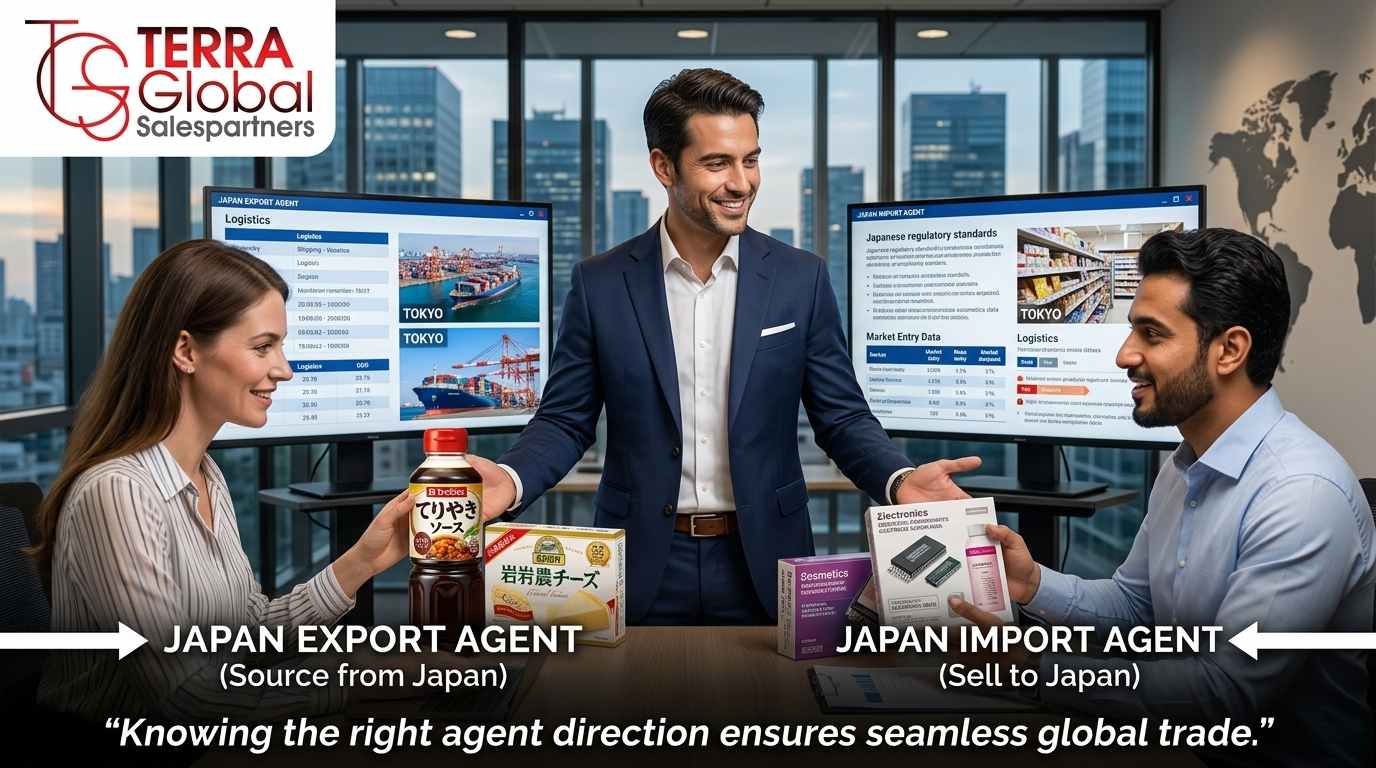
This is the clearest way to understand the japan export agent vs import agent distinction. They serve opposite directions of trade.
| Factor | Japan Export Agent | Japan Import Agent |
| Who They Represent | Japanese seller / overseas buyer sourcing from Japan | Foreign seller entering the Japanese market |
| Direction of Trade | Japan → World | World → Japan |
| Primary Location | Based in Japan | Based in Japan or in the exporter’s country |
| Main Tasks | Sourcing, export docs, freight, quality checks | Import clearance, compliance, local distribution |
| Regulatory Focus | Japanese export rules | Japanese import regulations (food law, PMD Act, PSE) |
| Language Role | Bridges Japanese suppliers with foreign buyers | Bridges foreign sellers with Japanese buyers/regulators |
| Who Pays Them | Usually the overseas buyer or on commission from supplier | Usually the foreign company entering Japan |
| Market Knowledge | Japanese supply chain depth | Japanese retail, distribution, and regulatory landscape |
The difference matters enormously when you are planning your trade strategy. Hiring a japan export agent when you need an import agent, or vice versa, means paying for the wrong expertise and missing critical compliance steps.
When Do You Need a Japan Export Agent?
You need a japan export agent when:
- You are an international buyer looking to source products directly from Japanese manufacturers
- You want to access premium Japanese goods, food, cosmetics, automotive parts, building materials, agricultural products, without building a Japan office
- Your supplier cannot handle export paperwork and needs a third-party agent to manage documentation and freight
- You are scaling a private-label or OEM operation and need ongoing supplier management in Japan
- You have had bad experiences with middlemen who mark up prices without adding value, and want a transparent sourcing partner
Terra Global Sales Partners operates as a japan export agent for buyers across Asia, Europe, the Middle East, and beyond. Our product range spans agriculture, cosmetics, construction materials, wood supplies, and building equipment, alongside a deep catalogue of Japanese food and beverage products.
If you are building an e-commerce business importing Japanese goods, our blog post on Best Japanese Products for Amazon & Shopify Sellers shows exactly which categories perform best in global online markets.
When Do You Need a Japan Import Agent?
You need a japan import agent when:
- You manufacture products outside Japan and want to sell them inside Japan
- You have received interest from Japanese buyers but do not know how to fulfil orders compliantly
- Your product category requires Japanese regulatory approval, food, pharma, cosmetics, electronics
- You need a local representative who can attend trade shows, meet buyers, and build relationships in Japan on your behalf
- You want to test the Japanese market before committing to a full-scale market entry strategy
The japan import agent role is especially critical for food and cosmetics brands. Japan’s Food Sanitation Act requires importers to meet strict labeling rules: all ingredients must be listed in Japanese, allergen disclosures are mandatory, and some additives permitted in Western markets are banned in Japan.
How Japan Export and Import Agents Help International Businesses Source Products?

Let us go deeper on how japan export and import agents help international businesses source products, because this is where the real value gets built.
1. Market Access Without a Local Office
Setting up a representative office in Japan costs anywhere from ¥500,000 to ¥2,000,000+ annually before you factor in staffing, legal registration, and compliance overhead. A professional japan trade agent gives you that market presence at a fraction of the cost. You get a Japan-based expert working for your business without the overhead of incorporation.
2. Supplier Vetting and Relationship Management
Japan has tens of thousands of manufacturers. Many are excellent. Some are not export-ready. A seasoned japan export agent already has relationships with vetted, export-capable suppliers across categories. They know who delivers on time, who handles international documentation correctly, and who meets food safety or manufacturing quality standards.
For example, Terra Global connects buyers with suppliers like Daisho (for Japanese sauces and condiments), Koiwai Farm (for premium dairy and cheese products), Mizkan (for mirin and cooking sake), and Takara (for hon mirin). Products like the Mizkan Honteri Mirin Style Seasoning 400ml and Mizkan Cooking Sake 400ml are sourced from established Japanese manufacturers with consistent export track records.
3. Documentation and Compliance Management
This is where deals die without an agent. Export documentation for Japanese goods typically includes:
- Commercial Invoice (in English and sometimes in Japanese)
- Packing List (net weight, gross weight, number of cartons, dimensions)
- Bill of Lading or Air Waybill
- Certificate of Origin (Japan)
- Phytosanitary Certificate (for agricultural products)
- Health Certificate (for food products going to regulated markets)
- Fumigation Certificate (for wood products, critical for timber and wood supplies)
A professional japan export agent manages all of this as standard procedure. Buyers who try to handle this independently often face delays, rejected shipments, or failed customs clearances in their destination country.
4. Logistics Coordination and Cost Optimisation
Freight from Japan is not one-size-fits-all. LCL (Less than Container Load) works for small orders. FCL (Full Container Load) is more cost-efficient for large volumes. Air freight is faster but expensive. A good japan trade agent helps you choose the right mode, consolidate shipments when possible, and select freight forwarders with Japan-specific expertise.
Terra Global has logistics relationships built over years of cross-border trading. We have helped buyers cut per-unit freight costs by consolidating orders across product categories, for example, combining food condiments with cosmetics or building materials within a single shipment where permitted.
5. Cultural and Communication Bridging
Japanese business culture operates on principles of trust, long-term relationship building, and formal communication. Cold emails from foreign buyers rarely get responses from Japanese suppliers. Requests that seem normal in Western business contexts, like asking for a sample without prior relationship, can be awkward or declined in Japan.
A japan export agent already has these relationships. They introduce your business to suppliers with the right context, manage expectations on both sides, and ensure that miscommunications do not derail deals. Our guide on Japanese Business Culture: What International Buyers Must Know goes deep on this topic, it is required reading before you approach any Japanese supplier directly.
Pros and Cons, Japan Export Agent vs Import Agent
Japan Export Agent, Pros and Cons
| Pros | Cons |
| Access to Japan’s supply chain without local presence | You rely on their supplier relationships, quality depends on their network |
| Handles all export documentation and compliance | Not suitable for companies trying to sell into Japan |
| Reduces sourcing risk through vetted manufacturer relationships | Adds a service cost layer to product pricing |
| Bridges language and cultural barriers on your behalf | You have less direct control over supplier relationships |
| Can manage quality inspections before shipment | Response times depend on Japan-Australia/Europe time zone gaps |
Japan Import Agent, Pros and Cons
| Pros | Cons |
| Deep understanding of Japanese regulatory requirements | More complex engagement, usually requires longer onboarding |
| Local market access for foreign brands | Japan’s import compliance is strict and slow, expect 3–6 months for regulated categories |
| Can build buyer/retailer relationships inside Japan | Requires the foreign seller to produce Japan-compliant labeling |
| Acts as your legal and operational local representative | Not suitable for companies that want to source from Japan |
| Reduces market entry risk significantly | Costs are higher for full market representation services |
What Is the Difference Between a Japan Export Agent and Import Agent?

To answer what is the difference between a japan export agent and import agent in one clear paragraph:
A japan export agent helps you buy from Japan. They represent the trade flow going out of Japan to international markets. A japan import agent helps you sell into Japan. They represent the trade flow coming into Japan from international markets. Both agents are based in Japan and both have deep Japan-market knowledge, but they serve completely opposite business objectives.
If you are an overseas company trying to source Japanese food, cosmetics, agricultural goods, or industrial materials, you need a japan export agent. If you are a foreign manufacturer trying to enter the Japanese consumer or B2B market, you need a japan import agent.
Industry Statistics, Why Japan Trade Agents Matter
Understanding the scale of Japan’s global trade helps explain why professional agent services are in high demand.
| Statistic | Data |
| Japan’s total exports (2024) | Approx. USD 714 billion |
| Japan’s total imports (2024) | Approx. USD 764 billion |
| Top export categories | Machinery, vehicles, electronics, chemicals, food |
| Top food export growth category | Processed foods (+12% YoY, 2023–2024) |
| Number of Japanese food manufacturers | 50,000+ registered producers |
| Japan’s food export target (government) | ¥5 trillion by 2030 |
| % of Japanese SMEs with export departments | Less than 30%, the rest need export agent support |
Sources: Japan Customs, MAFF (Ministry of Agriculture, Forestry and Fisheries), JETRO trade statistics.
The last statistic is critical: over 70% of Japanese SME manufacturers do not have dedicated export teams. That is the gap a japan export agent fills, making Japanese products available to global buyers even when the manufacturer has no international infrastructure.
Our blog post on Why Japanese FMCG Products Lead in Global Markets documents exactly how this dynamic plays out in the fast-moving consumer goods sector, and why demand for export agent services is accelerating.
Why Terra Global Sales Partners Is the Right Japan Trade Agent for You?
Most guides on japan export agent vs import agent stay theoretical. We do not. At Terra Global Sales Partners, we have been operating as an active japan export agent connecting international buyers with verified Japanese suppliers across multiple product categories.
Here is what makes us different from generic sourcing agencies:
Verified, Multi-Category Product Range
We do not limit buyers to one industry. Our catalogue spans:
- Food and Beverages: Japanese condiments, sauces, dairy, mirin, cooking sake, including premium lines from Daisho, Koiwai Farm, and Mizkan. For example, the Daisho Sukiyaki Sauce 600g, Daisho Grilled Eel Sauce 240g, Daisho Yuzu BBQ Sauce 185g, and Koiwai Farm Hors D’oeuvre Cheese with Yonezawa Salami 42g
- Agriculture: Fresh and processed agricultural goods from verified Japanese producers
- Cosmetics: Japanese-formulated skincare and beauty products with full export documentation
- Construction Materials and Building Equipment: Structural and finishing materials for project-scale procurement
- Wood Supplies: Certified timber and wood products with proper fumigation documentation
Transparent Operations
We do not hide markups inside opaque pricing structures. Our clients know exactly what they are paying for: sourcing fees, logistics coordination, documentation preparation, and agent service costs, all disclosed clearly before any order is confirmed.
Deep Supplier Relationships
Our relationships with Japanese suppliers have been built over years. When you ask us for a specific product, say, the Daisho Mentsuyu Noodle Dipping Sauce in Wasabi Flavour 180g or the Takara Hon Mirin 1L PET, we are not going to a search engine to find a supplier. We already have the relationship, we know the export process for that product category, and we know what documentation your destination country will require.
End-to-End Service, Not Just Introductions
Some agents make introductions and disappear. We stay involved from first enquiry to delivery confirmation. That includes:
- Product sourcing and confirmation
- Sample coordination (where applicable)
- Pro forma invoice issuance
- Export documentation preparation
- Freight booking and tracking
- Destination port clearance support
- Post-delivery follow-up
This is what separates a professional japan trade agent from a simple broker.
How to Choose the Right Japan Export or Import Agent?
Not all agents are equal. Here is what to look for, and what to walk away from.
Green Flags
- Specific category experience. A food export agent who has handled phytosanitary certificates, health certificates, and cold-chain logistics is worth more than a generalist with no category depth.
- Transparent pricing. You should know what you are paying for before you commit.
- Verifiable supplier relationships. Ask for the brands or manufacturers they work with. A professional agent can name them.
- Responsive communication. Cross-border trade has time-sensitive moments, documentation deadlines, vessel cutoffs, customs queries. Your agent should respond within 24 hours.
- Documented track record. Case studies, repeat clients, or portfolio examples all signal genuine experience.
Red Flags
- Agents who cannot name their suppliers. If they claim wide access but cannot give you brand names, be cautious.
- Upfront fees with no deliverables attached. Service fees should be tied to actual outputs, sourcing results, documentation, freight bookings.
- No knowledge of destination country regulations. A good japan export agent knows that Japan can export it. A great one also knows whether your destination country can receive it.
- Overpromising on timing. Sea freight from Japan to Europe is typically 25–35 days. Anyone promising 7 days by sea is not being honest.
Japan Export Agent vs Import Agent, Decision Framework
Use this simple framework to decide which agent type fits your situation.
Step 1: Identify your direction of trade.
- Are you buying FROM Japan? → You need a japan export agent
- Are you selling INTO Japan? → You need a japan import agent
Step 2: Identify your product category.
- Food, cosmetics, agriculture, industrial goods all have category-specific compliance requirements. Your agent must have category-specific experience, not just general trade knowledge.
Step 3: Identify your volume and frequency.
- One-off order? A transactional sourcing agent works.
- Ongoing supply? You need a long-term japan trade agent relationship with consistent account management.
Step 4: Assess your internal capabilities.
- Do you have logistics and customs expertise in-house? If not, your agent needs to cover that gap fully.
- Do you have Japan-language capability in-house? If not, your agent is your communication layer, choose one that communicates with fluency and professionalism.
Terra Global’s Product Knowledge, A Proof Point
We talk about expertise. Here is what it looks like in practice. Below are products we currently source and export, each representing verified supplier relationships, product-category compliance knowledge, and export-ready operations.
Japanese Food Condiments and Sauces:
- Daisho Teriyaki Sauce 1.25kg, Restaurant and food service grade
- Daisho Sukiyaki Sauce 600g, Premium retail and hospitality format
- Daisho Mentsuyu Noodle Dipping Sauce Yuzu Flavour 185g
- Daisho Mentsuyu Noodle Dipping Sauce Wasabi Flavour 180g
- Daisho Grilled Eel Sauce 240g
- Daisho Yuzu Dressing 150ml
- Daisho Wasabi Dressing 150ml
- Daisho BBQ Sauce Yuzu Flavour 185g
- Daisho BBQ Sauce Wasabi Flavour 180g
Japanese Dairy and Cheese:
- Koiwai Farm Spread Cheese 90g
- Koiwai Farm Hors D’oeuvre Cheese with Yonezawa Salami 42g
- Koiwai Farm Hors D’oeuvre Cheese with Onion 42g
Japanese Mirin and Cooking Sake:
Every one of these products is supported by proper export documentation, cold-chain logistics coordination where required, and health and origin certification support. That is not something a general trading company can offer. That is the difference a category-specialist japan export agent makes.
If you want to reduce import costs on orders like these, our detailed guide on How to Reduce Import Costs When Buying from Japan gives practical, actionable strategies you can apply immediately.
When Do You Need a Japan Import Agent vs Export Agent for Cross-Border Trade?
The clearest answer to when do you need a japan import agent vs export agent for cross-border trade is this:
- Cross-border trade moving products out of Japan = export agent
- Cross-border trade moving products into Japan = import agent
But here is the nuance: some businesses need both, depending on their trade model. An FMCG company might source Japanese condiments for their global retail network (export agent needed) while simultaneously distributing their own European-made sauces into Japan (import agent needed). In those cases, Terra Global can facilitate the export direction entirely, and advise on the right import agent partners for the other direction.
The key is not to assume one agent type covers everything. It does not. Be specific about your trade direction, and find agents with the right category and regulatory depth for each direction.
Conclusion
The japan export agent vs japan import agent distinction is not just semantic, it determines who you hire, what services you receive, and whether your cross-border trade actually works.
A japan export agent represents your gateway into Japan’s supply chain. They help you source verified products, manage export compliance, coordinate logistics, and bring Japanese quality to your market. A japan import agent is your local operator inside Japan, managing compliance, distribution, and market access for foreign goods entering Japan.
At Terra Global Sales Partners, we operate as a dedicated japan export agent for international buyers who want real, verified access to Japanese manufacturers, across food, cosmetics, agriculture, construction materials, wood supplies, and building equipment. Our operations are transparent, our supplier relationships are direct, and our documentation expertise is built on real trade experience, not theory.
If you are ready to source from Japan the right way, with a japan trade agent that actually understands the products, the paperwork, and the people involved, contact Terra Global Sales Partners today.
Frequently Asked Questions
Q1: What is the main difference between a japan export agent and a japan import agent?
A japan export agent helps international buyers source and import goods from Japan. A japan import agent helps foreign companies sell and distribute their products into Japan. They serve opposite directions of trade. Knowing which one you need is essential before starting any Japan cross-border trade operation.
Q2: What does a japan export agent do for international buyers?
A japan export agent sources verified Japanese manufacturers, negotiates pricing, manages all export documentation (invoices, certificates of origin, health certificates), arranges freight logistics, and handles Japan customs export declarations, acting as your complete operational representative inside Japan.
Q3: When do you need a japan import agent instead of an export agent?
You need a japan import agent when you are a non-Japanese company trying to enter the Japanese market. They handle Japanese import customs clearance, local regulatory compliance (food law, PMD Act, PSE certification), Japanese labeling requirements, and local buyer or retailer relationship management inside Japan.
Q4: Can one agent act as both a japan export and import agent?
Some larger trading companies offer both services, but specialisation matters. For sourcing from Japan, choose an agent with deep Japanese supply-chain and export documentation experience. For selling into Japan, choose one with Japanese regulatory compliance and local distribution expertise. Generalist agents often lack the category depth for regulated products.
Q5: How do japan export and import agents help international businesses source products more efficiently?
They remove language barriers, navigate Japan’s strict supplier culture, manage all compliance paperwork, coordinate freight at competitive rates, and provide ongoing quality oversight, reducing sourcing time by weeks and eliminating costly errors in documentation, customs clearance, and logistics that often derail independent sourcing attempts.