Most guides on customs clearance in Japan give you a generic list of steps and call it a day. They skip the hard part, how to actually evaluate and choose the right customs clearance agency before your shipment gets stuck at a Japanese port.
That is not what this guide is.
At Terra Global Sales Partners, we have spent years helping international buyers move Japanese goods across borders without delays, hidden fees, or compliance surprises. We work directly with importers, e-commerce sellers, and B2B buyers who need real, on-the-ground expertise, not a checklist downloaded from a government website.
This guide will walk you through everything: what a customs clearance agency actually does, what separates a great partner from an average one, and why your choice of agent could determine whether your business scales or stalls.
What Is a Customs Clearance Agency in Japan?
A customs clearance agency is a licensed service provider that manages the documentation, compliance, duties, and logistics required to move goods legally in and out of Japan.
Think of them as your legal representative at the border.
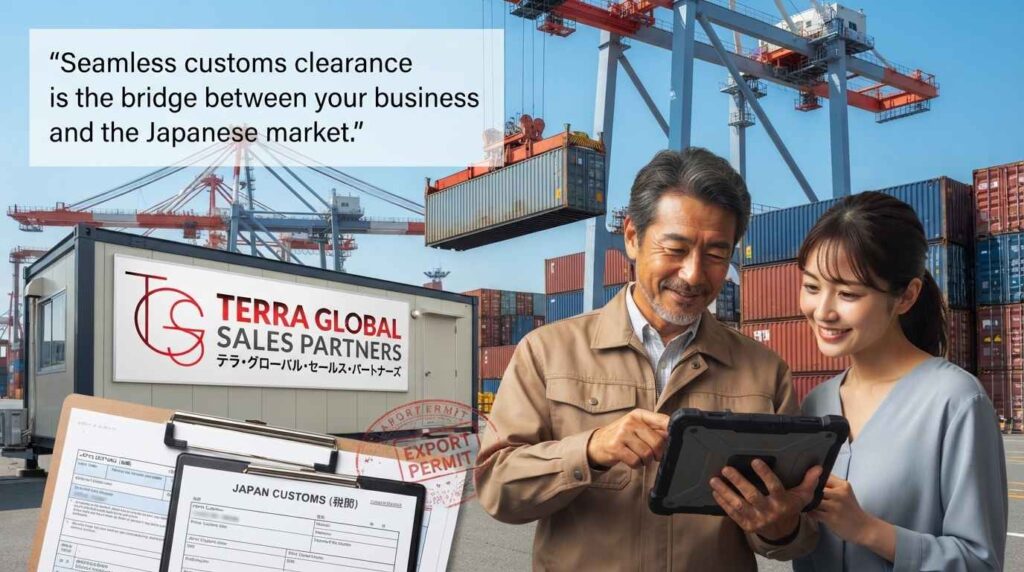
They interact directly with Japanese customs authorities (Japan Customs, 税関) on your behalf. Without a qualified agent, you are navigating a complex regulatory system in a foreign language with foreign rules.
Here is what a customs clearance agency in Japan typically handles:
| Function | What It Involves |
| Import clearance | Filing import declarations with Japan Customs |
| Export customs | Preparing export documentation and compliance checks |
| Tariff classification | Assigning the correct harmonized tariff schedule code (HTS code) |
| Duty calculation | Applying the correct tariff rate based on the product and country |
| Document preparation | Commercial invoice, packing list, certificate of origin, bill of lading |
| Port liaison | Coordinating with freight forwarders and port agents |
| Compliance check | Ensuring goods meet Japanese import regulations |
| Customs bond | Handling bonded warehouse or deferred duty arrangements |
A professional customs broker (通関士, tsukkanshi) in Japan must hold a national license, issued only after passing Japan’s Customs Service exam. This is not a role anyone can claim without formal qualification.
Why Japan’s Customs System Is Different?
Japan does not operate like other major trading nations. Its customs system is notably thorough, document-heavy, and unforgiving of errors.
Here are five reasons why importers consistently underestimate Japanese customs:
1. Japan Has Strict Non-Tariff Barriers
Even when tariffs on Japan are low, non-tariff barriers create friction. These include labeling requirements, food safety inspections, phytosanitary certificates, and quarantine checks. Many shipments get held not because of duties , but because of a labeling error.
2. Japanese Customs Requires Precision Documentation
Japan Customs will reject incomplete or inconsistent paperwork. The Japan customs declaration form must match the commercial invoice exactly, weight, value, quantity, and country of origin.
3. HTS Code Errors Are Costly
Choosing the wrong harmonized tariff code can result in paying the wrong duty rate or triggering an inspection. A qualified customs broker classifies goods correctly the first time.
4. Japan Tariff Rates Are Layered
Japan’s tariff rate structure includes standard rates, EPA (Economic Partnership Agreement) preferential rates, and temporary duty reductions. Without expertise, most importers miss preferential rates they are legally entitled to.
5. Japan’s Language Barrier Is Real
All official communication with Japan Customs happens in Japanese. Most customs documentation requires Japanese-language submissions. Without a local customs clearance agency, miscommunication is almost guaranteed.
The Role of a Licensed Customs Broker in Japan
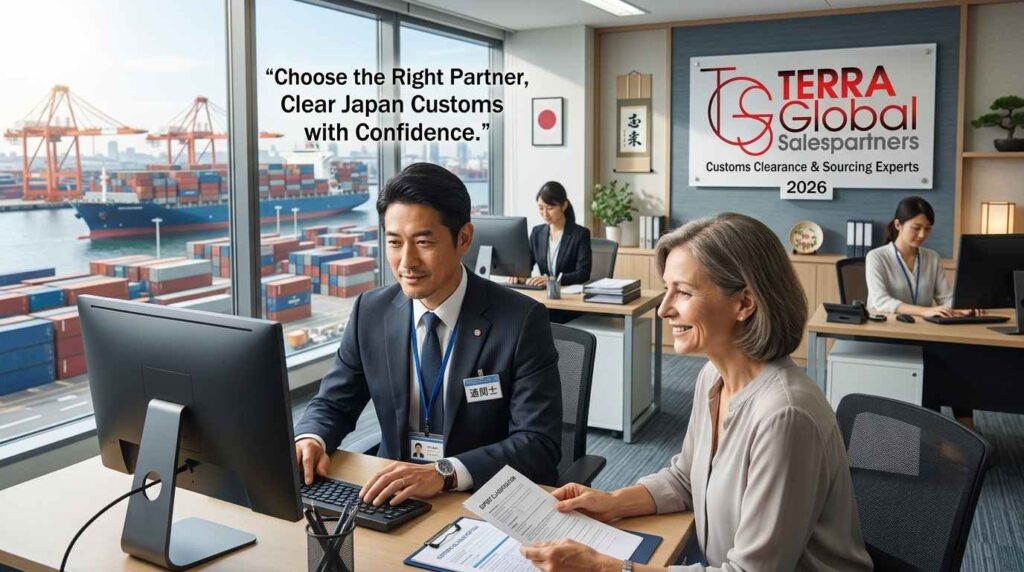
A licensed customs broker in Japan is not just a document filer. They are a strategic partner.
Here is how the right customs broker creates real business value:
What a licensed customs broker does:
- Classifies your goods under the correct harmonized tariff schedule (HTS)
- Checks whether your products qualify for EPA preferential tariff rates
- Files the Japan customs declaration on your behalf
- Coordinates with freight agents for smooth import clearance
- Advises on de minimis thresholds and exemptions
- Flags potential inspection risks before shipment arrives
- Handles customs bond and warehousing requirements if needed
- Tracks tariff ruling changes that affect your product category
A good customs broker saves you money. A great one saves you time, stress, and compliance risk.
How to Evaluate a Customs Clearance Agency in Japan?
Choosing the wrong partner is one of the most common import-export mistakes when sourcing from Japan. Here is a structured evaluation framework.
Step 1: Verify Their License
Only a licensed customs broker can legally file import declarations in Japan. Ask for their 通関士 license number. Do not work with any agency that cannot provide this.
Step 2: Check Their Product Experience
A customs clearance agency that handles industrial equipment may not be the right fit for food, cosmetics, or electronics. Each category has its own compliance rules. Ask for examples of product categories they have cleared successfully.
Step 3: Assess Their Language and Communication Capabilities
The agency must communicate fluently in both Japanese (for Japan Customs) and English (or your local language) for you. Poor translation is the root cause of most Japan customs delays.
Step 4: Ask About Their Tariff Classification Process
A professional agency does not guess at HTS tariff codes. They have a classification methodology, internal review, and an escalation process for complex items.
Step 5: Understand Their Fee Structure
Brokerage fees, handling charges, documentation fees , these add up. Ask for a full itemized quote before engaging. Reputable agencies are transparent. Avoid agencies with vague or “pricing varies” responses.
Step 6: Look for a Full-Service Partner
The best customs clearance agency in Japan does not operate in isolation. They work alongside sourcing agents, freight forwarders, and trading companies. This is the kind of integrated service that Terra Global Sales Partners provides.
Terra Global Sales Partners, Your Customs and Sourcing Partner in Japan
We do not just help you clear customs. We help you build a supply chain.
Terra Global Sales Partners operates as an end-to-end Japan sourcing and export partner. We connect international buyers with authentic Japanese products, and we handle the complexity of getting those products to your country reliably and compliantly.
Here is what makes us different:
We Are Japan-Based With Global Networks
Our team is on the ground in Japan. We work directly with Japanese suppliers, manufacturers, and trading partners. When your goods are ready to ship, we already have relationships in place with the customs services and freight agents needed to move them.
We Handle the Full Import-Export Process
From product sourcing to export customs clearance in Japan to import clearance in your country, we manage the entire pipeline. You do not need to coordinate five different vendors. We are one point of contact.
For a complete breakdown of how this works, read our guide on the import-export process from Japan: documents, costs, and timeline explained.
We Know Japanese Products Inside Out
Our catalog includes hundreds of authentic Japanese consumer goods, from Japanese condiments and sauces to refrigerated dairy and processed foods. We know the specific documentation requirements for each category.
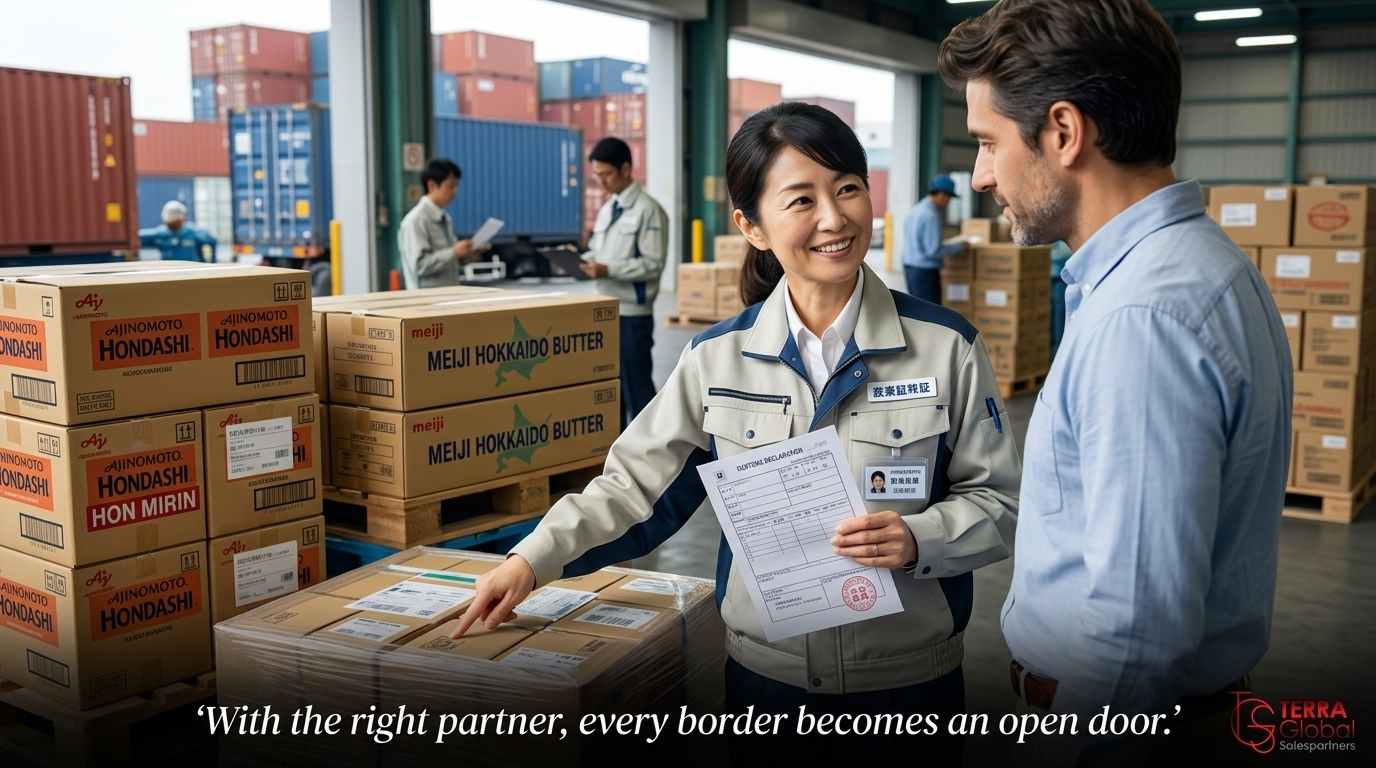
Products like Ajinomoto Hondashi Japanese Dashi Stock 1kg and Exdaisho Teriyaki Sauce 1.25kg require specific food safety documentation for export, something our team handles routinely.
We Are a Trusted Trading Partner
We do not just claim expertise. We demonstrate it through the products we source, the buyers we serve, and the supply chains we build. Our track record speaks through repeat clients and consistent delivery.
Understanding Japan Tariffs: What Every Importer Must Know
Tariffs are taxes imposed on imported goods. In Japan’s case, the Japan tariff system is governed by the Customs Tariff Law (Kanzei-hō).
Here is a quick breakdown of how the system works:
How Tariffs Are Collected
When goods are exported from Japan (or imported into another country from Japan), the applicable tariff rate is applied to the customs value of the goods. The tariff is typically paid by the importer in the destination country.
Who pays tariffs on imports? In most trade terms (especially under CIF or DDP Incoterms), it is the importer of record (IOR) in the destination country who is responsible for payment. Read more about the role of the importer of record and why it matters.
Current Japan Tariff Structure
| Tariff Type | Description |
| MFN (Most Favored Nation) | Standard rate applied to WTO members |
| EPA Preferential Rate | Reduced rate under Japan’s trade agreements |
| Temporary Rate | Short-term duty adjustments applied to specific goods |
| Anti-Dumping Duty | Applied when goods are priced below fair market value |
De Minimis Exemption
Japan applies a de minimis threshold below which duties are waived. For imported commercial goods, this threshold is generally low, do not assume your shipment qualifies without checking with a licensed customs broker.
Harmonized Tariff Schedule (HTS) Codes
Every product imported into or exported from Japan requires a harmonized tariff code. This is an internationally standardized HTS tariff code that determines:
- The applicable duty rate
- Any import restrictions or permits required
- Statistical trade tracking
Getting this wrong is one of the most expensive mistakes an importer can make. For help understanding this, read our article on customs clearance in Japan: your complete importer guide.
Japan Customs Process, Step by Step
Here is how the Japan customs process typically works when you export goods from Japan:
Stage 1: Pre-Shipment
- Confirm product compliance with destination country regulations
- Prepare commercial invoice, packing list, and certificate of origin
- Classify goods under the correct harmonized tariff schedule code
- Apply for any required export permits (food, agricultural goods, electronics)
Stage 2: Export Customs Filing in Japan
- Submit export declaration to Japan Customs via the NACCS (Nippon Automated Cargo and Port Consolidated System)
- Receive export permission
- Coordinate with freight forwarder for pickup and loading
Stage 3: International Transit
- Air or sea freight, for a full comparison, read our guide on global shipping from Japan: air freight vs sea freight
- Cargo tracking and monitoring
- Preparation of import documentation for the destination country
Stage 4: Import Clearance at Destination
- Submit import declaration to the destination country’s customs authority
- Pay applicable tariffs and VAT/GST
- Receive customs release and deliver to warehouse or end customer
A reliable customs clearance agency manages stages 1 and 2. A great partner like Terra Global Sales Partners helps coordinate all four.
Common Customs Clearance Mistakes, And How We Prevent Them
| Mistake | Consequence | How We Prevent It |
| Wrong HTS tariff code | Overpaid duty or inspection hold | Expert classification review before filing |
| Missing food safety certificates | Shipment rejected at destination | Pre-export compliance checklist |
| Incomplete Japan customs declaration | Customs hold and penalties | Document verification before submission |
| Undervaluing goods on invoice | Legal liability, fines | Accurate customs valuation guidance |
| Missing labeling requirements | Product seized or returned | Country-specific label review |
| Not using EPA preferential tariff rates | Overpaying on every shipment | Tariff optimization as standard service |
We have seen every one of these mistakes happen to importers who tried to manage customs alone. Our process is built to prevent all of them.
Global Shipping From Japan: Air vs Sea

Choosing the right shipping mode matters, not just for cost, but for customs purposes.
| Factor | Air Freight | Sea Freight |
| Speed | 2–5 days | 15–40 days |
| Cost | Higher per kg | Lower per kg |
| Volume | Small to medium | Large volumes |
| Customs complexity | Simpler | More documentation |
| Best for | High-value, perishable goods | Bulk FMCG, industrial goods |
| Customs processing time | Typically 1–2 days | 3–7 days depending on inspection |
For products like refrigerated goods, for example, Meiji Hokkaido Butter 200g or Koiwai Farm Spread Cheese 90g, cold chain integrity and speed of customs clearance are both critical. Our team coordinates both.
Japan Export Agent vs Import Agent, Understanding the Difference
Many buyers confuse these two roles. Here is a clear breakdown:
Japan Export Agent (that’s us):
- Based in Japan
- Sources products from Japanese suppliers
- Manages export customs from Japan
- Coordinates with freight forwarders for international shipping
- Acts on behalf of the foreign buyer
Japan Import Agent (in your country):
- Based in your destination country
- Files import declarations with local customs
- Acts as importer of record (IOR)
- Pays local duties and taxes on your behalf
For a deeper explanation of both roles, read our full guide on Japan export agent vs Japan import agent: understanding their roles.
At Terra Global Sales Partners, we serve as your Japan export agent , giving you a trusted partner on the Japanese side of every transaction.
Sourcing Company vs Trading Company in Japan, Which Do You Need?
Understanding the difference helps you choose the right type of partner:
| Feature | Sourcing Company | Trading Company |
| Primary role | Finds products on your behalf | Buys and resells products |
| Pricing transparency | Higher , you see supplier costs | Lower , markup built in |
| Flexibility | High , tailored to your brief | Medium , limited to their stock |
| Relationship control | You own supplier relationships | Company owns relationships |
| Best for | Niche sourcing, OEM, brand building | Quick wholesale access |
Terra Global Sales Partners operates as a trading company with sourcing capabilities, meaning we combine inventory access with custom sourcing flexibility. Read more in our detailed comparison of sourcing company vs trading company in Japan.
Why Japanese Products Are Worth the Logistics Investment?
Let us look at this from a business perspective. Is navigating Japanese customs clearance worth it?
The data says yes.
Key Market Statistics
| Metric | Data |
| Japan’s global export rank | 4th largest goods exporter (WTO, 2024) |
| Japanese food & beverage exports | $14.8 billion USD in 2024 , a record high |
| Price premium in international markets | 15–40% above comparable domestic alternatives |
| Japanese manufacturing defect rate | ~0.001% , among the lowest globally |
| E-commerce conversion uplift | Authentic Japanese products report higher conversion rates on Amazon and Shopify |
The challenge is not whether Japanese products sell. The challenge is building a reliable, compliant supply chain to get them to your market. That is exactly what a qualified customs clearance agency in Japan, and a trusted sourcing partner like Terra Global Sales Partners, exists to solve.
Pros and Cons, Managing Customs Yourself vs Using a Customs Clearance Agency
| DIY Customs Management | Using a Customs Clearance Agency | |
| Cost upfront | Lower | Higher (agency fees) |
| Hidden costs | High (mistakes, delays, fines) | Low |
| Time investment | Very high | Low |
| Error risk | Very high | Very low |
| Compliance confidence | Low | High |
| Scalability | Very difficult | Easy |
| Language barrier | Major obstacle | Handled |
| HTS classification accuracy | Unreliable | Professional |
| Relationship with customs | None | Established |
The verdict is clear. For any importer doing more than occasional personal purchases, a professional customs clearance agency pays for itself, often on the first shipment.
Terra Global Sales Partners, What We Actually Offer?
Here is a specific breakdown of what working with us looks like.
Product Sourcing Across Key Categories
We source authentic Japanese products across:
- Japanese condiments and sauces, soy sauce, mirin, sake, teriyaki, BBQ sauces, dressings
- Japanese dairy and refrigerated goods, butter, cheese, cream cheese, spreads
- Japanese snacks and nutrition bars, protein bars, cereal bars, freeze-dried goods
- Japanese pantry staples, dashi stock, miso soup ingredients, noodle sauce bases
- Japanese curry and stew, retort pouches, soup bases
- Japanese beverages, specialty drinks and regional favourites
Export Coordination
We handle export customs in Japan, documentation, quality checks, and freight coordination. Your goods leave Japan clean, compliant, and correctly documented.
B2B Wholesale
We support bulk orders for retailers, distributors, Amazon FBA sellers, and foodservice operators. For guidance on building profitable Japanese product lines online, read our guide on best Japanese products for Amazon and Shopify sellers.
How to Reduce Import Costs When Buying From Japan?
Customs clearance is one cost center. But smart importers reduce total landed cost across multiple levers. Here is how:
- Use the correct HTS code, wrong codes often mean higher duty rates
- Apply for EPA preferential tariff rates, many countries have trade agreements with Japan that reduce tariffs significantly
- Consolidate shipments, per-unit customs costs drop with volume
- Choose the right Incoterms, EXW, FOB, CIF, and DDP all shift cost and risk differently
- Plan for the de minimis threshold, if applicable, structure shipments to qualify
- Use a bonded warehouse, defer duty payment and improve cash flow
- Work with one integrated partner, reduce handoff costs between sourcing, freight, and customs
For a full cost reduction playbook, read our guide on how to reduce import costs when buying from Japan.
Products We Commonly Export, A Snapshot
Here is a sample of products from our catalog that international buyers frequently import , and that we routinely help clear through customs:
Japanese Sauces and Seasonings
- Exdaisho Sukiyaki Sauce 600g
- Exdaisho Grilled Eel Sauce 240g
- Exdaisho BBQ Sauce Yuzu Flavour 185g
- Exdaisho Dressing Wasabi Flavour 150ml
- Exdaisho Mentsuyu Noodle Dipping Sauce Yuzu Flavour 185g
Japanese Cooking Essentials
- Ajinomoto Hondashi Katsuo and Konbu 500g
- Hinode Cooking Sake 400ml PET
- Mizkan Honteri Mirin Style Seasoning 400ml
- Kikkoman Manjo Rich Aged Mirin 300ml PET
- Takara Hon Mirin 1L PET
Japanese Dairy and Refrigerated
- Snow Brand 6P Cheese 102g
- QBB Premium Baby Cheese Truffle 4 Pcs
- Meiji Hokkaido Tokachi Camembert Cheese with Black Pepper 90g
- Snow Brand Hokkaido Butter 200g
Japanese Snacks and Nutrition
- Asahi Ippon Manzoku Bar Giga Protein 65g
- Asahi Ippon Manzoku Bar Protein Chocolate 39g
- Acecook Super Cup 1.5x Tonkotsu Ramen 111g
- Ariake Gourmet Royal Beef Curry 210g
Each of these products comes with its own export documentation requirements. We know them. We handle them.
The Terra Global Sales Partners Difference
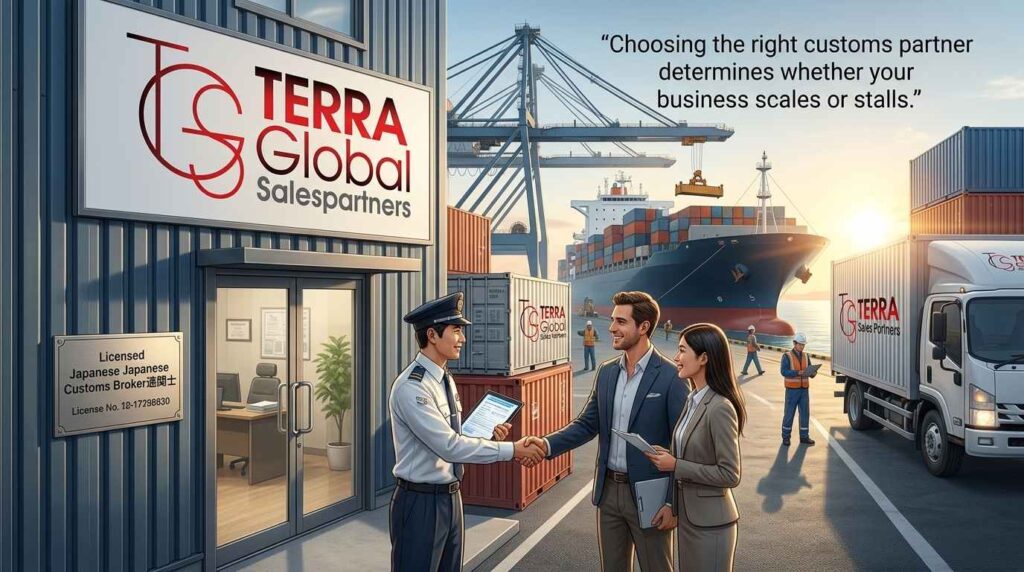
We want to be straightforward about who we are.
We are not a mass-market freight forwarder. We are a relationship-first, Japan-based trade partner for international buyers who want reliable access to authentic Japanese products , and the expertise to import them correctly.
Here is what you get when you work with us:
✅ Direct access to Japanese suppliers and manufacturers
✅ Export customs documentation handled in Japan, correctly, the first time
✅ Full product compliance guidance per destination country
✅ Transparent pricing, no hidden brokerage fees
✅ Multilingual communication (Japanese, English, and more)
✅ Product quality verification before shipment
✅ Flexible MOQ arrangements for new and growing buyers
✅ Category expertise across food, beverage, FMCG, and consumer goods
We have guided importers through their first Japanese order and we have helped established distributors scale to container-level volume. Both matter to us equally.
Conclusion
Importing from Japan is one of the best decisions a product business can make. The quality is unmatched, the brand value is real, and consumer demand globally is growing year over year.
But customs clearance in Japan is not something to figure out as you go.
The right customs clearance agency in Japan will save you money, protect you from compliance risk, and help your supply chain scale. The wrong choice, or no choice at all, will cost you time, money, and shipments.
At Terra Global Sales Partners, we have built our entire operation to make importing from Japan straightforward for international buyers. We know the suppliers, we know the regulations, and we know how to get your products to market correctly, every time.
If you are ready to source from Japan with confidence, contact us to discuss your needs.