
Most articles on sourcing from Japan just give you a generic checklist. “Check their credentials.” “Ask for samples.” “Verify their license.” That’s not enough.
If you are serious about importing Japanese products for your business, whether for Amazon FBA, a Shopify store, a wholesale distribution business, or retail, you need to understand how the Japan export ecosystem actually works. You need to know who the real players are, what separates a trustworthy Japan export company from an unreliable middleman, and how to protect your margins while getting access to premium Japanese products.
This guide is built on real experience working in the Japanese wholesale and B2B sourcing space. It covers everything: how to evaluate a Japan export agent, what makes Japanese companies different from sourcing in China or Korea, what to look for in documentation, and why Terra Global SalesPartners is the go-to partner for global buyers who want quality without the headache.
Let’s get into it.
1. Why Japan Is Still the Gold Standard for B2B Sourcing
Japan’s economy is the third largest in the world by nominal GDP. Japan’s GDP sits at approximately $4.2 trillion USD, and the country’s export machine is one of the most sophisticated on the planet. Even in 2025 and 2026, despite Japan’s 2025 inflation rate fluctuating and shifts in Bank of Japan interest rates, the country remains the single most trusted origin for premium goods globally.
Here is a quick look at what the numbers say:
| Indicator | Value (2025–2026) |
| Japan GDP (nominal) | ~$4.2 trillion USD |
| Japan’s Total Exports | ~$750 billion USD/year |
| Top Export Destination | United States, China, South Korea |
| Japan inflation rate 2025 | ~2.5–3.1% |
| Bank of Japan policy rate | 0.5% (as of early 2026) |
| Japan foreign direct investment | Growing YoY |
The Bank of Japan interest rate and Japan rate hike discussions have been major economic news in 2025 and 2026. The BOJ policy rate moving from zero to a modest positive rate reflects that Japan’s economy is stabilizing, which is good news for global buyers. A stronger and more stable Japanese yen means Japanese suppliers have more confidence in long-term contracts, which translates to reliability for you as a buyer.
Why does this matter for you?
Because when you find a reliable Japan export company, you are plugging into this stable, highly regulated, precision-driven economic system. Japanese businesses do not cut corners. Japanese firms are bound by strict quality standards at every level, from raw materials to final packaging. That is why Japanese products command premium positioning on platforms like Amazon and Shopify worldwide.
2. What Is a Japan Export Company and What Do They Do?
A Japan export company (also called a Japan export agent or Japan trading company) is a business that bridges Japanese manufacturers, distributors, and wholesalers with international buyers.
Their role typically includes:
- Sourcing products from Japanese manufacturers or wholesalers
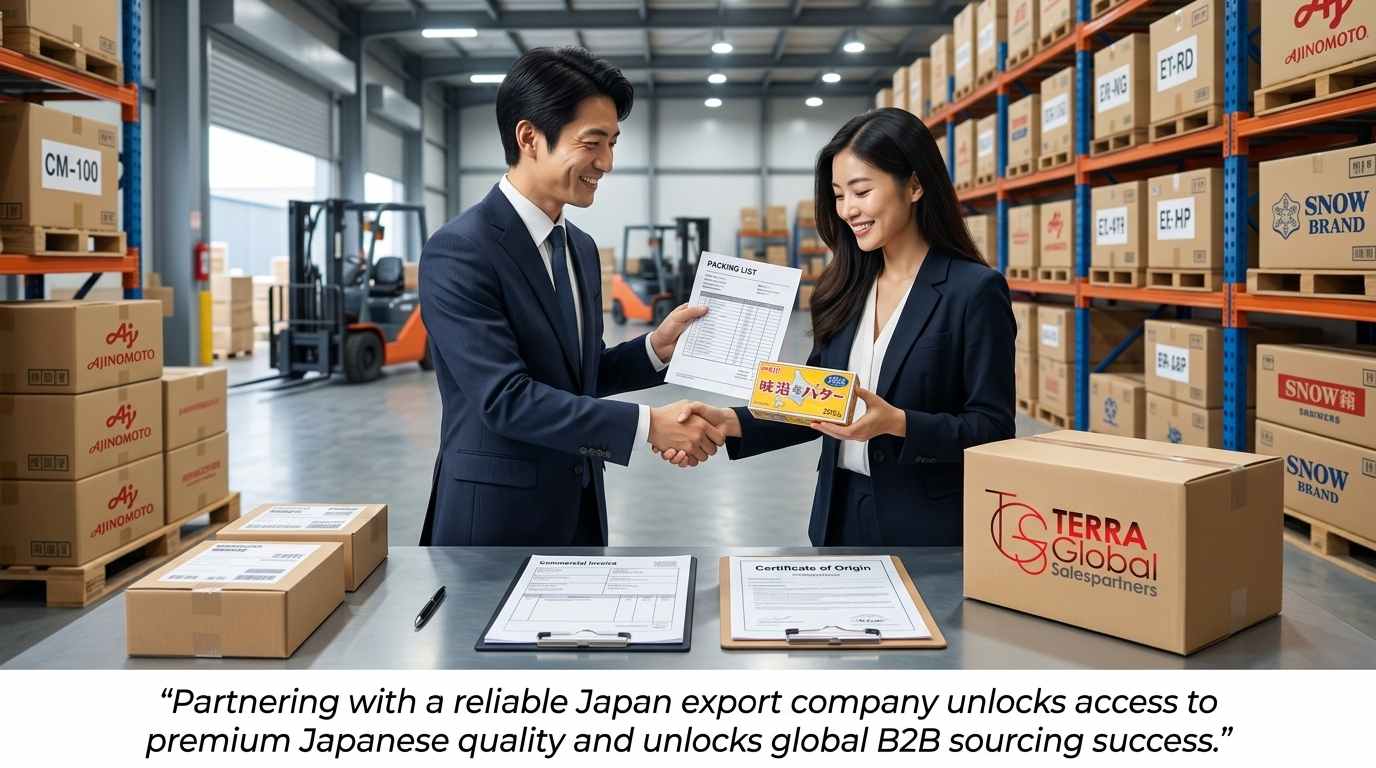
- Handling all export documentation (commercial invoice, packing list, certificate of origin, phytosanitary certs, etc.)
- Managing customs clearance in Japan on the export side
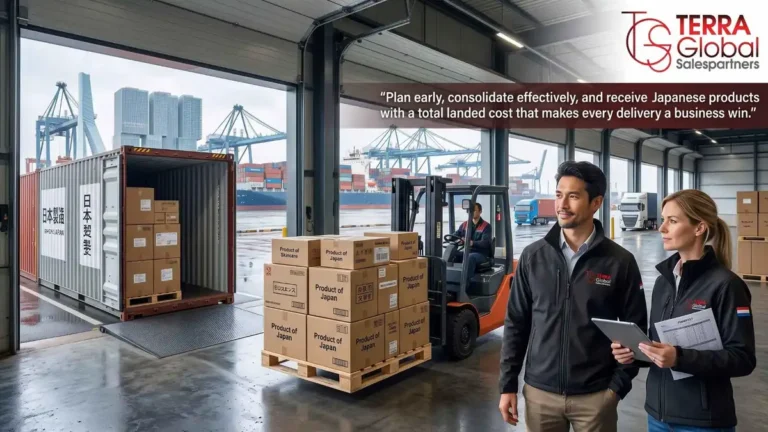
- Coordinating global shipping from Japan, both air freight and sea freight
- Acting as the importer of record (IOR) in some arrangements
- Facilitating MOQ negotiations with Japanese suppliers
- Quality inspection before shipping
A well-structured Japan export agent saves you from the most painful part of international trade: the bureaucracy, the language barrier, and the relationship-building with Japanese companies that takes years if you try to do it yourself.
Export Agent vs. Buying Agent vs. Procurement Agent
| Role | Primary Function | Who Pays Them |
| Japan export agent | Handles export logistics + supplier access | Supplier or buyer |
| Buying agent / Procurement agent | Finds and negotiates product deals on buyer’s behalf | Buyer |
| Trading company Japan | Buys and resells; holds inventory risk | Operates on margin |
| Sourcing company Japan | Comprehensive product sourcing + quality control | Buyer on retainer or per-project |
Understanding this distinction matters because it determines who is responsible for what, and who protects your interests if something goes wrong.
3. Japan’s Key Export Industries You Should Know
Japan’s main industries span a huge range. Japan’s industrialization history is long, and today the country exports everything from precision automotive parts to artisan food products. Knowing Japan’s key exports helps you figure out where your B2B sourcing opportunity lies.
Major Exports of Japan (2025)
| Category | Share of Total Exports | Key Products |
| Machinery & Equipment | ~20% | Industrial machines, robots, electronics |
| Vehicles & Auto Parts | ~22% | Cars, transmissions, Japanese car parts |
| Electronics | ~14% | Semiconductors, cameras, AV equipment |
| FMCG / Food Products | ~8% | Sauces, seasonings, dairy, beverages |
| Chemicals | ~10% | Specialty chemicals, pharma ingredients |
| Textiles / Apparel | ~4% | Japanese fabric, Japanese textiles, cotton fabric Japan |
| Cosmetics / Skincare | ~5% | Japanese cosmetic products, skincare |
| Consumer Goods | ~7% | Japanese toys, homeware, Japanese giftware |
For e-commerce and B2B wholesale buyers, the most actionable categories are FMCG, food and condiments, cosmetics, Japanese clothing, and Japanese home decor. These categories have consistent global demand, strong brand recognition, and high repeat purchase rates on platforms like Amazon and Shopify.
You can learn more about which products perform best in this space in our detailed guide on best Japanese products for Amazon and Shopify sellers.
4. How to Find a Reliable Japan Export Company, Step-by-Step
This is the core of what you need to know. Most buyers make one of two mistakes: they either trust too quickly (and get burned), or they overthink it (and never get started). Here is the structured process that works.
Step 1: Define What You Actually Need
Before you start searching for a Japan export company, get clear on:
- What products you are sourcing (Japanese food wholesale, automotive, textiles, cosmetics?)
- What volume you need (are you working within Japanese supplier MOQ requirements?)
- What your end market is (Amazon FBA, direct retail, restaurant wholesale, distributor network?)
- What your budget is for logistics, customs, and agent fees
This sounds basic. But most buyers skip it, and then waste weeks talking to the wrong partners. A company that specializes in Japanese car parts cannot help you source Japanese cosmetic products. A company focused on OEM manufacturing cannot help you buy off-the-shelf Japanese wholesale goods.
Step 2: Search the Right Channels
Here is where to look, and what each channel is actually good for:
| Channel | Best For | Limitations |
| Japan External Trade Organization (JETRO) | Verified supplier directories | Takes time; no hand-holding |
| Japan marketplace platforms (e.g., Super Delivery, Superdelivery, Webshop Japan) | Direct wholesale browsing | Language barrier; no export support |
| Japanese auction sites (e.g., Buyee, Buyee Japan) | Vintage, niche, resale goods | Not B2B; no bulk logistics |
| Google search + verification | Finding Japan export agents | Need to vet carefully |
| Referrals from other importers | Trusted introductions | Slow and relationship-dependent |
| Direct outreach via Japan ministry of trade listings | Large-scale verified suppliers | Complex; requires Japanese language skills |
For most international B2B buyers, working with a verified Japan export company like Terra Global SalesPartners cuts through all of these channels and gives you direct, curated access to Japanese suppliers.
Step 3: Verify Their Credentials
Once you have a shortlist of potential Japan export companies, verify:
✅ Business Registration
- Ask for their Japan company registration number
- Search x company Japan registered trade name in official Japanese business registries
- Check how to find Japan company reviews via Google, Trustpilot, and LinkedIn
✅ Export Experience
- How many years have they been exporting?
- Which countries do they currently ship to?
- Do they have experience with your specific product category?
✅ Supplier Network
- Do they have direct relationships with Japanese manufacturers or are they third-party brokers?
- Can they handle both established Japanese brands and emerging products?
✅ Logistics Capability
- Can they handle both air freight and sea freight from Japan?
- Do they work with established freight forwarders?
- Can they manage customs clearance end-to-end?
Step 4: Request a Product Catalog and Sample Order
Any legitimate Japan export agent will be able to provide:
- A structured product catalog with proper descriptions
- Accurate pricing in USD or your preferred currency
- Clear MOQ terms per product category
- Timeline estimates for sample order delivery
Do not work with any partner who is vague on pricing or cannot show you actual products.
Step 5: Assess Communication Quality
This one is underrated. Japanese business culture is precise, formal, and detail-oriented. A good Japan export company will reflect that in their communication. If their emails are sloppy, they take days to respond, or they cannot answer basic product questions, walk away.
For a deeper look at Japanese business culture and what international buyers need to know before engaging, read our guide on Japanese business culture for international buyers.
Step 6: Evaluate Their Pricing Transparency
A trustworthy Japan export company will show you:
- CIF pricing (Cost + Insurance + Freight) or FOB pricing (Free on Board) with clear breakdown
- Their service fee structure (fixed, percentage, or hybrid)
- Estimated Japan tariffs and customs duties at your destination country
- No hidden charges after you commit
If they cannot give you a clear landed cost estimate, they either do not have the experience or they are hiding something.
Step 7: Start Small and Scale
Even with a verified partner, start with a smaller test order before committing to full container quantities. This lets you:
- Verify product quality matches descriptions
- Test the shipping and logistics process
- Check documentation accuracy
- Build the relationship before increasing volume
5. Red Flags to Avoid When Sourcing from Japan
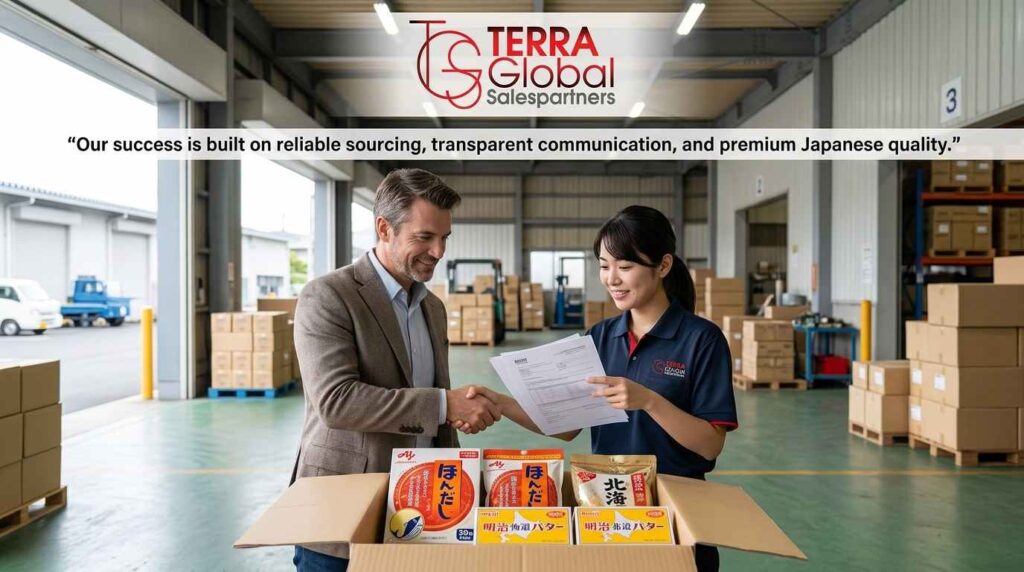
Here is an honest list of things that should make you pause immediately:
🚩 No verifiable physical address in Japan Any legitimate Japan company has a registered office. No address, or only a P.O. Box, is a warning sign.
🚩 Prices that are suspiciously low Japanese products are premium. If the pricing looks too cheap to be real, it probably is. You may be getting Chinese or Southeast Asian substitutes labeled as Japanese.
🚩 Pressure to pay 100% upfront without contract Legitimate Japanese businesses operate on documented contracts with clear payment terms.
🚩 No ability to provide product origin documentation If they cannot show you a Certificate of Origin or equivalent documentation, the product’s Japanese provenance cannot be verified.
🚩 Vague answers about supplier identity A trustworthy Japan export agent will tell you which manufacturers or distributors they work with. Extreme secrecy about the supply chain is a red flag.
🚩 No clear process for quality control Japanese quality control standards are among the strictest in the world. A good export partner will explain their QC process clearly.
For a detailed breakdown of the most common mistakes importers make, see our article on common import-export mistakes when sourcing from Japan.
6. Japan vs. China vs. Korea, A Sourcing Comparison
One of the most common questions global buyers ask is whether Japan vs. China vs. Korea makes a difference when sourcing. The short answer: absolutely yes. Here is an honest comparison.
| Factor | Japan | China | Korea |
| Product Quality | ⭐⭐⭐⭐⭐ Premium | ⭐⭐⭐ Variable | ⭐⭐⭐⭐ High |
| Price Point | Higher | Lowest | Mid-range |
| MOQ Flexibility | Moderate | Very flexible | Moderate |
| Brand Recognition | Extremely high | Growing | Growing |
| Quality Consistency | Extremely consistent | Inconsistent | Consistent |
| Food Safety Standards | World-class | Often questioned | Very high |
| Supplier Communication | Formal; requires trust-building | Fast but variable | Efficient |
| E-commerce Demand | Very high (niche premium) | High (mass market) | High (beauty/tech) |
| IP and Brand Protection | Strong | Weak | Moderate |
| Logistics Reliability | Excellent | Good | Good |
The bottom line: If your business model is built on premium positioning, brand trust, and repeat customers who care about quality, sourcing from Japan is the right move. You pay more per unit, but you earn more per sale and retain customers longer.
Japanese products consistently command 20–40% higher price points on Amazon and internet shopping in Japan platforms compared to similar Chinese products in the same category. If you are in the FMCG, Japanese food wholesale, cosmetics, or specialty goods space, Japan’s key exports in those categories are worth every extra dollar.
For a detailed breakdown of this comparison, see our guide: Japan vs China vs Korea, which is better for product sourcing?
7. The Role of a Japan Export Agent vs. Import Agent
A lot of buyers confuse these two roles. They are different, and both matter.
Japan Export Agent
- Based in Japan
- Manages the Japan export side of the transaction
- Handles supplier relationships, export paperwork, and pre-shipment logistics
- Their expertise is in the Japanese government organization requirements and export compliance
Japan Import Agent
- Based in your country (or a neutral hub country)
- Acts as your importer of record (IOR) if you do not have a local entity
- Handles customs clearance in the destination country
- Manages duties, local compliance, and last-mile delivery
Ideally, you want a partner who can coordinate both sides, or who has strong relationships on both ends so the handoff is seamless.
Terra Global SalesPartners operates primarily as a Japan export agent with logistics coordination capability, which means they handle the most complex part of the transaction: navigating Japanese firms, Japanese economic ministries, and supplier relationships that typically take years to build.
8. How Terra Global SalesPartners Simplifies the Process
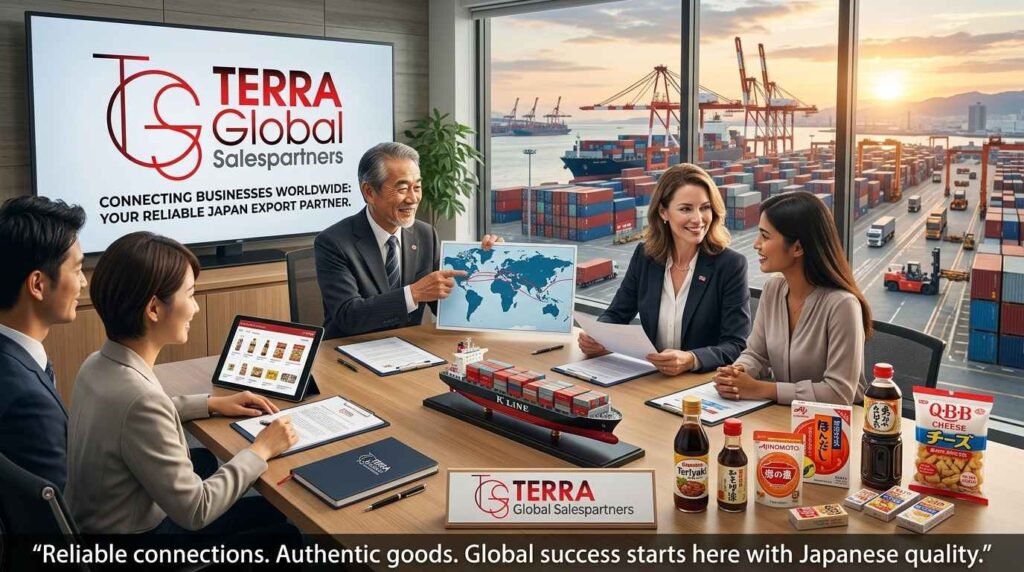
Here is what makes Terra Global SalesPartners different from a generic Japan trading company or broker:
Direct Supplier Relationships
Terra Global SalesPartners has built direct relationships with leading Japanese companies across multiple product categories, from Japanese food wholesale to FMCG, condiments, sauces, dairy, and consumer goods. This means no third-party markups on the supplier side and no miscommunication in the supply chain.
Product Breadth
The product catalog covers a wide range, from premium Japanese cosmetic products and skincare to Japanese giftware, condiments, beverages, and dairy. Whether you are sourcing ajinomoto hondashi, Meiji hokkaido butter, or specialty QBB cheese products, the catalog is deep.
Clear Export Documentation
Every shipment is supported by complete export documentation: commercial invoice, packing list, certificate of origin, and all compliance paperwork your destination country requires. No surprises at customs.
Transparent Pricing
Terra Global SalesPartners does not hide fees in vague “handling charges.” You get clear pricing from inquiry to landed cost. This is critical when you are calculating Amazon FBA or Shopify margins before committing to an order.
Shipping Flexibility
Buyers can choose between air freight from Japan (faster, higher cost per kg) and sea freight from Japan (slower, far lower cost for large volumes). Both options are available with trusted logistics partners.
Quality Assurance
Every product in the catalog comes from verified Japanese manufacturers and distributors. The quality standards meet or exceed Japanese domestic standards, which, as noted above, are among the most stringent in the world.
English-Language Support
One of the biggest friction points in sourcing products from Japan is the language barrier. Terra Global SalesPartners handles all supplier communication in Japanese on your behalf, and all buyer-facing communication is in clear, professional English.
9. Products You Can Source Through Terra Global SalesPartners
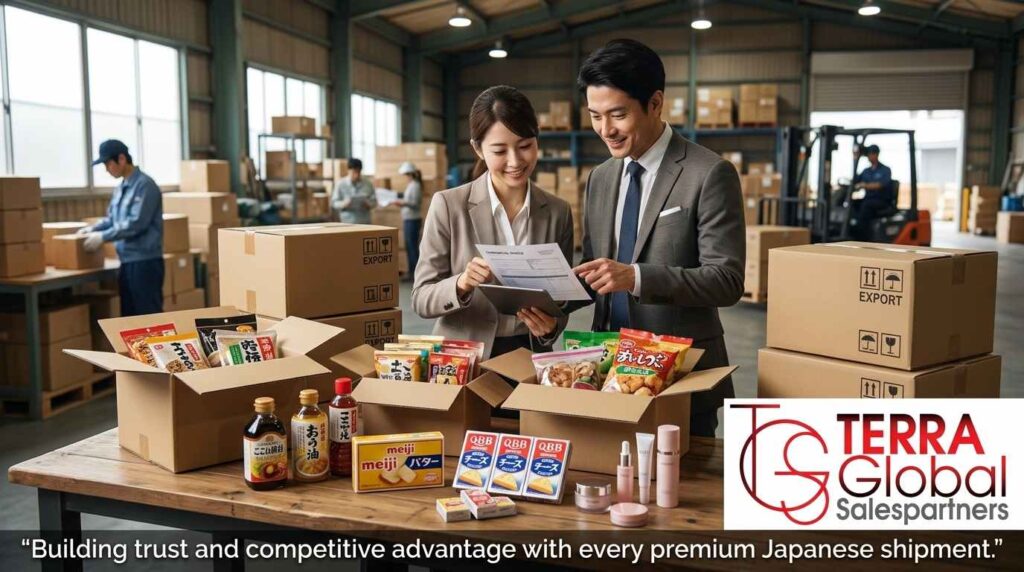
The catalog spans multiple high-demand categories. Here is a representative sample of what is available right now:
Condiments, Sauces & Seasonings
- Exdaisho Teriyaki Sauce 1.25kg, A restaurant-grade teriyaki sauce ideal for foodservice and wholesale distribution
- Exdaisho Sukiyaki Sauce 600g, Authentic sukiyaki base with strong demand in Asian grocery channels
- Exdaisho Grilled Eel Sauce 240g, Unagi sauce used in Japanese restaurants worldwide
- Exdaisho BBQ Sauce Wasabi Flavour 180g, A fusion-ready sauce that performs well in Western retail markets
- Exdaisho Dressing Yuzu Flavour 150ml, Premium yuzu dressing with growing demand in health-conscious markets
- Exdaisho Dressing Wasabi Flavour 150ml, A distinctive wasabi-based salad dressing with excellent shelf appeal
- Exdaisho Mentsuyu Noodle Dipping Sauce Yuzu 185g, Ready-to-use noodle dipping base with authentic Japanese flavor profile
Dashi Stocks & Umami Seasonings
- Ajinomoto Hondashi Japanese Dashi Stock 1kg, The benchmark dashi stock used across professional kitchens globally
- Ajinomoto Hondashi Katsuo & Konbu 500g, Blended bonito and kelp dashi, ideal for authentic Japanese cooking
- Ajinomoto Hondashi Less Salt 1kg, Health-focused variant for low-sodium markets
- Ajinomoto Iriko Dashi 1kg, Dried sardine-based dashi stock for regional and specialty Japanese cooking
- Ajinomoto Umami Seasoning Aji-Panda Bottle 70g, The iconic MSG-based umami seasoning with global brand recognition
Cooking Sake & Mirin
- Hinode Cooking Sake 400ml PET, Reliable everyday cooking sake at a competitive price point
- Hinode Shinmiryo Mirin-Style Seasoning 1.8L, Large-format mirin-style seasoning for foodservice and catering buyers
- Mizkan Cooking Sake 400ml, A trusted brand name that sells itself in Asian grocery markets
- Mizkan Honteri Mirin-Style Seasoning 400ml, A mild, well-balanced mirin alternative from one of Japan’s leading condiment brands
- Takara Hon Mirin 1L PET, Authentic hon mirin with real alcohol content, used in premium Japanese cooking
- Kikkoman Manjo Rich Aged Mirin 300ml PET, Premium aged mirin from the world’s most recognized Japanese sauce brand
Dairy & Cheese Products
- Meiji Hokkaido Butter 200g, Premium Hokkaido-origin butter that performs extremely well in specialty and gourmet retail
- Meiji Hokkaido Tokachi Camembert with Black Pepper 90g, A distinctive Japanese-style camembert with a flavored twist
- QBB Premium Baby Cheese, 4 Variants, Black pepper, cream cheese, rich almond, and truffle varieties, all four are strong convenience retail performers
- Snow Brand 6P Cheese 102g, Classic processed cheese from Japan’s most trusted dairy brand
- Snow Brand Hokkaido Butter 200g, Premium Hokkaido butter from Snow Brand, Japan’s iconic dairy company
Jams & Spreads
- Aohata Spoon-Free Jam, Multiple Flavors, Strawberry, blueberry, grape, apple, orange, and tropical varieties available; the spoon-free format is a major convenience differentiator in export markets
- Aohata Verde Garlic Toast Spread 100g, A Japanese-style toast spread that performs in specialty food retail
- Aohata Verde Curry Bread-Style Toast Spread 100g, Captures the popular Japanese curry bread flavor in a convenient spread format
Instant Noodles & Ready Meals
- Acecook Super Cup 1.5x Miso Ramen 129g, Oversized cup ramen with strong brand recognition in the Asian grocery channel
- Acecook Super Cup 1.5x Tonkotsu Ramen 111g, The rich tonkotsu variant, one of the best-selling Japanese instant noodle styles globally
- Ariake Gourmet Royal Beef Curry 210g, Premium retort curry from a brand known in Japanese professional kitchens
- Anber Tonkotsu Style Ramen Soup (Plant-Based) 1L, A plant-based ramen soup base that taps into the growing vegan and flexitarian market globally
Protein Bars & Health Snacks
- Asahi Ippon Manzoku Bar Protein Series, Chocolate, strawberry, black, and baked caramel variants; strong performers in the Japanese functional snack category
- Asahi Ippon Manzoku Bar Giga Protein 65g, High-protein format targeting fitness and performance nutrition channels
This is a fraction of the full product catalog. For buyers looking to increase e-commerce profit with Japanese products, the breadth of available categories means you can build a diversified Japan-sourced product line across a single trusted supplier relationship.
10. Why Japanese FMCG Products Outperform on Global E-commerce
Let us look at the data. Japanese FMCG products have been gaining ground on global internet shopping platforms consistently.
Key Performance Indicators for Japanese FMCG on Amazon (2025–2026 Benchmarks)
| Metric | Japanese FMCG | Average Category |
| Average Selling Price Premium | +25–40% | Baseline |
| Customer Return Rate | 3–7% lower | Baseline |
| Review Ratings (avg.) | 4.4–4.8 stars | 3.9–4.3 stars |
| Brand Search Volume Growth (YoY) | +18–22% | +8–12% |
| Repurchase Rate | High (food/condiment category) | Variable |
Japanese products are not just premium, they are sticky. Customers who discover quality Japanese goods keep buying them. That is a structural advantage for sellers who build their catalog around Japan’s main exports in food, condiments, and FMCG.
Pros and Cons of Sourcing Japanese FMCG for E-Commerce
Pros:
- ✅ Extremely high brand trust globally
- ✅ Consistent quality, zero batch variability
- ✅ Premium price point improves margin
- ✅ Strong repeat purchase behavior
- ✅ Differentiated from mass-market Chinese alternatives
- ✅ Long shelf life on most shelf-stable products
- ✅ Established demand on Amazon, Shopify, and specialty retail
Cons:
- ❌ Higher per-unit cost than China or Southeast Asia
- ❌ MOQ requirements vary; some brands have firm minimums
- ❌ Regulatory compliance (labeling, import permits) varies by destination
- ❌ Longer lead times if products are not in stock at distributor level
The cons are manageable. A good Japan export company helps you navigate every single one of them. The pros are structural advantages that your competitors without a Japanese supplier relationship simply cannot match.
11. Practical Tips for First-Time Importers Sourcing from Japan
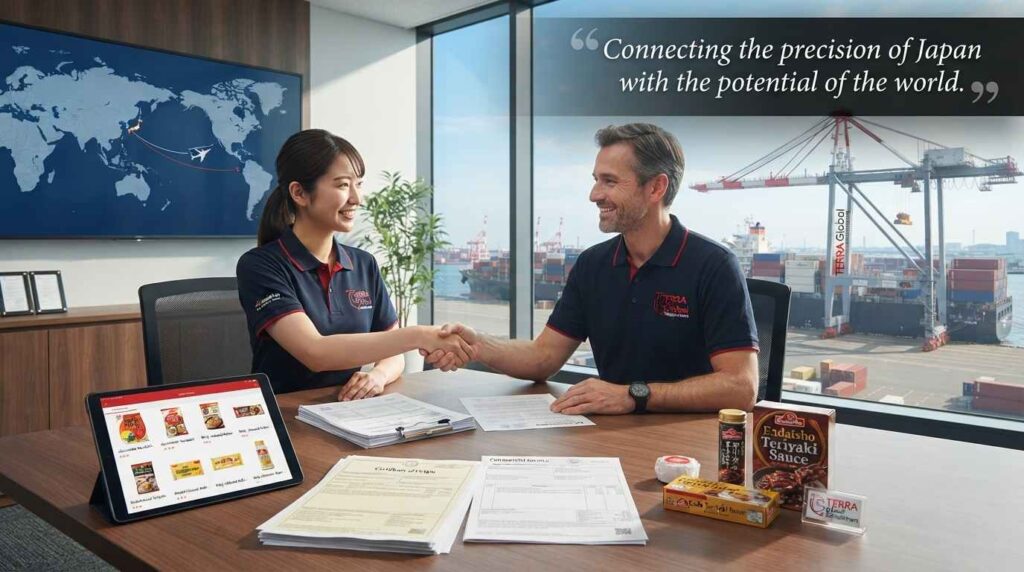
If this is your first time working with a Japan export agent, here are the most practical things to get right from day one.
Set Realistic Lead Times
Japanese businesses value accuracy over speed. Expect:
- Sample orders: 7–14 business days (air freight)
- Regular commercial orders (air): 5–10 business days from ready-to-ship
- Sea freight bulk orders: 3–6 weeks depending on your destination port
Plan your inventory cycles around these timelines. Do not try to rush Japanese suppliers, it damages the relationship and rarely achieves anything.
Understand Labeling Requirements Early
Every destination country has its own food labeling and import compliance rules. When sourcing products from Japan in the food and FMCG category, check:
- Ingredient declaration requirements in your market
- Allergen labeling rules
- Language requirements on outer packaging
- Halal or kosher certification needs (if relevant to your market)
Terra Global SalesPartners can advise on standard labeling configurations for major export markets.
Build a Long-Term Relationship, Not a Spot Order Mentality
Japanese economic system values long-term partnerships. Japanese firms give better pricing, priority stock access, and faster communication to buyers who commit to ongoing relationships. Even if you start small, signal that you intend to grow. That changes how you are treated.
Track Market Trends for Japanese products
Japanese FMCG trends move from domestic Japan to global markets on roughly an 18–24 month lag. Things that are trending in Japan’s main industries and consumer markets today will be in demand in global specialty retail within two years. Staying close to what is happening in Japan’s economy and consumer culture gives you a first-mover advantage in your market.
Conclusion
Finding a reliable Japan export company for B2B sourcing is not just a procurement decision. It is a strategic business decision. The partner you choose determines your product quality, your margins, your customs compliance, and ultimately your brand reputation with your customers.
Japan exports are among the most trusted in the world. Japanese companies operate with a level of precision and integrity that is genuinely rare in global trade. When you find the right Japan export agent, one who has direct supplier relationships, clear logistics, full documentation support, and English-language service, you are not just filling a warehouse. You are building a competitive advantage.
Terra Global SalesPartners is that partner. With a catalog spanning premium condiments, dairy, FMCG, instant meals, snacks, and more, all from verified Japanese manufacturers, and a process that handles everything from first inquiry to customs clearance, they take the complexity out of sourcing products from Japan and leave you with what matters: high-quality products that sell.
Whether you are a first-time importer looking to buy from Japan or an established distributor wanting to expand your Japanese wholesale product line, Terra Global SalesPartners is ready to simplify the entire process for you.
Start your sourcing inquiry today at terraglobalsalespartners.live.