
Most guides on IOR agencies in Japan either bury you in legal jargon or give you a checklist that applies to any country on earth. That is not what this guide does. Here, you get a focused, Japan-specific breakdown of what an IOR agency actually does, what to look for when choosing a Japan IOR partner, and why picking the wrong one can cost you far more than the import duties themselves.
At Terra Global Sales Partners, we have worked directly with global buyers, e-commerce brands, and B2B distributors navigating Japan customs clearance every day. We know where things go wrong and how to stop that from happening to you.
What Is an IOR in Japan? (And Why It Matters More Than You Think)
Before diving into agency selection, you need a solid importer of record definition. The importer of record, or IOR, is the legal entity responsible for ensuring goods shipped into Japan comply with all local customs laws. The IOR is listed on Japan customs declaration forms, holds liability for duties and taxes, and ensures the shipment clears Japan’s strict import standards.
IOR meaning in shipping is deceptively simple on paper. In practice, it carries enormous weight. If your shipment is flagged, seized, or fined, the IOR bears the legal responsibility, not the overseas seller and not the freight forwarder.
Here is what the importer of record is responsible for in Japan:
- Filing the correct Japan customs form with all required documentation
- Paying applicable customs duties and consumption tax (currently 10%)
- Ensuring product compliance with Japanese safety, labeling, and food standards
- Maintaining import records for the required period under Japanese law
- Acting as the point of contact for the Japan Customs Authority
If you do not have a registered legal entity in Japan, you cannot self-import. You need a Japan IOR service, a licensed local partner that assumes this legal role on your behalf.
What Does ACP Mean in Japan Customs? Understanding the Full Picture
When global buyers research Japan customs, they often encounter ACP in official documentation. ACP meaning in a Japan customs context refers to the Authorized Customs Procedure, a classification that simplifies and accelerates customs processing for trusted importers. Understanding what does ACP stand for helps you know whether your Japan IOR provider qualifies for fast-track clearance.
Companies that operate under Japan ACP status benefit from:
- Reduced inspection rates at the border
- Priority processing of Japan customs declaration forms
- Streamlined documentation requirements
- Faster release of commercial goods
Not every IOR agency in Japan holds ACP status. When evaluating a Japan IOR partner, ask directly whether they are ACP-certified. The answer tells you a great deal about their compliance standing and how smoothly your goods will move.
What Are Importers? Understanding Who Can Legally Import Into Japan
What are importers? In Japan’s trade system, an importer is any individual or company that brings goods into Japan for commercial purposes. The importer meaning includes anyone who places goods into domestic circulation, whether for resale, distribution, or own use.
The distinction between a general importer and an importer of record is important:
| Term | Definition |
| Importer | Buys or receives goods from overseas |
| Importer of Record (IOR) | Legally responsible party on Japan’s customs declaration |
| IOR Partner | The agency that acts as IOR on your behalf |
| Customs Attorney | Legal professional handling disputes or complex compliance |
What is the importer of record specifically? It is the entity whose name appears on the Japan customs declaration form and who is liable to the Japanese government for duties and compliance. The importer of record vs consignee distinction matters too: the consignee receives the goods; the importer of record bears legal responsibility for the clearance process.
What are IOR and EOR? While an IOR handles imports, an EOR (Exporter of Record) handles the export side. When sourcing from Japan, your Japanese supplier typically acts as EOR, while you, or your appointed Japan IOR service, handles the receiving side.
Why Japan’s Import Rules Are Uniquely Complex?
Japan is one of the world’s most regulated import markets. Japanese customs requirements are specific, multilayered, and frequently updated. Global buyers who try to navigate Japan customs clearance without local expertise face consistent delays, surprise costs, and compliance failures.
Here is what makes Japan different:
1. Product-Category-Specific Regulations
Japan applies unique rules to food products, cosmetics, electronics, pharmaceuticals, and regulated goods. Importing food products, such as the Japanese condiments, sauces, dairy, and specialty items featured across Terra Global’s product catalog, requires compliance with Japan’s Food Sanitation Act in addition to standard customs procedures.
2. Japanese Labeling Requirements
All goods sold in Japan must meet labeling standards under Japanese law. Labels must include specific information in Japanese. Your Japan IOR partner must verify label compliance before goods enter Japan’s distribution chain.
3. Documentation Requirements for Japan Customs
The Japan customs declaration process requires precise documentation. Missing or incorrect information on Japan customs forms leads to inspections, delays, or rejection. Required documents typically include:
- Commercial invoice
- Packing list
- Bill of lading or airway bill
- Import permit (where applicable)
- Certificates of origin
- Product-specific compliance certificates
4. Consumption Tax and Duty Calculation
Japan levies customs duties by product category plus a 10% consumption tax on the total import value. Your Japan IOR service calculates this accurately before shipment to avoid surprises at the border.
IOR Shipping, What Happens During the Japan Import Process?
Understanding IOR shipping gives you visibility into every stage of the import chain. Here is the step-by-step flow when your Japan IOR provider handles a shipment:
Step 1: Pre-Shipment Documentation Review
Your Japan IOR partner reviews all documents before goods leave the origin country. They flag missing certificates, check HS code classification, and confirm compliance with Japanese customs requirements.
Step 2: Shipment Arrival and Customs Submission
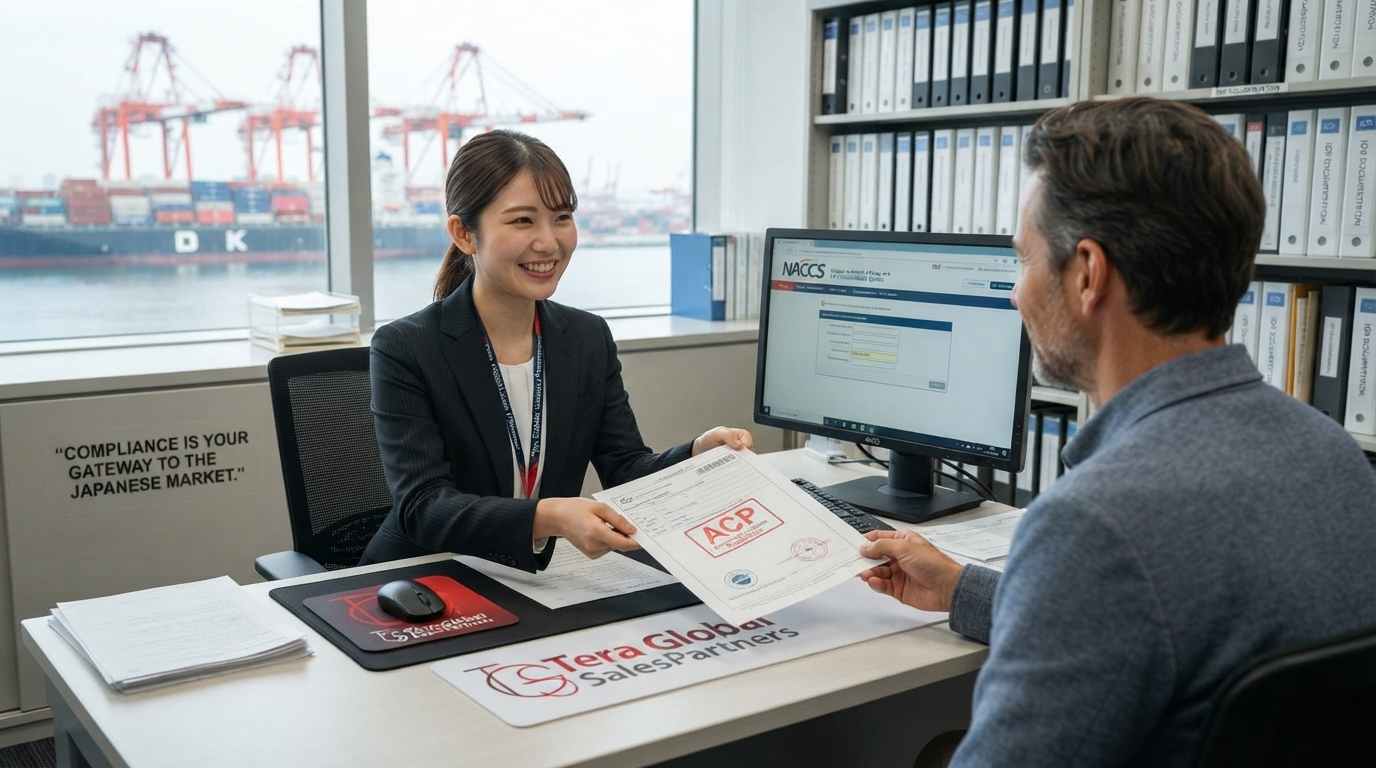
When goods arrive at a Japanese port or airport, the IOR submits the Japan customs declaration electronically through Japan’s NACCS (Nippon Automated Cargo and Port Consolidated System). This is where ACP status accelerates the process for approved importers.
Step 3: Customs Inspection and Clearance
Japan Customs reviews the declaration. Goods may be released automatically under Japan ACP protocols, or selected for physical inspection. Your IOR agency handles all communication with customs officers on your behalf.
Step 4: Duty Payment and Release
The importer of record pays all duties and taxes. Once confirmed, customs releases the goods for domestic delivery. Your Japan IOR service provides full documentation of the cleared import.
Step 5: Post-Clearance Record Keeping
Under Japanese law, import records must be maintained for a statutory period. Your IOR partner manages this obligation so you remain compliant without managing it internally.
Can a Customs Broker Be the Importer of Record?
This is one of the most common questions global buyers ask. Can a customs broker be the importer of record? In Japan, the answer is: not automatically.
A customs attorney or customs broker can file clearance documents on your behalf, but acting as the legal importer of record requires them to assume full legal liability for the shipment. This is a separate, formal arrangement. Most standard brokers do not offer this service.
A specialist IOR agency in Japan specifically offers this. They are not just filing paperwork, they are the named legal entity on Japan customs declaration forms and they carry the associated liability. This distinction matters enormously when something goes wrong.
How to Choose the Right IOR Agency in Japan? 7 Non-Negotiable Criteria
Picking a Japan IOR partner is not a procurement decision you can reverse easily. Once goods are in transit, changing your IOR arrangement is disruptive, expensive, and sometimes impossible. Here is the framework we recommend for evaluating IOR services in Japan.
1. Confirmed ACP Status
As covered earlier, Japan ACP certification is a meaningful quality signal. An IOR agency Japan with ACP status has already passed Japan Customs’ compliance verification. This translates directly into faster clearance for your goods.
2. Product Category Experience
General IOR providers are not always equipped for specialized product categories. If you are importing Japanese food products, like the cooking sake, mirin, and premium condiments available in Terra Global’s catalog, your Japan IOR service must have specific experience with food import regulations, Japan’s Food Sanitation Act, and cold chain requirements for refrigerated items.
3. Transparent Pricing and Duty Calculations
A trustworthy Japan IOR provider gives you full cost transparency before shipment. This includes duty rates by HS code, consumption tax, handling fees, and their IOR service fee. There should be no surprise invoices after clearance.
4. End-to-End Process Ownership
The strongest IOR agencies in Japan do not just file your Japan customs declaration. They own the process from pre-shipment document review to post-clearance record keeping. Ask specifically what each stage of their service covers.
5. Verified Track Record with Global Buyers
Ask for references from buyers in your region and your product category. Generic testimonials are not enough. You want evidence that the Japan IOR partner has successfully cleared goods from your country of origin into Japan for businesses with a similar import profile.
6. Communication Standards
Japan’s business culture prizes precision and clear communication. Your IOR agency must be reachable in your time zone, provide real-time shipment updates, and respond within agreed SLAs. For a deeper look at Japanese business communication standards, see our guide on Japanese business culture and what international buyers must know.
7. Compliance Monitoring and Regulatory Updates
Japan’s import regulations change. Your Japan IOR service should proactively notify you of any regulatory shifts affecting your product category, before a shipment is blocked at customs.
Pros and Cons, Using an IOR Agency in Japan vs. Self-Importing
| Factor | Using a Japan IOR Agency | Attempting Self-Import |
| Legal Liability | Agency assumes liability | You carry full liability |
| Speed | ACP-status agencies clear faster | No ACP benefit without entity |
| Cost Transparency | Upfront fee structure | Hidden surprises common |
| Compliance Risk | Agency tracks regulation changes | You must monitor independently |
| Scalability | Scales with your volume | Entity setup costs don’t scale |
| Market Entry Speed | Immediate, no entity needed | 3,6 months entity registration |
| Japan Customs Expertise | Built in | Must be hired or learned |
The verdict is clear for most global buyers: using a Japan IOR partner is lower risk, faster, and more cost-effective than establishing a local entity for initial market entry.
Amazon Japan IOR, What E-Commerce Sellers Need to Know
If you are selling on Amazon Japan, Amazon Japan IOR requirements add another layer of complexity. Amazon requires a compliant importer of record on all shipments entering Japanese FBA warehouses. You cannot simply ship to Amazon’s Japanese fulfillment centers without one.
Key requirements for Amazon Japan IOR:
- The IOR must be a legal entity registered in Japan
- All products must clear Japan customs before entering Amazon FBA
- Product labeling must comply with Japanese standards
- Restricted product categories require additional permits before clearance
Working with a specialist IOR agency Japan that understands Amazon’s specific intake requirements saves significant time and reduces FBA rejection risk. For a full breakdown of selling Japanese products on Amazon, read our guide on Amazon FBA with Japanese products.
Japan IOR Costs, What to Budget for IOR Services?
IOR services in Japan are priced in several ways depending on the agency and shipment type. Here is a realistic breakdown:
| Cost Component | Typical Range | Notes |
| IOR Service Fee | ¥15,000,¥80,000 per shipment | Varies by value and complexity |
| Customs Duties | 0%,20%+ by HS code | Product-specific |
| Consumption Tax | 10% of import value + duty | Applied to all commercial imports |
| Customs Broker Fee | ¥5,000,¥30,000 | If separate from IOR fee |
| Inspection Handling | ¥10,000,¥50,000 | If goods are selected for inspection |
| Document Translation | ¥3,000,¥15,000 per document | If Japanese translation required |
The most important thing to understand: IOR shipping costs are almost always lower than the cost of compliance failures. A single rejected shipment, storage fee accumulation, and reshipment cost typically exceeds a full year of professional Japan IOR service fees.
What Terra Global Sales Partners Offers as Your Japan IOR Partner?
Terra Global Sales Partners is a Japan-based B2B sourcing and trading company with direct relationships across Japan’s food, consumer goods, and specialty product sectors. We do not just help you find Japanese products, we help you move them compliantly from Japan to your market.
Our Japan IOR service covers:
Full Customs Declaration Management
We handle every Japan customs form, file accurate declarations, and maintain complete import records on your behalf. You never touch a customs document.
Product Compliance Verification
Before your goods ship, we verify that every item in your order meets Japanese export standards and your destination country’s import requirements. For food items, including the premium Japanese cheese, butter, and dairy products in our catalog, this includes cold chain documentation and food safety certificates.
Transparent, Upfront Costing
We provide a full landed cost calculation before shipment. You know your duties, consumption tax, IOR fees, and freight costs before you confirm the order. No surprises.
Category-Specific Expertise
Our team has handled Japan customs clearance for food products, consumer electronics, specialty ingredients, beverages, and lifestyle goods. We know the HS codes, the common inspection triggers, and the documentation that moves goods fastest.
Ongoing Regulatory Monitoring
Japan’s import regulations are updated regularly. We monitor changes across all relevant product categories and notify clients proactively, so your supply chain never gets blindsided by a regulatory shift.
Analytics, Why Japan IOR Matters for Business Growth?
The data supports what experienced importers already know: compliance failures are expensive and avoidable.
| Metric | Industry Data | Impact on Your Business |
| Average cost of a detained shipment | ¥200,000,¥1,000,000+ | Storage fees compound daily |
| % of first-time Japan importers who face customs delays | ~40% | Source: industry estimates from Japan Customs Authority data |
| Time lost to customs holds without IOR support | 7,30+ days | Lost sales, damaged client relationships |
| Reduction in clearance time with ACP-status IOR | Up to 60% faster | Direct competitive advantage |
| Cost of Japan entity registration for self-import | ¥500,000,¥2,000,000 | IOR agency is almost always cheaper for early-stage entry |
These numbers underscore a simple business reality: working with a qualified Japan IOR provider is not just a compliance expense. It is a business continuity investment.
IOR Partners vs. Trading Companies, Know the Difference
When researching Japan IOR services, many buyers conflate IOR partners with trading companies or freight forwarders. These are distinct roles, and mixing them up leads to coverage gaps in your supply chain.
A trading company like Terra Global Sales Partners sources products, manages supplier relationships, and handles commercial transactions on your behalf. An IOR partner is a legally designated entity on your Japan customs declaration, the party the Japanese government holds accountable for import compliance.
Some companies, like Terra Global Sales Partners, operate as both. This is the most efficient setup for global buyers, because it eliminates the coordination risk between your sourcing agent and your Japan IOR provider. When one team manages product sourcing and Japan customs clearance, documentation stays consistent, errors are caught earlier, and clearance moves faster.
Here is how the roles compare:
| Role | What They Do | Legal Liability |
| Trading Company | Sourcing, supplier relations, order management | Commercial only |
| Freight Forwarder | Arranges transport, books cargo | None for customs |
| Customs Broker | Files customs documents | None unless IOR |
| IOR Agency Japan | Acts as legal importer of record | Full customs liability |
| Terra Global Sales Partners | All of the above | Full, end-to-end |
This matters practically: if you use a separate trading company, forwarder, broker, and IOR service, you have four parties who must stay perfectly coordinated for every shipment. A single miscommunication on a Japan customs form, a misclassified HS code, a missing certificate, a wrong declared value, can hold your goods at the port while parties point fingers at each other.
Consolidating with a single Japan-based partner who covers sourcing and IOR shipping eliminates that coordination risk entirely.
For buyers who want to understand the broader sourcing landscape before committing to a partner, our comparative guide on sourcing company vs. trading company in Japan explains the distinctions in full detail. And if you are weighing Japan against other Asian sourcing markets, our analysis of Japan vs. China vs. Korea for product sourcing gives you a data-backed framework for the decision.
The most important takeaway: what is ior is a legal question, not just a logistics one. Your Japan IOR partner carries legal accountability to the Japanese government. Choose accordingly.
Japan IOR vs. Customs Attorney, What Is the Difference?
Global buyers sometimes assume a customs attorney provides the same service as an IOR agency. They do not.
| Service | Customs Attorney | IOR Agency Japan |
| Acts as legal importer of record | No (advisory only) | Yes |
| Files Japan customs declarations | In dispute/legal cases | Yes, for all shipments |
| Assumes liability for duties | No | Yes |
| Handles day-to-day import operations | No | Yes |
| Represents you in customs disputes | Yes | Partially |
| Best for | Legal challenges, disputes | Ongoing import operations |
You may need a customs attorney if a shipment is seized or disputed. For routine Japan IOR services, a specialist agency is the right choice. Terra Global Sales Partners operates as your ongoing Japan IOR partner, not a legal advisor.
Japan IOR for Specific Product Categories
Food and Beverage
Importing Japanese food products requires compliance with Japan’s Food Sanitation Act on the export side and your destination country’s food import regulations. Japan IOR service for food products includes:
- Health certificate management
- Ingredient label verification
- Cold chain documentation for refrigerated items
Terra Global’s catalog includes premium Japanese condiments, sauces, and specialty food items that move globally under our IOR arrangements.
Consumer Electronics and Goods
Electronics imports into Japan require VCCI and PSE certification compliance. Our team verifies certification status before shipment to prevent rejection at Japanese customs.
Specialty and Lifestyle Products
Products like G-Shock watches and Japanese lifestyle goods require accurate HS code classification and valuation. Misclassification is one of the leading causes of customs delays for specialty goods.
How to Start Working with Terra Global Sales Partners as Your Japan IOR Service?
Getting started is straightforward. Here is the process:
Step 1: Share Your Product List and Sourcing Needs Send us your target products, estimated order volumes, and destination markets. We review feasibility, HS code classification, and applicable duty rates.
Step 2: Receive a Full Landed Cost Proposal We provide a transparent cost breakdown, including IOR fees, duties, consumption tax, and freight estimates, before you commit to any order.
Step 3: Product Sourcing and Compliance Check We source your products from verified Japanese suppliers. Our team verifies export documentation, labeling, and all certificates required for Japan customs clearance.
Step 4: Shipment and IOR Filing We manage the full IOR shipping process. We file the Japan customs declaration, handle inspection coordination if required, and release goods to your freight carrier.
Step 5: Post-Clearance Support We maintain all import records and provide post-clearance documentation. If your receiving country requires Japanese export certificates, we prepare and supply them.
For a complete overview of the sourcing and import process, read our detailed guide on how to source products from Japan as a global B2B buyer.
Internal Knowledge Resource, Our Published Japan Import Guides
Terra Global Sales Partners publishes in-depth guides on every aspect of Japan trade. These resources are written by our team based on real operational experience, not generic research.
Relevant reading for buyers evaluating Japan IOR services:
- Import-Export Process from Japan: Documents, Costs, Timeline Explained
- Importer of Record (IOR): What It Is and Why It Matters
- Customs Clearance in Japan: Your Complete Importer Guide
- Global Shipping from Japan: Air Freight vs. Sea Freight
- How to Reduce Import Costs When Buying from Japan
- Common Import-Export Mistakes When Sourcing from Japan
- Japan Export Agent vs. Japan Import Agent: Understanding Their Roles
Why Terra Global Sales Partners Is Japan’s Most Trusted IOR Partner for Global Buyers?
The Japan IOR market has many participants. Very few combine the product expertise, regulatory knowledge, and sourcing capability that Terra Global Sales Partners brings together in a single service.
Here is what sets us apart:
1. We Are Operators, Not Brokers We are not a middleman who connects you to someone else. We are the operational entity that handles your Japan IOR service directly, with accountability at every step.
2. We Know Japanese Products Deeply Our catalog spans hundreds of genuine Japanese food, beverage, and consumer products, from Japanese Hondashi dashi stock to premium Meiji Hokkaido cheese to Acecook instant ramen. This means we know the regulatory profile of your products before you ask.
3. We Handle the Entire Supply Chain From supplier identification and MOQ negotiation to Japan customs clearance and post-clearance documentation, we operate as a complete Japan trade partner. You do not need to coordinate between multiple service providers.
4. We Are Transparent About Costs We believe the importer of record meaning should include cost transparency. Every engagement starts with a full landed cost proposal. Our fee structure is stated clearly before any order is placed.
5. We Publish What We Know Our library of Japan trade guides reflects our genuine expertise. We share knowledge openly because we are confident our operational capability speaks for itself. Buyers who are well-informed are better clients and better partners.
6. We Scale With Your Business Whether you are testing Japan imports for the first time with a single small shipment or running weekly FCL containers into three markets, our Japan IOR service scales with you. You do not need a new provider as your volume grows, we grow with you. This is the kind of IOR partner relationship that genuinely reduces your operational load over time, not just at the start.
7. We Reduce MOQ Barriers One of the biggest friction points for global buyers entering Japan is minimum order quantities. Japanese suppliers often set MOQs that make sense for domestic distributors but are too high for first-time international buyers. As your Japan IOR partner, we often consolidate orders from multiple buyers to meet supplier MOQs, giving you access to products you could not source independently. For a full explanation of how MOQs work in the Japanese wholesale context, see our dedicated guide on MOQ explained for Japanese wholesale suppliers.
Conclusion
Choosing the right IOR agency in Japan is one of the highest-leverage decisions a global buyer makes. The wrong choice leads to delayed shipments, unexpected costs, compliance failures, and potential legal exposure. The right Japan IOR partner accelerates your market entry, protects your supply chain, and gives you a direct competitive advantage.
Terra Global Sales Partners delivers the full stack: product sourcing, Japan customs clearance, IOR filing, compliance management, and landed cost transparency, all under one roof, with direct accountability to your business.
If you are ready to move Japanese products to your market compliantly and efficiently, we are ready to work with you.