
Most guides on choosing a freight forwarder hand you a generic checklist and call it a day. Lists like “check their license” and “compare quotes”, things you already knew. That’s not what this is.
This guide is built on real-world experience navigating Japan freight forwarding from both sides of the deal: as a buyer sourcing Japanese products and as a team that has helped dozens of global businesses move goods from Japan to shelves, Amazon FBA warehouses, and retail networks worldwide. We have seen deals fail because of the wrong forwarder. We have also seen businesses scale fast because they chose right.
By the end of this article, you will know exactly what to check before you sign anything, and why Terra Global SalesPartners consistently comes up as the trusted name in this space.
Why Choosing the Right Japan Freight Forwarder Matters More Than You Think?
The freight forwarding process is not just about moving boxes from Point A to Point B. When you are importing from Japan, you are dealing with:
- Strict Japanese export documentation requirements
- Language and communication barriers
- Complex customs clearance procedures in both Japan and your destination country
- Coordinating between manufacturers, warehouses, ports, and carriers
- Managing temperature-sensitive or fragile products like refrigerated cheese, cooking sake, or mirin
A wrong choice here costs you real money. According to a 2024 industry report by the Japan Customs and Tariff Bureau, customs compliance errors account for over 15% of shipment delays in Japanese export logistics. Late shipments, damaged goods, and compliance failures are not rare, they are the direct result of working with the wrong freight forwarding company.
The stakes are high. Let’s get into what to check.
7 Things to Check Before Hiring a Freight Forwarder in Japan
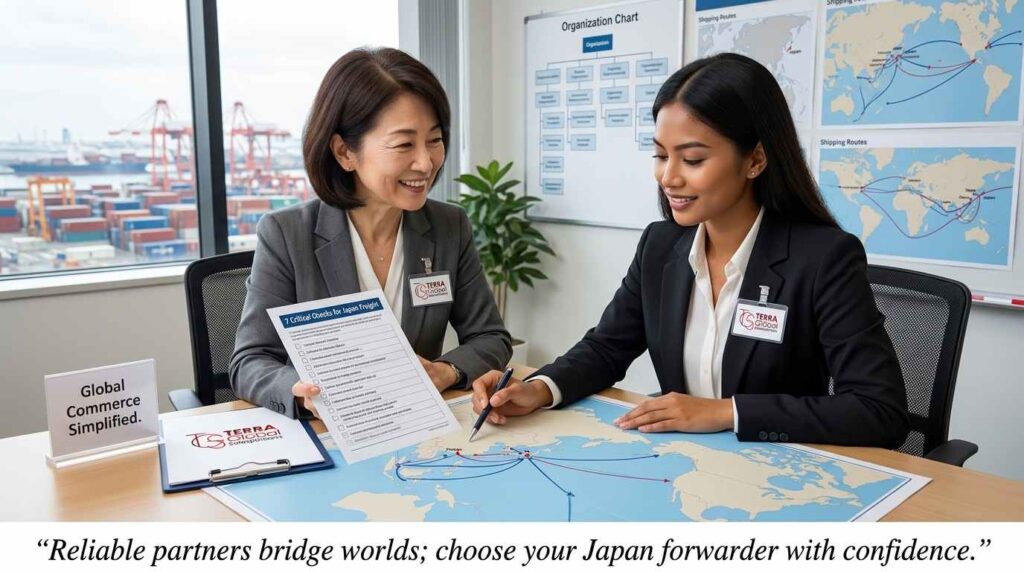
1. Are They Licensed and Compliant with Japanese Export Regulations?
This is your baseline. A legitimate Japan freight forwarder must hold the appropriate registrations under Japan’s Customs Business Law and comply with the Foreign Exchange and Foreign Trade Act (FEFTA).
Ask every potential forwarding agent for:
- Their Japanese Customs Broker license number
- Their registration under Japan’s Ministry of Land, Infrastructure, Transport and Tourism (MLIT)
- Proof of liability insurance (do not skip this, freight forwarder insurance matters enormously when goods are damaged in transit)
What to watch out for: Some small operators act as middlemen without holding direct licenses. They subcontract everything. If something goes wrong, accountability disappears fast.
Terra Global SalesPartners operates with full compliance documentation and transparent accountability at every stage. No hidden layers.
2. Do They Understand Japanese Business Culture?
This one surprises new importers. Japanese business culture is fundamentally different from Western or even other Asian business norms. Japanese suppliers value:
- Long-term relationships over transactional speed
- Formal communication and clear documentation
- Precision, even minor errors in product specs or shipping documents are taken seriously
A freight forwarding company that does not understand these norms will damage your supplier relationships without realizing it. Rushed emails, vague purchase orders, and skipped confirmation steps are red flags to Japanese manufacturers.
If you want to understand this dynamic more deeply, our blog on Japanese business culture: what international buyers must know gives a thorough breakdown.
Terra Global SalesPartners has been operating within the Japanese B2B ecosystem for years. We communicate in Japanese, understand the formality expected, and act as your cultural bridge, not just a cargo forwarder.
3. What Shipping Modes Do They Offer, and Which Is Right for You?
Not all shipments are the same. A good international freight forwarder should give you genuine guidance on:
| Shipping Mode | Best For | Typical Transit Time | Cost Level |
| Air Freight | Urgent, high-value, lightweight goods | 2–5 days | High |
| Sea Freight (FCL) | Large volume, full container loads | 15–35 days | Low per unit |
| Sea Freight (LCL) | Small to medium volume | 20–40 days | Medium |
| Express Courier | Samples, small test orders | 3–7 days | Very High |
What is LCL? LCL stands for Less than Container Load, you share container space with other shippers. It is ideal for businesses that are not yet moving full container loads (FCL).
What is FCL? FCL means you book the entire container. Better rates per unit at scale, and lower contamination/damage risk.
A trustworthy Japan cargo shipping partner will help you choose the right mode based on your actual volume, product type, and urgency, not just push you toward the most expensive option.
For a deeper comparison, read our guide on global shipping from Japan: air freight vs sea freight.
4. Can They Handle Customs Clearance, Both In Japan and at Destination?
Customs clearance in Japan is a multi-step process. On the export side, your forwarder needs to:
- Prepare and file the Export Declaration (ED) with Japan Customs
- Ensure all commercial invoices, packing lists, and certificates of origin are accurate
- Manage any export licensing requirements for specific goods
On the import side (in your country), they need to understand:
- Your destination country’s HS codes and import duties
- What incoterms apply (EXW, FOB, CIF, DDP, etc.)
- Whether your goods need any special certificates (food safety, phytosanitary, organic)
What are incoterms? They are standardized international trade terms that define who is responsible for freight costs, insurance, and risk at each stage of shipment. Choosing the wrong incoterm can expose you to massive unexpected costs.
What does a customs broker do? A customs broker handles the paperwork and regulatory compliance to get your goods through customs legally and on time. Some freight forwarders offer in-house customs brokerage, this is a major advantage. It means one point of contact, fewer hand-off errors, and faster clearance.
Terra Global SalesPartners provides end-to-end support including custom brokerage services, so you are never left chasing separate vendors to piece together your shipment.
5. Do They Have Experience With Your Specific Product Category?
A freight forwarder that handles industrial machinery well may have zero experience with Japanese FMCG products, food, beverages, dairy, seasonings, and snacks that require careful handling, correct temperature conditions, and food import documentation.
This matters enormously. Consider some of the products Terra Global SalesPartners regularly ships for global clients:
- Refrigerated items like Meiji Hokkaido Butter 200g, QBB Premium Baby Cheese, and Snow Brand Hokkaido Butter
- Alcohol and mirin such as Takara Hon Mirin 1L PET, Mizkan Cooking Sake 400ml, and Kikkoman Manjo Rich Aged Mirin 300ml
- Pantry staples including Ajinomoto Hondashi Japanese Dashi Stock 1kg, Daisho Teriyaki Sauce 1.25kg, and Daisho Sukiyaki Sauce 600g
- Instant noodles like Acecook Super Cup 1.5x Tonkotsu Ramen, Acecook Super Cup Miso Ramen
- Spreads and jams like Aohata Spoon Free Jam Strawberry and Aohata Verde Garlic Toast Spread
- Protein bars such as Asahi Ippon Manzoku Bar Protein Chocolate and Asahi Giga Protein Bar 65g
Shipping refrigerated dairy is not the same as shipping dried noodles. Ask your potential freight transport company directly: “Have you shipped this product category before? What certifications are required for my destination market?”
If they hesitate or give a vague answer, that is your sign to keep looking.
6. Are They Transparent About Costs, Including Hidden Fees?
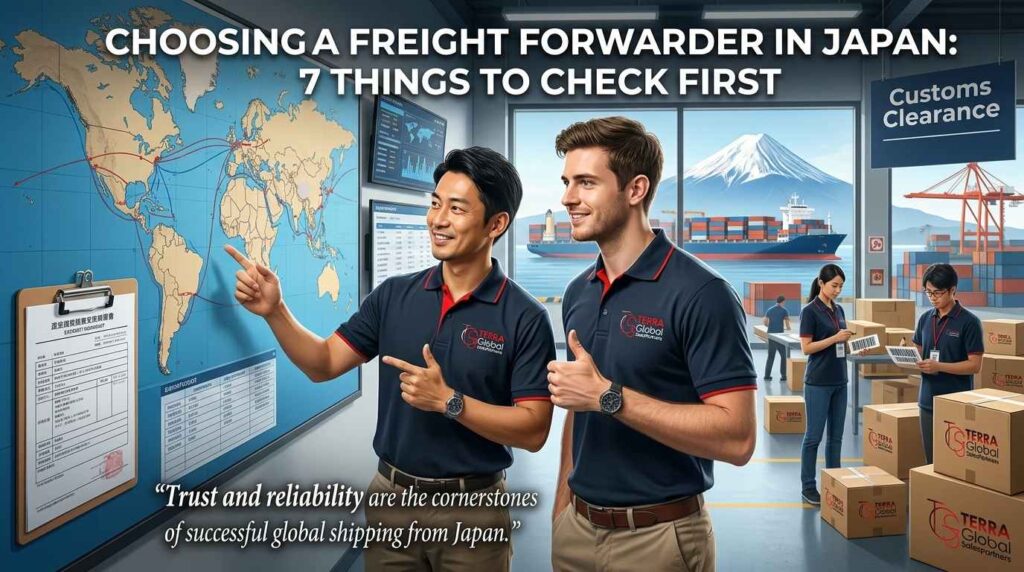
How much does freight shipping cost? It depends on many variables: weight, volume, distance, mode, fuel surcharges, port fees, and destination customs duties. But what matters just as much as the base rate is what they are not telling you.
Common hidden charges in international freight shipping:
- BAF (Bunker Adjustment Factor), fuel surcharge that fluctuates monthly
- THC (Terminal Handling Charges), port handling fees at origin and destination
- Documentation fees, sometimes listed separately after the quote
- Customs examination fees, if your shipment is selected for physical inspection
- Detention and demurrage, charges if containers are not returned on time
A trustworthy freight shipping company will provide a fully itemized quote upfront. Not a “starting from” price. A real, complete cost breakdown.
Pros and Cons: Working with a Transparent Forwarder vs. a Low-Quote Forwarder
| Transparent Forwarder | Low-Quote Forwarder | |
| Initial Quote | Higher (all-in) | Low (baited) |
| Hidden Fees | None | Common |
| Budget Accuracy | High | Low |
| Dispute Risk | Low | High |
| Long-term Trust | Builds over time | Erodes quickly |
| Supplier Relationship Impact | Positive | Often negative |
Terra Global SalesPartners provides clear, detailed cost breakdowns with every quote. No surprises at the end of the shipment.
Our blog on how to reduce import costs when buying from Japan outlines how smart buyers control freight spend without sacrificing quality or reliability.
7. Do They Offer End-to-End Support, Including an Importer of Record (IOR) Service?
This is the question most buyers forget to ask, until it is too late.
What is an Importer of Record? The Importer of Record (IOR) is the legal entity responsible for ensuring imported goods comply with all laws and regulations in the destination country. They are officially listed on customs documentation. If you do not have a legal entity in your destination country, you need an IOR service.
Without an IOR, your goods can be stuck at customs, sometimes for weeks. You may also face penalties if the documentation is wrong.
A full-service Japan freight broker or Japan logistics company will either:
- Act as your IOR directly
- Connect you with a trusted IOR partner in your destination market
Beyond IOR, look for forwarders that also support:
- Amazon FBA freight forwarding, if you are selling on Amazon, your forwarder must understand FBA prep requirements, label compliance, and delivery windows
- Warehousing and consolidation, especially useful if you are ordering from multiple Japanese suppliers
- Track and trace, real-time shipment visibility, not just “we’ll call you when it arrives”
- Returns management, rare but important for e-commerce businesses
Terra Global SalesPartners offers full end-to-end support from initial sourcing through delivery confirmation. For Amazon sellers in particular, our guide on Amazon FBA with Japanese products is essential reading before you place your first order.
Common Mistakes Buyers Make When Choosing a Freight Forwarder in Japan
Even experienced importers make avoidable errors. Here are the most costly ones we have seen:
❌ Choosing Based on Price Alone
The cheapest quote almost never reflects the true cost. Low-quote forwarders routinely add fees after the fact, and when goods are delayed or damaged, they often lack the insurance coverage or accountability to make it right.
❌ Ignoring the Forwarder’s Product Experience
What does a freight forwarder do when your refrigerated goods arrive warm because the cold chain documentation was filed incorrectly? A general forwarder with no food-industry experience may not even know what went wrong.
❌ Not Clarifying Who the Importer of Record Is
This is one of the most common import-export mistakes when sourcing from Japan. If this is not settled before shipment, your goods can be seized at the border.
❌ Skipping the Insurance Conversation
Freight forwarder insurance is not optional for high-value or fragile shipments. Ask specifically: “What cargo insurance do you carry, and what is the claims process?” If they cannot answer clearly, move on.
❌ Assuming One Forwarder Fits All Routes
A strong Japan ocean freight specialist may not be the right choice for urgent Japan air freight shipments. Ask about their specific carrier relationships and track record on the exact routes you need.
How Terra Global SalesPartners Compares
We are not just a freight forwarding company. We are a full-spectrum Japan sourcing and trading partner that connects global buyers with Japanese manufacturers, handles logistics, and supports every step of the import process.
Here is how we stack up against a generic freight forwarder:
| Service Area | Generic Freight Forwarder | Terra Global SalesPartners |
| Product Sourcing | ❌ Not offered | ✅ Full sourcing support |
| Japanese Language Support | ❌ Often limited | ✅ Native-level communication |
| FMCG / Food Category Expertise | ❌ Rare | ✅ Deep product knowledge |
| Amazon FBA Preparation | ❌ Extra cost or unavailable | ✅ Built into service |
| Customs Brokerage | ❌ Subcontracted | ✅ In-house capability |
| Importer of Record Support | ❌ Often unavailable | ✅ Available on request |
| Transparent Pricing | ⚠️ Varies | ✅ Itemized quotes |
| Product Catalogue Access | ❌ Not offered | ✅ Hundreds of Japanese brands |
Whether you are importing Ariake Gourmet Royal Beef Curry for a specialty grocer, Anber Tonkotsu Ramen Soup Base for a restaurant chain, or Ajinomoto Pure Select Mayonnaise for an e-commerce store, we know the product, the paperwork, and the process.
Key Statistics, Why Japan Freight Logistics Knowledge Matters?
| Data Point | Source / Context |
| Japan is the world’s 4th largest exporter by value | WTO Trade Statistics, 2024 |
| 68% of Japanese food exports require food safety certificates at destination | Japan External Trade Organization (JETRO), 2024 |
| Customs compliance errors cause 15%+ of shipment delays from Japan | Japan Customs and Tariff Bureau, 2024 |
| FBA non-compliance rejections cost Amazon sellers an avg. of $800–$2,200 per incident | Jungle Scout Seller Report, 2025 |
| Businesses using integrated sourcing + forwarding freight services reduce per-unit costs by 12–18% vs. using separate vendors | Industry estimate, 2025 |
These numbers tell a clear story: knowledge gaps in Japanese logistics are expensive. Partnering with a team that combines product expertise with freight logistics competence is not a luxury, it is a cost-saving decision.
What to Ask a Japan Freight Forwarder Before You Commit?
Use this as your checklist before signing any agreement:
Documentation & Licensing
- Are you a licensed customs broker in Japan?
- Do you have cargo liability insurance, and what does it cover?
- Can you provide references from clients who import similar products?
Shipping & Operations
- Which ocean freight carriers and air freight carriers do you work with?
- Do you offer both LCL and FCL options?
- Can you handle Amazon FBA freight including label compliance?
- What is your average transit time on my target route?
Customs & Compliance
- Do you provide in-house custom brokerage services?
- Can you act as or arrange an Importer of Record (IOR)?
- How do you handle customs examination delays?
Transparency & Communication
- Will I receive a fully itemized quote before committing?
- What is your escalation process if something goes wrong?
- Do you have Japanese-language communication capability?
Why Japanese Products Are Worth the Logistics Investment?
Let us not lose sight of the bigger picture. Japanese products carry a quality premium that translates directly to e-commerce profit margins. Whether you are selling on Amazon, Shopify, or into retail:
- Japanese FMCG brands like Ajinomoto, Meiji, Kikkoman, and Acecook carry instant consumer recognition
- Japanese food products tend to have strong repeat purchase rates, quality drives loyalty
- Niche and premium Japanese items (specialty sauces, artisan cheeses, health-focused snacks) command higher prices in Western and Southeast Asian markets
Our blog on why Japanese FMCG products lead in global markets goes deep on exactly why sourcing Japanese goods for resale is one of the smartest moves a global importer can make right now.
Products like Daisho BBQ Sauce Yuzu Flavour, Aohata Spoon Free Jam Tropical, Fanta Melon Soda, and Ariake Nagasaki White Broth 1.8L are all actively imported and resold by global buyers who understand the margin opportunity.
The right Japan freight forwarder makes this possible at scale.
Choosing Between a Freight Forwarder and a Trading Company, Which Do You Need?
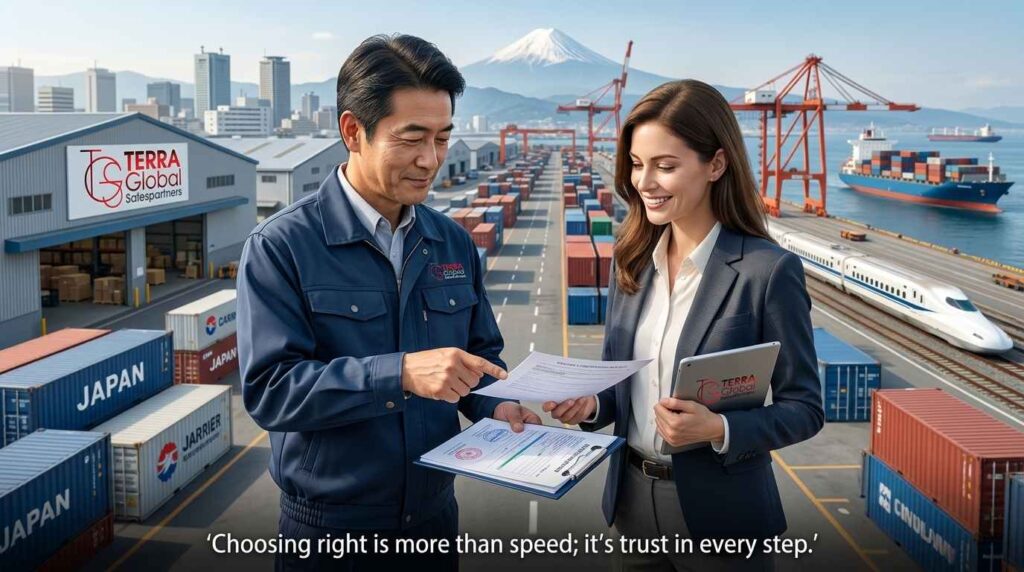
This question comes up often. Here is the short answer:
- A freight forwarder moves goods. They are logistics specialists.
- A trading company or sourcing company sources goods, negotiates with suppliers, and manages the commercial relationship.
- The best outcome for most global buyers is a partner that does both.
Our detailed breakdown in sourcing company vs. trading company in Japan explains exactly how to think about this decision based on your stage of growth and import volume.
Terra Global SalesPartners operates as a Japan trading partner that integrates sourcing, supplier management, and freight forwarding services into one relationship. This is the model that eliminates the most risk for global buyers.
Conclusion
Choosing a freight forwarder in Japan is one of the highest-leverage decisions you make as an importer. Get it right, and you have a reliable pipeline of quality Japanese goods moving to your market on time, on budget, and fully compliant. Get it wrong, and you face delays, hidden costs, damaged goods, and broken supplier relationships.
The seven things to check, licensing, cultural knowledge, shipping mode expertise, customs capabilities, product category experience, pricing transparency, and end-to-end support, are not boxes to tick quickly. They are the foundation of a durable import operation.
Terra Global SalesPartners exists to make every one of those boxes easy to check. We bring the sourcing knowledge, the logistics expertise, the cultural fluency, and the product catalogue to serve global buyers who want the best of what Japan has to offer.
Ready to start? Explore our full product range and get in touch with our team today.
Frequently Asked Questions
Q1: What is a freight forwarder in Japan, and what do they do?
A freight forwarder in Japan arranges international shipments by coordinating carriers, customs paperwork, and documentation on behalf of importers and exporters.
Q2: How much does it cost to use a Japan freight forwarding service?
Costs vary by shipment size, mode (air freight vs. ocean freight), route, and services required. Always request a fully itemized quote before committing.
Q3: Do I need a customs broker separate from my freight forwarder?
Not always. Many full-service Japanese logistics companies like Terra Global SalesPartners offer integrated custom brokerage services, eliminating the need for a separate vendor.
Q4: What is an Importer of Record, and do I need one?
The Importer of Record (IOR) is the legal entity responsible for imported goods in the destination country. If you lack a local legal entity, you need an IOR, ask your forwarder about this upfront.
Q5: Can a freight forwarder in Japan help with Amazon FBA shipments?
Yes, but not all of them. Choose a Japan freight broker with verified Amazon FBA experience, including label compliance, delivery window management, and FBA prep services.